
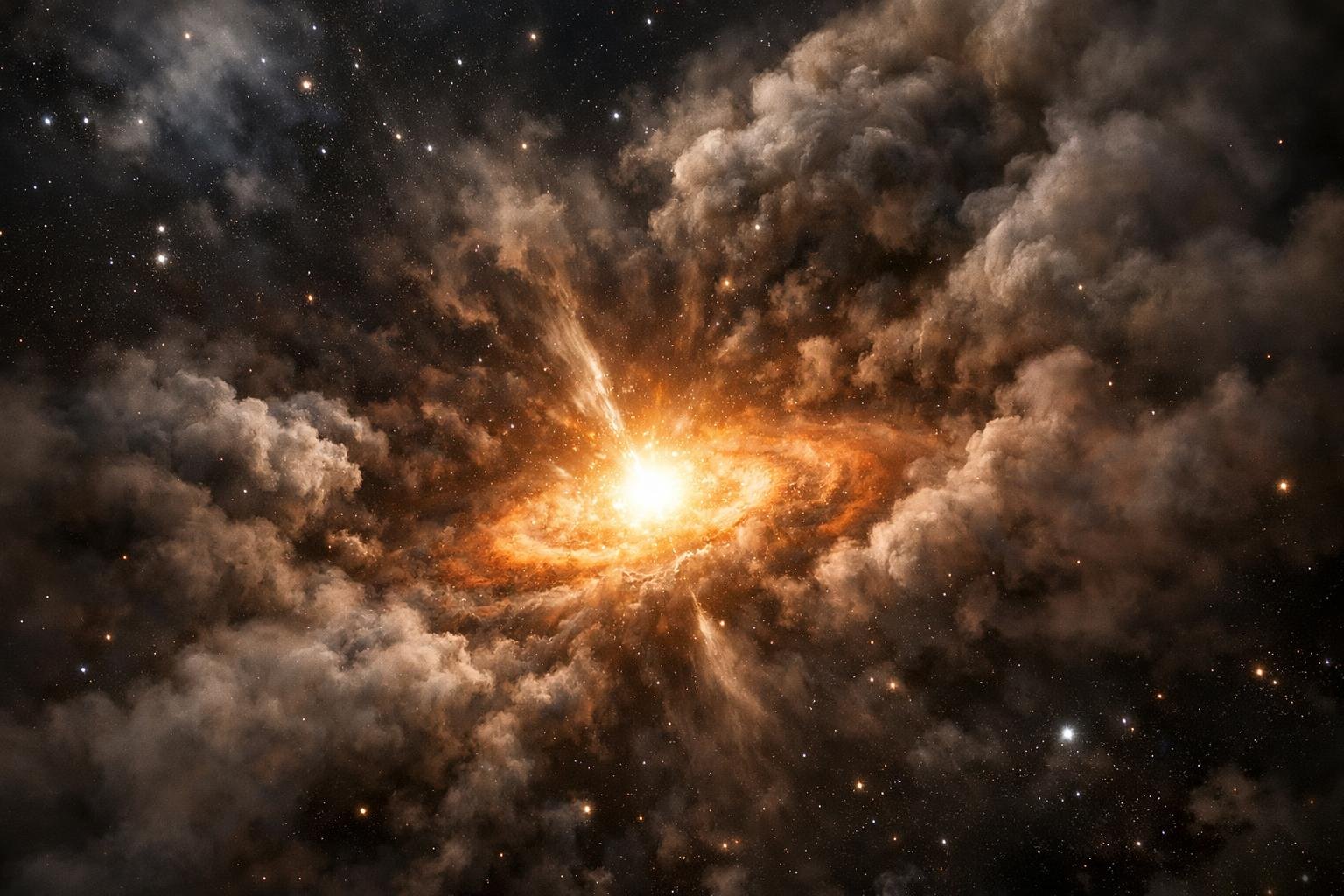
For a brief and breathtaking instant, the universe offered a window into its most private work. Astronomers have seen the exact spark when a cold cloud of gas and dust began to yield to gravity. The moment is both exquisitely quiet and cosmically loud, rewriting how we witness the earliest heartbeat of a star.
The team watched turbulence taper, temperatures dip, and a fragile knot of material quiver toward imbalance. In that imbalance, gravity won, and the cloud’s center began to sink under its own weight. “It’s like catching lightning in a bottle,” one astronomer said, “only the bottle is a light‑year wide.”
A shutter click in cosmic time
Seeing the start of collapse is notoriously hard, because gas clouds look deceptively still on human timescales. Most observations show either fully quiescent clouds, or newborn protostars already blazing in infrared. This time, the data captured the pivot, the instant a diffuse veil turned into a falling core.
Scientists traced subtle motions inside the cloud, using spectral line profiles that betray infall. The light from certain molecules became skewed, a telltale sign that material is streaming inward. A razor‑thin temperature drop and a rise in density sealed the case.
What a collapsing cloud actually looks like
Through radio and infrared eyes, the region appeared darker at its heart and glossier at its fringe. Dust grains aligned with magnetic fields produced polarized glow, sketching invisible rails guiding the material inward. The map looked like a funnel, wide at the outskirts and knife‑narrow near the seed of the star.
Chemistry played a quiet role, with CO lines dimming as molecules froze to dust at low temperatures. That freeze‑out is a signature of a core crossing the threshold into runaway collapse.
The tools that made the glimpse possible
The achievement came from a synergy of instruments, timing, and analytic craft. No single telescope could watch such faint physics unfold without clever coordination.
- A network of radio arrays offered sharp resolution and exquisitely sensitive spectra that reveal inward motion.
- An infrared space observatory traced warm dust and the first wisps of shock heating near the forming core.
- Magnetic mapping through polarized light showed how fields threaded the cloud and shaped the flow.
- Time‑domain scheduling caught the target during a predicted window of instability.
“We knew we would get only a sliver of time,” a team member noted, “so the plan had to be surgical.”
Physics written in dust and light
In the data, gravity played its ancient tune against thermal pressure and magnetic tension. When cooling outpaced support, the core mass crossed the Jeans threshold, where collapse becomes inevitable. The balance tipped from static puff to accelerating plunge, a change small in numbers yet huge in destiny.
The infall rate looked initially modest, then rose in a crescendo as the center compacted. That shift matched models, but the early timing came sooner than many had expected.
Rethinking the timeline of stellar birth
For decades, star‑formation textbooks drew neat phases divided by tidy boundaries. These observations blur those lines, revealing overlap between pre‑stellar and protostellar stages. The cloud did not wait for perfect symmetry or textbook quiet before it fell.
Magnetic fields seemed more pliable than some theories assumed, bending but not fully braking the collapse. Turbulence, once cast as a noisy villain, here acted as a subtle gate, delaying but not denying gravity.
The human side of a stellar birth
“It felt like watching a door open that’s been closed for a billion years,” one observer admitted. Another called it “a photograph of a verb,” because collapse is action more than object. The team spoke of awe, but also of meticulous doubt, testing each signature against mundane alternatives.
They rechecked calibration files, reran radiative transfer codes, and stress‑tested every assumption. Only when independent methods converged did they allow the word collapse to stand.
What this means for planets and disks
Catching the first lurch toward a star also clarifies how planet‑forming disks get their start. Angular momentum, the universe’s quiet accountant, must be managed from the first moments. The data show nascent rotation braided with magnetic braking, laying tracks for future orbits.
Dust grains already seem to clump, hinting at early pathways toward pebbles and, eventually, worlds. The seeds of tomorrow’s planets may be sown while the star is only beginning to breathe.
What comes next
The team plans rapid‑cadence follow‑ups to watch the core’s brightening over months and years. If the infall continues, a protostellar ember should flicker in infrared, then flare as accretion surges. With each new snapshot, models will be pruned, tuned, and tested against reality.
“Stars are our most familiar strangers,” one scientist remarked. Today, they feel a little less distant, because we have finally seen the moment they start to become.
