
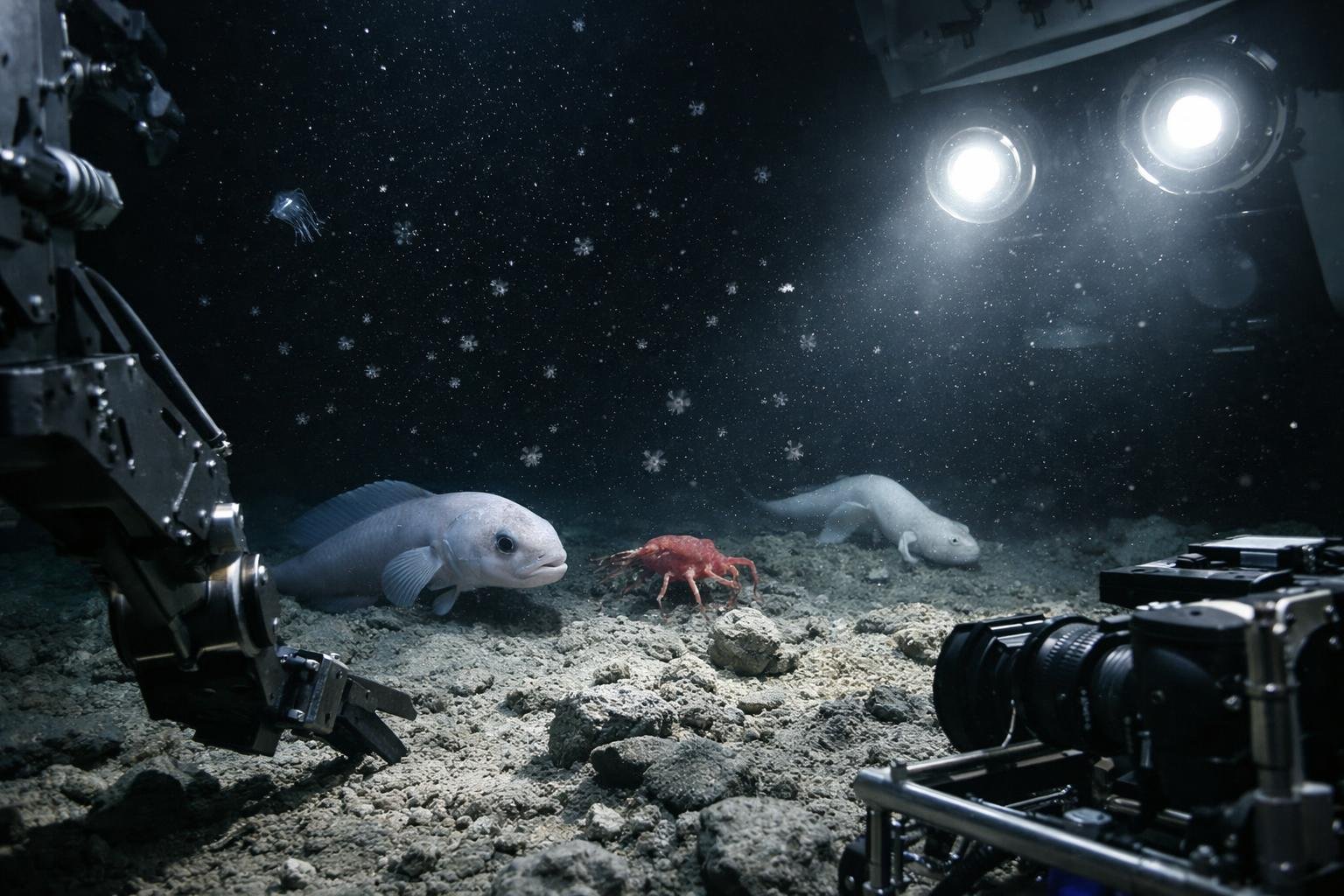
The ocean’s deepest rooms are not silent; they whisper in slow, pressurized syllables. What a small team glimpsed far below the last reach of sunlight felt like a new alphabet of life. Cameras tucked into the belly of a Japanese submersible watched the dark unfurl, and then the dark looked back.
Down where the clock of the sea ticks once an hour, the glow of the vehicle’s careful lamps brushed silhouettes that didn’t fit any familiar drawer. Shapes hovered, flexed, and vanished, as if the water itself were practicing thought.
Otherworld on a Blue Planet
At nearly 9.7 kilometers beneath the surface, the world becomes a cathedral of pressure. Each square inch bears a mountain’s worth of weight, and yet something delicate still finds a way. The sub’s cameras rolled in slow, patient frames, tuned to sip light without chasing it away.
“Down here, the sea is not empty,” one team member murmured. “It’s just tremendously careful about being seen.” Their words hung like a low bell, swallowed by corridors of water older than any map.
Creatures That Refused Our Names
What appeared were bodies sketched in living geometry. A ribbon with a glassy spine folded itself into a Mobius secret, then slipped through a curtain of sinking snow. A kite-shaped organism with transparent wings held position against a current no instrument could feel, as if tethered to an invisible nail.
There was a lattice of articulated filaments, each node pulsing a dim, synchronized glow, like a thought passing down a long neuron. A bell of tissue, thin as breath, beat once, paused for an eternity, and beat again. Bioluminescent freckles winked in quiet chords, not strobe but script.
“Every movement was economic,” another observer said. “Not a flinch wasted, not a gram of calcium where a whisper of gel would do.” The footage felt less like a safari and more like eavesdropping on a physics lesson that had evolved into a hymn.
How to Be Alive Where Almost Nothing Is
To persist at such depth, living systems must make uneasy bargains. Bones thin to membranes, and proteins tune their shapes with pressure-loving molecules that keep them from locking into fatal knots. Cell membranes grow supple, more silk than shield, flexing with the crush instead of bracing against it.
Food arrives like weather—a slow drift of marine snow, interrupted by rare falls of sunlit fortune. Metabolism becomes a whisper, not a shout. Some microbes tease energy from chemistry alone, turning rocks and fluids into quiet calories, and that chemistry threads outward into fragile, austere webs.
Light is both weapon and language. Sparks advertise, lure, or lie, coding survival in dots and dashes that fade before they can draw attention. In the footage, flashes never erupted; they breathed, as if respecting a rule older than the trench itself.
Cameras That Learn to Listen
This wasn’t just luck; it was design. The vehicle’s imaging suite stayed dim, and motors hummed at frequencies less likely to scatter the neighborhood into a frantic absence. The team treated visibility as a privilege, not a right, preferring half a scene to a frightened, empty frame.
Moments that might have vanished under brighter floods remained intact—undramatic, factual, and therefore astonishing. When the sub rose, it carried not trophies but time, hours of motion that can be replayed into insight.
Why It Matters Now
In those few hours, the dark produced an argument for patience and for restraint. The hadal world, long treated as empty margin, is a library that happens to be written under a crushing roof. Opening it has consequences that reach back to our own coastlines.
- New behaviors suggest adaptations no lab can yet mimic, teaching chemistry, materials, and robotics.
- Habitat clues may refine how we model carbon sinks and deep-sea currents that govern climate memory.
- Before industry touches abyssal minerals, we need baselines of living complexity that could be erased silently.
What We Didn’t Expect to Feel
The surprise wasn’t only what the cameras saw, but how the images made time feel slow. There is a dignity in a creature that spends an hour deciding to move, a serenity in a web that absorbs disaster by being mostly space. Watching, you begin to realize the surface is the noisy part, not the rule but the exception.
In the review room, someone finally laughed, the breathy kind you hear at a planetarium’s first reveal. “It’s like meeting neighbors you’ve always had,” they said, “and noticing you’ve never once said hello.”
What comes next is more listening. More machines that whisper, more voyages intent on leaving everything where it was, except our assumptions. The abyss doesn’t need our rescue; it asks only that we witness without presuming to own.
Somewhere below, a transparent wing holds its station against a pressure we can scarcely name, a patient diagram of how life stays possible when the world says it shouldn’t. If that isn’t news, it’s at least a new grammar—a way for the planet to tell us what it has always known.
