
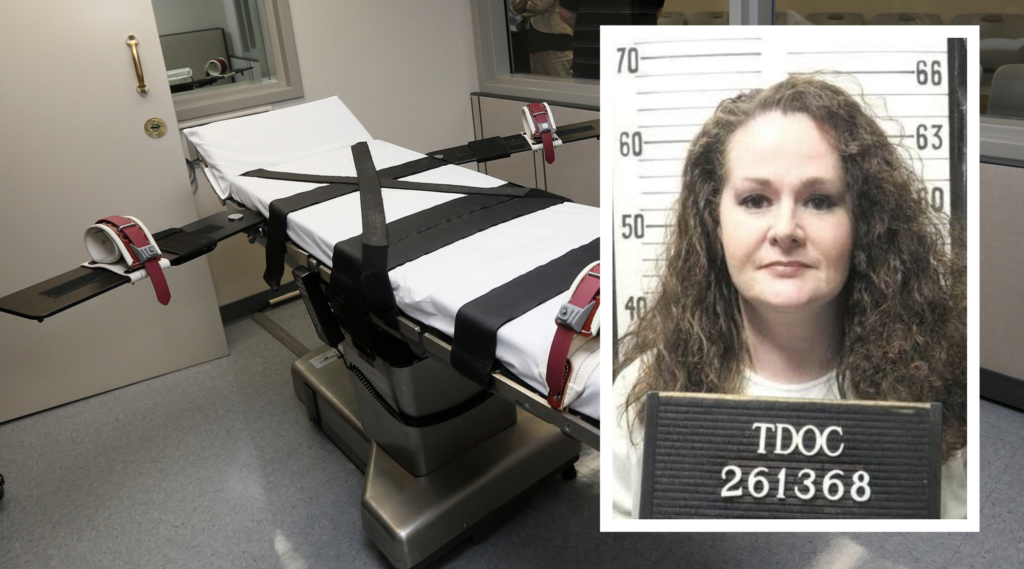
Although she has awakened and can communicate, Christa Pike remains in the hospital after September 30, when she was set to become the first woman to be executed under a death sentence in the state of Tennessee in 200 years. This was already news that drew national attention, just as when she was convicted following the murder of Colleen Slemmer, 19, in 1995.
The day she was scheduled for execution, in the midst of the process that would end Pike’s life and finally close the circle of justice around Slemmer’s death. The inmate survived the attempted execution by lethal injection, triggering a wave of events that followed. Still, her medical and legal future remains highly uncertain.
Pike is receiving vital medical attention after having been administered two doses of pentobarbital, apparently lethal, they said.
“She is receiving treatment for the severe effects of the pentobarbital administered during the attempted execution, including significant injuries to both arms,” said her lawyers, Stephen Ferrell and Luke Ihnen, in a statement.
Pike’s legal team filed an emergency motion asking a Nashville court to order the Tennessee Department of Corrections to “protect and preserve all evidence related to the state’s failed attempt to execute her on Wednesday night.”
They have also requested an expedited hearing to address the motion. The state Department of Corrections declined to comment on the ongoing litigation.
In the face of criticism and renewed controversy over the death penalty, Governor Bill Lee announced that a third party would conduct an “exhaustive and thorough” review of Pike’s case.
“The governor has rightly called for an investigation. We need to know what happened,” said the office of Tennessee Attorney General Jonathan Skrmetti.
Regarding the family of the woman murdered by Pike who were present at the time of the failed execution, not much has been said, only that they are shattered and exhausted by this catastrophic outcome, said Robert Bracewell, executive director of the Justice Coalition.
Bracewell, who has helped Slemmer’s parents navigate the process, noted that the family is angry with the State for not offering assistance or providing clear information about what will come next.
As a consequence of this failure. The governor also suspended the execution of Gary Sutton, a death-row inmate, which was scheduled for December.
Returning to Pike’s case, her execution was scheduled for the morning of September 30, but late-stage legal motions delayed it until later that same day.
The execution protocol began in the late afternoon and she spoke her last words at 7:26 p.m., according to reporters present. However, after receiving two doses of the drug cocktail, she snored and seemed to be alive, witnesses said.
“None of that was normal. I covered all the executions from last year and most of this year. We hadn’t seen anything like it. It all went very wrong,” commented Catherine Sweeney, a reporter for WPLN.