
Somalia has barely managed to emerge from one crisis before finding itself engulfed in another, often more complicated than the last, raising fears that the country could slide back into the prolonged years of conflict and destruction that have marked its turbulent history.
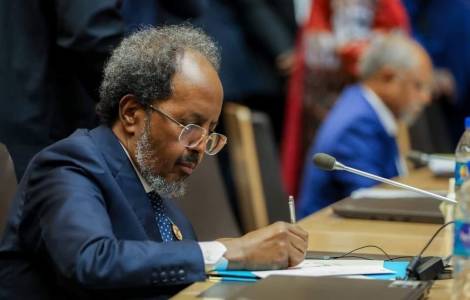
President Hassan Sheikh Mohamud now finds himself at the center of the country’s latest political turmoil, facing accusations of seeking to prolong his grip on power and violating the constitution.
The controversy intensified following constitutional amendments that extended the presidential term from four to five years, effectively allowing Mohamud to remain in office until 2027, despite his original term being scheduled to expire in May 2026.
Beyond extending his tenure, the amendments introduced sweeping changes to Somalia’s political system, including a transition from a parliamentary to a presidential system, the abolition of the prime minister’s position, and the introduction of a vice president elected alongside the president.
The changes also sought to dismantle Somalia’s long-standing clan-based power-sharing arrangement, commonly known as the 4.5 formula, while replacing the indirect electoral system with a new voting framework. These measures have sparked fierce opposition across the country’s political landscape.
Among the most prominent opponents is the Somali opposition alliance, which includes influential political figures and leaders from Puntland in the north and Jubaland in the south, as well as Abdiaziz Hassan Mohamed Laftagareen, the former president of South West State.
The opposition recently rejected a unilateral announcement by the electoral commission scheduling parliamentary and presidential elections for April and May 2027.
According to the Associated Press, the constitutional dispute has contributed to renewed armed confrontations, with violent clashes erupting in Mogadishu and Baidoa, the administrative center of South West State.
Other reports indicate that recent fighting near Baidoa, involving government forces and opposition-aligned fighters loyal to Laftagareen, has drawn thousands of combatants and involved the use of drones and fighter aircraft.
Constitutional Changes Ignite a New Power Struggle
On November 6, 2026, President Hassan Sheikh Mohamud reportedly suffered a significant legal setback after the Supreme Court ruled that his presidential mandate had expired in May 2026 and ordered elections to be held within 90 days.
The court reportedly determined that parliament’s decision to extend presidential and parliamentary terms from four to five years did not automatically grant current officeholders an additional year in power.
It maintained that their constitutional mandates had already expired.
The ruling also reportedly invalidated Mohamud’s decision to dismiss Supreme Court Chief Justice Bashe Yusuf Ahmed, adding another dimension to the escalating institutional confrontation.
Corruption and Nepotism Allegations Shadow Mohamud’s Presidency
The political crisis surrounding President Hassan Sheikh Mohamud is not the only controversy overshadowing his administration.
Since returning to office in 2022, his government has faced repeated allegations of corruption, abuse of authority, and the concentration of political and economic influence among individuals close to the presidency.
Somalia ranked 179th out of 180 countries in the 2024 Corruption Perceptions Index, scoring just 9 out of 100, while senior figures within the federal government have faced accusations of corruption.
In a recent report by the US Department of State, corruption was described as pervasive across Somalia’s government institutions.
In January 2026, Washington also suspended assistance to the Somali government following allegations that officials had demolished a World Food Programme warehouse and seized food aid.
Somali authorities rejected the allegations, maintaining that expansion work at the Port of Mogadishu had not affected humanitarian aid storage facilities.
In another controversy, Somalia’s second deputy prime minister, Jibril Abdirashid Haji, was reportedly stopped by Kenyan immigration officials at Nairobi airport in June 2026 amid allegations that his Kenyan passport had been fraudulently obtained.
The incident was highlighted in an African Arguments report, which also pointed to broader concerns about governance and institutional accountability in Somalia.
The publication further reported that President Mohamud acknowledged in 2022 that a biometric attendance system had recorded the presence of only 1,500 employees out of more than 5,000 registered government workers.
In November 2025, Somali Guardian reported another scandal involving the suspension of several officials at Somalia’s presidential palace.
The officials reportedly faced accusations of including unauthorized individuals in official delegations traveling abroad.
Meanwhile, Mohamud has faced additional allegations of nepotism and favoritism, with critics accusing him of appointing family members and relatives by marriage to influential government, institutional, and financial positions.
Among the appointments cited by critics was that of his son-in-law, Adam Roble, as director-general of the Development and Reconstruction Bank in March 2024.
Other family members and relatives have also reportedly held security and administrative positions, prompting critics to raise concerns about conflicts of interest and the concentration of influence within a narrow circle surrounding the presidency.
Saudi Arabia’s Growing Influence Raises Questions
As political and institutional crises continue to engulf his administration, President Hassan Sheikh Mohamud has maintained close relations with Saudi Arabia, which has expanded its economic and defense cooperation with Somalia.
The military dimension of this partnership, however, has attracted growing scrutiny and controversy.
Saudi Arabia has previously faced allegations of overseeing the training of more than 5,000 Somali fighters in the Guri’el area of the Galgaduud region, allegedly using foreign military contractors recruited from Romania, Ukraine, South Africa, and Colombia.
According to military and media reports, the nine-month training program involves 5,107 Somali recruits, including approximately 2,000 from the country’s northeastern region.
The reports allege that Saudi Arabia directly financed the operation following a visit by a Saudi military delegation in late June 2026.
The controversy emerged against the backdrop of a joint military and defense cooperation agreement signed in Riyadh by the Somali and Saudi defense ministers.
Some opponents of the partnership have expressed concern that the training program could eventually facilitate the deployment or transfer of Somali fighters to other regional conflicts, including the war in neighboring Sudan.
Such suggestions remain allegations and have not been independently established.
Analysts note that relations between Saudi Arabia and Somalia have historically centered on religious and economic ties, with the kingdom serving as a major destination for Somali livestock exports.
However, they argue that the relationship has taken on a more strategic dimension as Riyadh seeks to expand its influence in the Red Sea region.
Critics contend that Saudi Arabia’s growing support for Mohamud has coincided with mounting allegations of corruption and attempts to consolidate political power within Somalia.
Creating an External Enemy: A Strategy to Divert Attention from Domestic Crises?
With Somalia grappling with a deepening constitutional dispute, widening divisions between federal member states and the central government, renewed fears of armed conflict in Mogadishu, persistent security threats from the militant group Al-Shabaab, and longstanding corruption allegations, President Hassan Sheikh Mohamud appears to have adopted a confrontational approach toward the United Arab Emirates.
Critics argue that the diplomatic escalation may serve as an attempt to redirect public attention away from Somalia’s internal political and institutional challenges.
Mohamud recently accused the UAE of interfering in Somalia’s domestic affairs, undermining the federal government, fueling internal divisions, and maintaining security relationships outside the framework of the country’s official state institutions.
The confrontation escalated when the Somali authorities gave the UAE ambassador in Mogadishu 72 hours to leave the country and recalled Somalia’s ambassador to Abu Dhabi for consultations.
The UAE, for its part, condemned what it described as the Somali government’s “unjustified hostile and escalatory approach,” expressing regret over attempts to draw Abu Dhabi into Somalia’s domestic political disputes.
In a statement, the UAE Ministry of Foreign Affairs said the Somali government’s “irresponsible” positions were damaging bilateral relations and undermining the foundations of cooperation between the two countries.
The ministry stressed that decisions affecting relations between sovereign states should be guided by shared interests rather than domestic political considerations and internal power struggles.
The UAE Foreign Ministry also noted that Abu Dhabi had already closed its embassy in Mogadishu and withdrawn its diplomatic personnel in January 2026.
According to the ministry, the decision followed what it characterized as hostile actions by the Somali government toward the Emirati diplomatic mission and the UAE’s policies, including decisions to terminate bilateral agreements between the two countries.
Against this backdrop, Somali writer Mohamed Osman argued in an article published by The Times of Israel that the escalation against the UAE appeared to be little more than an attempt to escape domestic political realities.
Osman questioned the effectiveness of efforts to portray an external power as the source of Somalia’s troubles.
He maintained that the forces paralyzing the Somali state are fundamentally domestic, rooted in institutional failures, power struggles among political elites, and unresolved federal arrangements that have continued to undermine the country’s stability.