
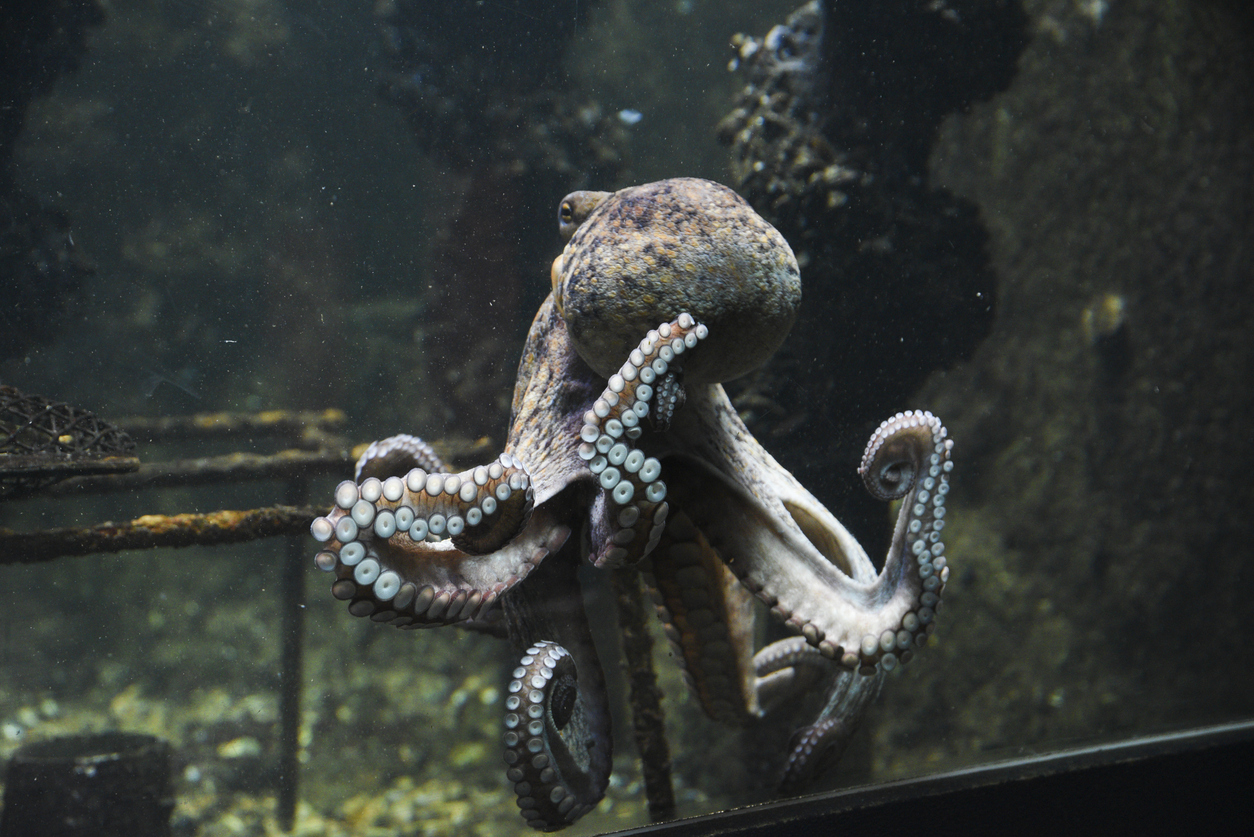
Before dawn in Napier, a celebrated octopus named Inky turned curiosity into freedom. What began as a routine night at a national aquarium became a tale of ingenuity and nerve. By sunrise, the tank’s most charismatic cephalopod had vanished, leaving a trail of telltale suction prints and a mystery washed in saltwater.
A midnight getaway
According to staff, the wily octopus exploited a small gap in his enclosure, then slithered across the damp floor with limber, purposeful grace. He found a drainage pipe about four meters away, a dark corridor that led straight to the Pacific. With only a hard beak to constrain him, Inky compressed his soft body and disappeared into the plumbing. Minutes later, his world reopened into open water, and the aquarium had a legend on its hands.
Brains in every arm
Octopuses are renowned for their intelligence, carrying a large central brain and millions of neurons distributed through their arms. Each limb can process information locally, making their problem-solving feel almost eerily independent. They deploy color-shifting chromatophores to vanish against rock, sand, or shadow with cinematic speed. Tool use, short- and long-term memory, and quick, flexible learning are all part of their cognitive arsenal.
- Masterful camouflage, powered by skin-deep chromatophores
- Remarkable dexterity, with sensitive, exploratory suckers
- Strong problem-solving, from jar-opening to latch manipulation
- Robust spatial memory and fast, experiential learning
- Persistent curiosity, the spark behind innovation and escape
How the escape worked
Engineers of soft matter, octopuses can thread through openings barely larger than their beak. Inky’s route likely involved a careful probe, a decisive squeeze, and a slick, determined crawl. The moist floor preserved a dotted trail of prints, as if the aquarium had been signed in living ink. What looks like magic is really exquisite anatomy, channeled by a restless, exploratory mind.
“An adult octopus can squeeze through an opening the size of its **beak**—the only truly rigid part of its **body**.”
Curiosity as a survival strategy
In the wild, curiosity is not a quirk; it is a strategy for finding food, avoiding predators, and mapping escape routes. A restless mind turns tidepools into classrooms, each crevice a lesson in risk and reward. Captivity, even in the best-managed facilities, can’t mute that persistent drive to explore. When an opportunity appears, a prepared animal will take it with silent, efficient grace.
Lessons for aquariums
Inky’s odyssey underscores a design truth: if there is a gap, an octopus will likely find it. Secure lids, fine-tuned filtration, and redundant barriers are necessary but not always sufficient. Enrichment—puzzles, varied textures, and changing layouts—can channel curiosity into healthy, stimulating tasks. Welfare is not just about safety; it is about challenge, agency, and choice.
Why we root for the escape artist
Part of Inky’s charm lies in the quiet daring of a creature that rewrote the blueprint of its world. We cheer because the story celebrates ingenuity, not defiance for its own sake. It reminds us that intelligence blooms in unexpected bodies, and that the line between captive and wild can sometimes fit inside a drain-sized circle.
From exhibit to ocean
By the time staff traced the wet trail, the Pacific had already welcomed its elusive traveler. Out beyond the pipes and pilings, a city of reefs, kelp, and shifting light reopened to a master of disguise and adaptation. As legends go, it is simple and clean: curiosity met opportunity, and the sea answered with freedom.
A final ripple
Inky’s escape is more than a delightful anecdote; it is a case study in animal minds. It nudges us to design with respect for elastic bodies and elastic intelligence alike. And it asks a question that lingers like a faint, briny signature on a polished floor: if a door can be imagined, who wouldn’t try to see what’s on the other side?