
A floodplain fill in Harris County tied to a TxDOT project in Huffman violated local rules and sparked neighborhood complaints.
Soil excavated from a Texas Department of Transportation road project ended up deposited within Cedar Bayou’s floodplain, in northeast Harris County. The case opened new criticisms of oversight of development in at-risk areas and the response of local authorities.
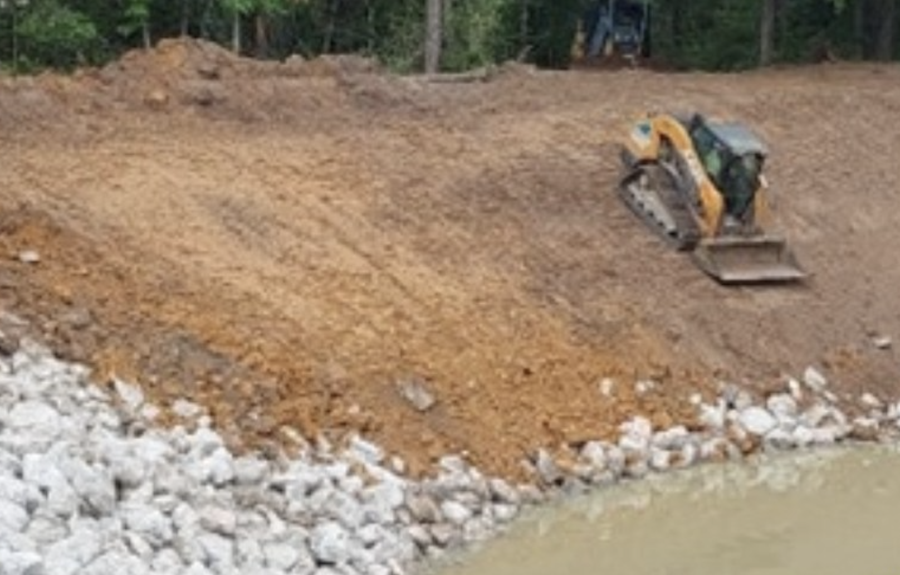
A floodplain fill in Harris County reignited concerns among residents of Huffman and Kingwood, after material excavated from a drainage project linked to the widening of FM 2100 was hauled to private property within Cedar Bayou’s floodplain. Harris County confirmed that the deposit violated local rules because it was performed without prior permission.
The case also left dissatisfaction among neighbors who consider the official response insufficient. Although the county issued a violation notice to the landowner and ordered the soil deposition to stop, the material remains on the property while a mitigation process proceeds.
From a road project to private land in Cedar Bayou
The soil came from a Texas Department of Transportation (TxDOT) project on FM 2100, where the road is being widened from two to four lanes between Grand Parkway and Huffman Cleveland Road. As part of that work, contractors excavated a large detention basin near Luce Bayou.
The problem arose when that soil was moved less than three miles south, to land on Huffman Eastgate Road. There it was dumped within Cedar Bayou’s floodplain, where any fill or change in elevation of the land requires first an assessment and then approval by the county.
The accumulation left a mound reaching halfway up nearby trees, just a few feet from a drainage canal. That condition placed the case under scrutiny because county rules prohibit adding unauthorized fill in floodplains. Those rules were updated in 2019 in response to problematic developments that occurred before Hurricane Harvey.
The Harris County floodplain fill had already been notified
The Harris County Engineer’s Office issued on January 22 a violation notice to the landowner, identified as Leopoldo Herrera. At that time, inspectors estimated that about 40,000 cubic yards of fill had been placed.
On a five-acre site, that volume could raise the entire property by about six inches. In a floodplain, that amounts to six inches of water displaced elsewhere, according to explanation cited by residents and observers.
Mike Etienne, head of planning and development services at the county engineer’s office, said that TxDOT also ordered its contractor to stop depositing soil on the property. However, area residents stated that trucks continued hauling material into mid-February.
Later, county officials met with Herrera and with a private engineer hired by him to discuss possible remedies. At that meeting, the county again ordered an immediate halt to any additional filling activity. Etienne said afterwards that the owner complied with that instruction.
The soil remains, and there is now a plan to redistribute it
Although no more external fill is allowed on the site, the deposited soil remains on the property. The case involves not only that material. Herrera was also cited for structural development without permit related to two metal buildings.
County officials issued a grading permit that allows leveling the mound of material and working on a mitigation of water storage within the property. According to Etienne, that permit is intended to allow the owner to “mitigate floodplain storage on the site.”
Joe Stewart, owner of the engineering firm assisting Herrera, said crews are working to smooth the mound and use the material to level the land in compliance with County rules. He added that the northeast corner of the property could be raised without affecting the floodplain and that swales are also planned to direct water flow.
Stewart argued that public attention could have been avoided with timelier filings and better documentation. In his view, what Herrera intends to do with the property is permitted, but it required permits and engineering evaluations from the start.
Neighbors question the county’s and TxDOT’s response
The Harris County floodplain fill case has stirred frustration among residents who feel the problem took too long to stop. Chris Summers, a Kingwood resident, said he was frustrated that weeks passed and that it had to be the neighbors who raised their voices before the trucks with dirt stopped arriving.
Summers said that in seeking answers he was shuffled from one office to another. At one point, both TxDOT and the county attorney’s office steered him in different directions, even suggesting that he file a police report about an issue that actually falls under civil jurisdiction and is overseen by the county.
Bob Rehak, a Kingwood resident and critic of floodplain management since Harvey, insisted that the problem is cumulative. He said that raising dirt at one spot ends up affecting another. He also compared floodplain protection rules to a speed limit that exists but is not enforced firmly.
That sense of insufficient oversight has become more visible since Harvey, when tens of thousands of homes flooded. Since then, residents in several areas have paid more attention to constructions, fills, and changes in land elevation within risk zones.
The county recognizes limits and calls for more citizen reports
Etienne said the county values public reports because they help detect possible violations, but also warned that identifying an issue does not mean it will be resolved immediately. He explained that Harris County does not have resources to monitor the entire area that size and that it partly depends on resident participation.
He also noted that finding the irregularity and issuing a violation is just the beginning. Fixing the problem can take months or even years, even when the owner cooperates with authorities. When he does not, the process can be even longer.
Meanwhile, TxDOT reported that the agreement to move the soil from the detention basin to the private land was made by a subcontractor in charge of hauling the material. The agency confirmed that that hauler has stopped bringing soil to the site. It also indicated that Webber, the contractor for the $53.2 million project, is reviewing three other sites to deposit material and verify that they are authorized.
Additionally, TxDOT spokesperson Bambi Hall said that there are now enhanced field inspections to monitor environmental compliance and coordinate more closely with Harris County during the construction of the detention basin.
The Harris County floodplain fill case remains open while the material stays on the property and mitigation measures are applied. For area residents, the bottom line remains the same: if there are rules to protect floodplains, they expect faster and stricter enforcement.