
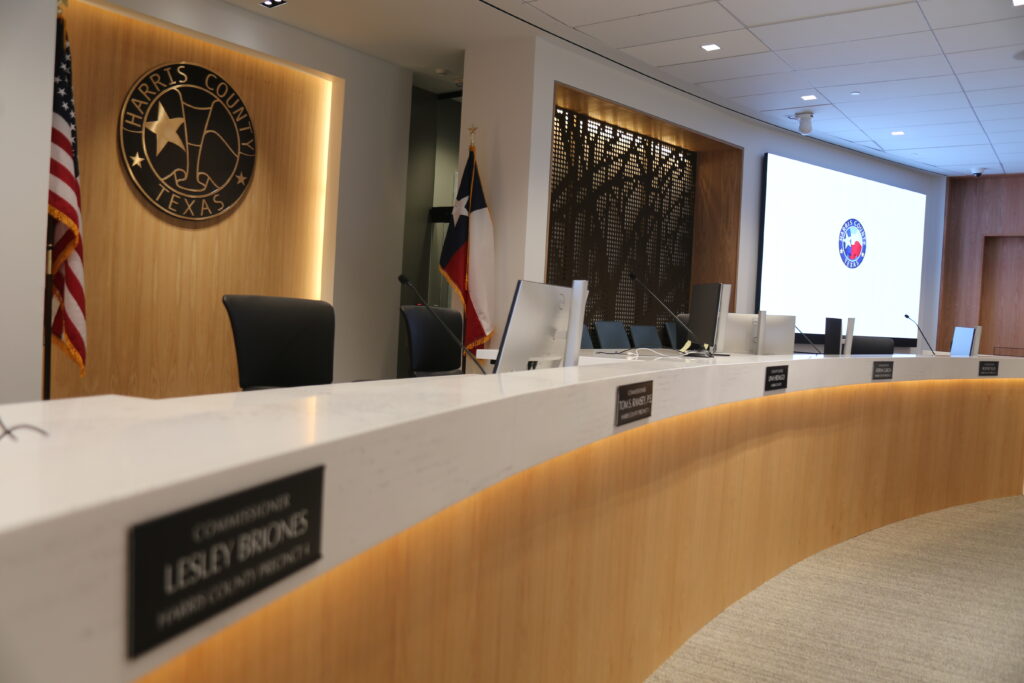
The Harris County Commissioners Court approved a new labor policy that will allow certain employees to seek representation from labor organizations to file complaints and advocate for wage and working condition improvements.
The Harris County labor policy marks a major shift in the relationship between the local government and its workforce. On Thursday, the Commissioners Court approved the measure in a 3-1 vote, with Commissioner Tom Ramsey voting in opposition and the county judge, Lina Hidalgo, absent as she was out of the country on a trade mission. With that decision, Harris County became the first county in Texas to adopt a comprehensive labor consultation model for its employees.
The key lies in what the policy does and does not do. According to the official agenda and the information presented during the public discussion, the new framework creates a consultation figure so that employees covered by the policy can raise concerns about pay, working conditions, and grievance handling through a labor organization. But the county retains the final decision on any recommendation.
The labor policy creates formal consultation, not collective bargaining
That nuance is central in Texas. State law prohibits public officials from entering into collective bargaining contracts with labor organizations and also prevents recognizing them as agents representing public employees. Therefore, the model approved in Harris County was designed as a process of consultation and representation, not as a binding collective bargaining contract.
Practically speaking, that means the policy does not grant new contractual rights nor legally obligate the county to accept every proposal. What it does do is open a more structured pathway for workers to file complaints, request support, and present recommendations more formally to the administration. According to publicly available data, the scheme will allow periodic discussions with management and recommendations for changes in internal workplace policies.
The difference matters because it avoids presenting the measure as formal unionization, something that would not be compatible with Texas law for most public employees. The debate, then, is not about a collective bargaining contract, but about how much institutional space the workers’ voice will have within the county’s most populous jurisdiction in the Houston area.
The minimum employee support will be the entry point
The labor policy also sets a threshold for a labor organization to act as a representative within this new model. According to the process data, an organization will need backing from at least 20% of eligible employees to become a consultation agent. That requirement seeks to demonstrate real support before opening the door to formal representation within the county’s framework.
With that step, Harris County follows a path that already exists in other parts of Texas, though until now not in counties. Similar models already operate in cities such as Austin and in other public bodies, including Houston ISD, but this approval places Harris County in a pioneering position at the county government level. For the Texas political environment, where public sector labor discussions tend to move cautiously, the change carries weight.
The official agenda describes the measure as a resolution to establish a consultation agent that fosters employee participation in the development of personnel policies and in better handling of grievances and disciplinary matters. That wording shows that the focus is not only on pay. It also covers how internal conflicts, administrative complaints, and everyday working conditions are addressed.
The county retains final say on recommendations
Another important point is that the policy does not displace the authority of the Commissioners Court. The court still has the final control over whether it implements the recommendations that arise from this mechanism. In other words, the consultation formalizes the conversation, but does not replace the local government’s decision-making power.
That design was one of the reasons its proponents defended the measure’s legality. It also explains why the debate within the board focused less on whether the county could listen to labor organizations and more on the political, administrative, and budgetary scope of the new process. Publicly available information indicates that implementation costs were not yet defined at the time of the vote.
The measure does not automatically cover the entire county structure. According to process-reported data, it will initially apply to employees under the jurisdiction of the Commissioners Court and County Administration, while other elected offices are excluded and the commissioners may decide whether to include their own staff as well. That detail delineates the immediate scope of the policy and makes clear that its implementation will be gradual, not total from day one.
The local debate is just starting in a county with thousands of workers
Beyond the vote, the relevance of this decision lies in what it could open up going forward. Harris County has a large workforce and a public operation that touches health, emergency response, courts, infrastructure, and community services. In that context, any policy that reorganizes how employees channel complaints or seek representation could ultimately influence retention, workplace climate, and service delivery.
It is also a politically charged measure. Its critics see it as an indirect doorway to strengthening the presence of labor organizations in the county. Its supporters present it as a way to give greater procedural dignity to employees who already sustain much of the daily public operation. In both cases, the key datum is the same: Harris County’s labor policy has already been approved and now opens a new phase in the conversation about public work in Houston.
