
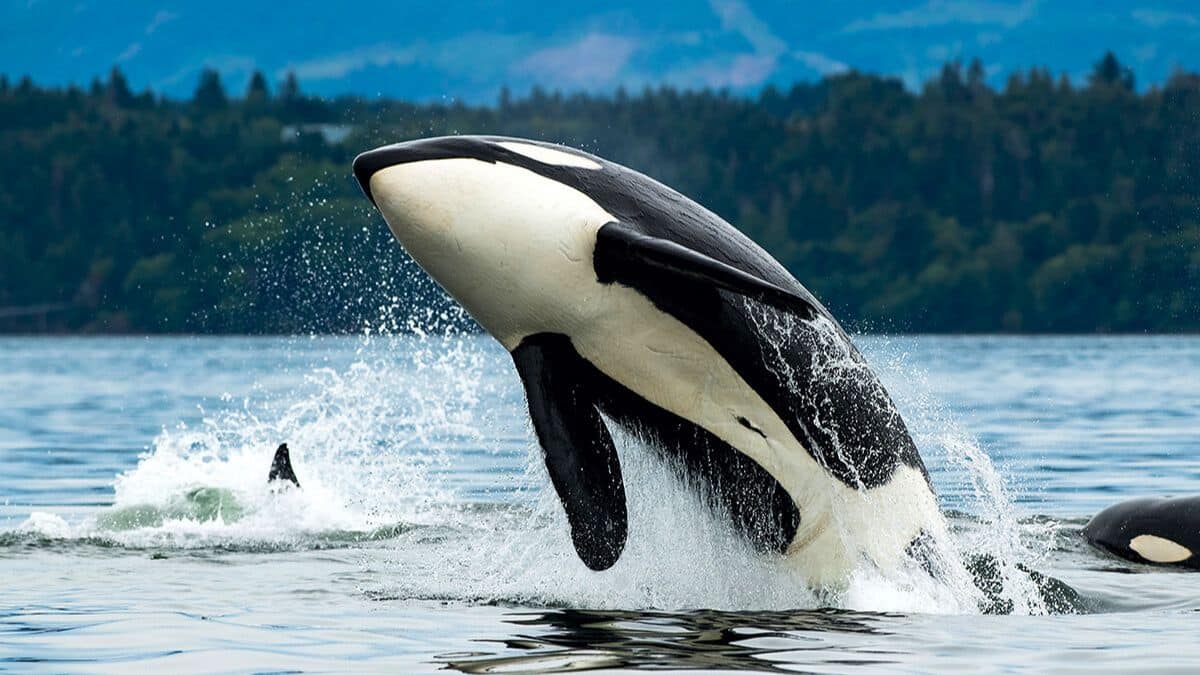
A wave of new research argues that dolphins and killer whales have crossed an evolutionary threshold that rules out any future on land. Once their lineage committed fully to the ocean, the cascade of adaptations that followed locked them into a marine destiny. In evolutionary terms, they have passed a point of no return for life on land. That realization reframes how we think about their past, and how urgently we must protect their future.
The evolutionary threshold
A 2023 study in Proceedings of the Royal Society B identified a crucial threshold separating semi-aquatic species from those fully adapted to the sea. By surveying more than 5,600 mammal species, the authors showed that once certain traits accumulate, reversing back to terrestrial life becomes improbable. The finding echoes Dollo’s law, which holds that complex evolutionary pathways rarely retrace their steps.
Marine mammals began as land walkers, venturing into coastal waters and gradually transforming across tens of millions of years. In cetaceans, that journey accelerated during the Eocene, around 50 million years ago. The shift was not a single leap but a sequence of interlocking changes that hardened into an irreversible strategy for survival at sea.
What makes a return impossible
When a lineage crosses that threshold, its biology becomes tuned to water in ways that make land a losing bet. Body plans, diets, and life histories reorganize around buoyancy, heat retention, and the physics of swimming. The result is a suite of traits that excel in oceans but fail on shore.
Key adaptations include:
- Dramatic increases in body size, which improve heat retention and hydrodynamic stability
- Limbs reshaped into flippers and a powerful tail fluke, trading stride for streamlining
- Dense blubber and specialized muscle, optimizing energy storage and thermal control
- A reworked respiratory system, with blowholes, rapid gas exchange, and diving reflexes
- Specialized sensory and feeding strategies, from echolocation to high-calorie carnivorous diets
“Once past this evolutionary threshold, the land is no longer an option.”
A one-way path in the tree of life
Evolution often explores and abandons options, but not all paths remain open once taken for long enough. In dolphins and orcas, the integrated architecture of swimming, breathing, and thermal physiology knits together into a deeply constrained package. Breaking that package apart would require mutations that degrade success in water long before they could build a viable life on land.
That is why talk of cetaceans “returning to shore” is a biological mirage. They can beach or bask, but sustained terrestrial living demands knees, ankles, and shoulder girdles they no longer possess. It would also require revamping balance, lung mechanics, and newborn care, all finely honed for buoyant bodies in moving seas.
The costs and benefits of specialization
Specialization unlocks extraordinary performance, but it narrows the corridor of possibility. The streamlined silhouette of an orca is a masterpiece of natural engineering. Yet the very traits that power long dives and high-speed chases reduce resilience when oceans change.
Seen this way, dolphins and orcas exemplify an evolutionary trade-off. They surrendered terrestrial potential to dominate a watery niche. The payoff is astonishing speed, social complexity, and acoustic intelligence—all phenomena that flourish in the ocean.
Conservation in an era of rapid change
Because they cannot pivot back to land, dolphins and orcas face environmental shocks with fewer escape routes. Warming waters, shifting prey distributions, chemical pollution, noise, and bycatch compress their ecological breathing space. Conservation must therefore target the integrity of the marine systems that make their lives possible.
Priorities include:
- Protecting critical habitats, from breeding grounds to migratory corridors
- Cutting ocean noise to preserve communication and foraging efficiency
- Reducing pollutants and plastic waste, which accumulate in top predators
- Managing fisheries to stabilize prey webs and curb accidental entanglement
- Expanding international monitoring and rapid-response networks for strandings and mass events
The broader lesson reaches beyond cetaceans. Across the tree of life, deep specialization can become an evolutionary cul-de-sac, especially when environments shift faster than organisms can adapt. Recognizing that constraint is not defeatism; it is a blueprint for focused, science-based action.
In the end, these animals are not failed terrestrials, but consummate mariners. Their future will rise or fall with the health of the seas they perfected, not the lands they left behind. If we value their speed, song, and social worlds, we must defend the only stage on which such brilliance can still be performed.