
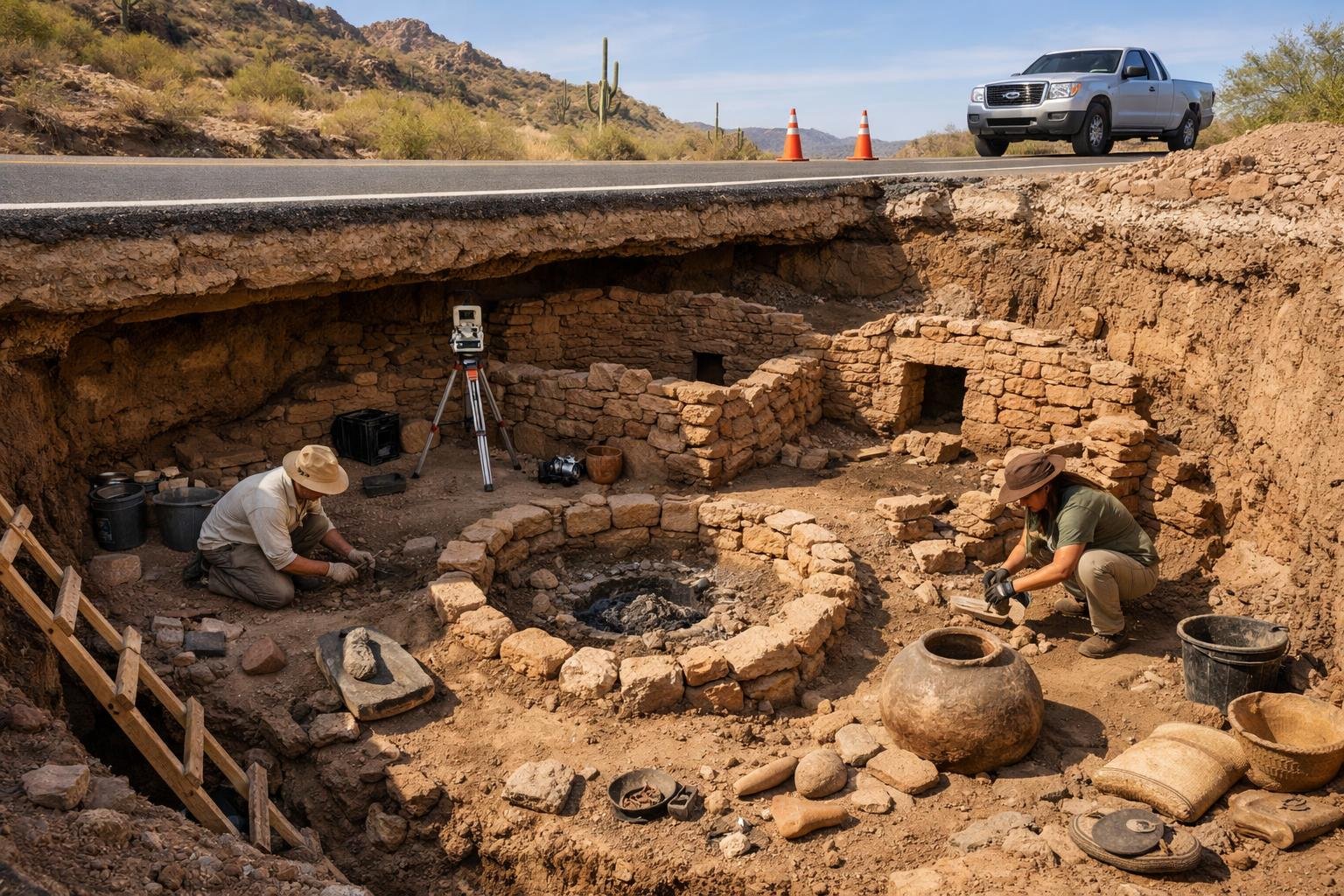
Beneath a stretch of sunbaked asphalt in central Arizona, workers widening a county road met the unexpected: a sanctuary sealed by silt, stone, and careful intent. What appeared as a routine infrastructure job paused into a breath-holding moment, as the ground opened to a space that felt unmistakably ceremonial, twelve feet below the ordinary hum of passing tires. “It was like a door opened,” said one observer, “and a quiet voice stepped through.”
A discovery beneath the ordinary
Crews noticed a pattern first—rounded walls of adobe, a ring of river-worn basalt, and the shadow of a hearth aligned with light squeezing through a service trench. A call went out to archaeologists, and just as quickly to tribal representatives, because the earliest rule on sacred ground is that no one walks it alone. The site took shape in a day, and then in layers, as feet slowed, voices lowered, and machines drew back.
The space wasn’t grand, but it was deliberate—a room-and-corridor complex, floors polished by sandal soles, entryway set to meet the morning head-on. The air held the faintest trace of char and clay, the kind of scent a place keeps when it’s meant to remember. “Not a ruin,” said a field archaeologist, palms dusted with ochre-tinted soil. “A memory, still working.”
A corridor of time and ritual
What made the discovery feel singular wasn’t just its preservation, but its intimacy. The sanctuary sat like a pulse, walled from noise, tuned to light and season. A narrow entry defeated wind, encouraged silence, and guided the head to bow at the threshold. Floor features suggested gathering, not habitation—small enough to be private, composed enough to be shared. In one corner, a shallow basin mirrored a notch in the ceiling, a subtle invitation for water or smoke to rise and return.
No one rushed to pin a precise century or a single people to this place, because the space itself asked for care over certainty. “We listen first,” a tribal cultural advisor said, tracing a finger across a plaster seam. “If what’s meant to be known comes forward, it will do so willingly.”
Guardianship before answers
Hours turned into protocol, and the dirt road became a detour, then a rumble of redirected traffic at the edge of cottonwood shade. Instead of rapid excavation, the team moved to stabilize, to document, and to consult with those whose inheritance is bound to this ridge and river. Tape measures gave way to offerings, notebooks to listening circles. Nothing in the room was taken, and nothing was named without consent.
“Archaeology can be a kind of hunger if you aren’t careful,” the project lead admitted. “Here, restraint is the method.” Soil readings proceeded with gloves, photography with muted light, and mapping at the pace of breath. Even the language bent to courtesy—site before finds, guardianship before answers.
Engineering around memory
County planners faced a simple fork: reroute a road, or risk injuring a once-in-a-lifetime site. The choice moved with surprising speed. Barricades blinked like constellations, and heavy equipment idled a respectful distance away. “Steel can wait,” the county engineer said. “What can’t be rebuilt doesn’t get rushed.” The revised plan arcs the asphalt in a gentle curve, yielding a permanent buffer and a way for caretakers to return safely.
With that decision, the buried room took on a new status—not exhibit, not excavation, but a sanctuary recognized in policy and practice. The goal, everyone agreed, is to let the site keep breathing on its own terms.
What the sanctuary suggests
Pieces of context coalesced, not as solutions, but as respectful clues—markers of an ethic that prized balance, alignment, and the presence of story within space.
-
Orientation to horizon events and river-bend light, where dawn and dusk thread through a scripted entry.
-
Building methods using river stone, caliche, and plaster, repaired in courses that read like seasonal chapters.
-
A sound profile that turns footsteps to whispers, and a roof geometry that drinks wind but does not swallow it.
- Artifacts by absence rather than abundance—little to collect, much to consider, implying use measured in ritual, not residence.
Listening as method
The days since have been a study in restraint, a choreography of hands, time, and shade cloth. A simple wooden screen marks the threshold, and a small sign asks for quiet more than it commands distance. “Think of it as a room that still has work to do,” a community member said. “Our job is to let that work continue.”
There are plans for co-management, for seasonal visits, and for teachings that happen on-site, with whatever privacy the space requests. No brochures, no glossy renderings, no hasty narratives that convert wonder into easy consumption.
The road above, the story below
By week’s end, traffic flowed along its new contour, and the sanctuary returned to a darkness that feels intentional, not forgotten. Every so often, a caretaker steps below with a lamp, not to pry, but to greet. At the surface, the world hurries by; beneath, a chamber keeps its timing, calibrating light, air, and the slow alchemy of place.
“Some sites explain themselves,” one archaeologist murmured. “This one explains the rest of us.” Perhaps that is the rarest find—not proof of a single ritual, but a template for listening: the reminder that knowledge can be quiet, and that a nation’s oldest rooms are sometimes the ones that teach us how to walk more lightly over what we can never fully own.