
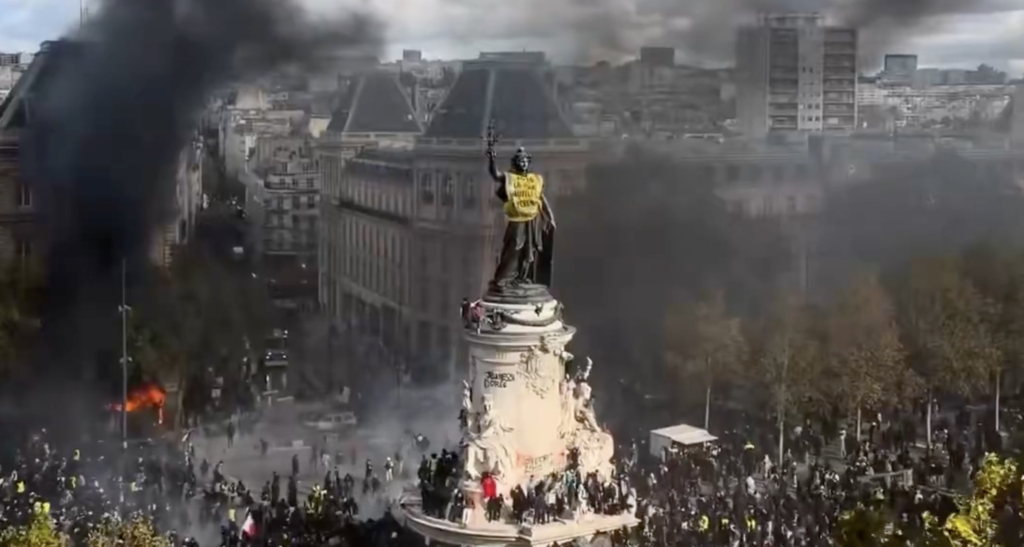
France.— A massive wave of protests that, beginning in the educational sphere, has escalated to become a generalized outburst against the high cost of living, budgetary austerity, and the policies of President Emmanuel Macron’s government.
What began in mid-September as a teachers’ and students’ strike at Saint-Exupéry High School in Créteil due to a lack of teachers and infrastructure, transformed within a matter of weeks into an unprecedented cross-cutting mobilization.
Under calls such as the ‘Yellow Vests and Youth’ movement, the discontent has brought together segments of Generation Z, former Yellow Vests, unions, farmers, and retirees, unleashing violent riots, urban blockades, and the imposition of partial curfews in cities such as Paris, Lille and Nice.
The magnitude of the current conflict does not stem from an isolated trigger, but from the overlap of severe economic, political and public management tensions.
Student discontent erupted over the chronic shortage of teachers, the deterioration of educational facilities, and the widespread rejection of Parcoursup (the higher education admissions platform), which is why youth organizations are demanding a 10 billion euro shock plan to reverse the precarization of the public education system.
To this demand is added the constant rise in prices for food, energy and basic services, which tightens the budgets of middle- and low-income households. The gap between the rising cost of living and stagnant wages reactivated the demands of the Yellow Vests movement, whose economic agenda again resonated strongly in public opinion.
At the same time, to contain the bloated deficit and the public debt, Macron’s administration is projecting a budget adjustment of more than 54 billion euros within the framework of the public accounts.
This package of cuts has intensified citizens’ fears about the dismantling of social welfare, pensions and the quality of essential public services.
Moreover, the discontent accumulated since the controversial reform of pensions that raised the retirement age to 64 continues to operate as a mobilizing engine, fueling a deep rejection of the government’s governance style.
Recently, looting of shops, the burning of Limoges City Hall, and serious damage to municipal offices in Marseille have been recorded.
The Ministry of Justice confirmed the detention of more than 2,500 people nationwide and ordered the prosecution to categorize serious disorders as acts of organized crime, extending the periods of preventive detention.
For his part, Emmanuel Macron condemned with firmness the destruction of public heritage and acknowledged misalignments in security operations, while Interior Minister Laurent Nuñez put his resignation at the president’s disposal. With a highly constrained fiscal margin and a tense political climate heading toward the 2027 presidential succession, the French government faces the complex challenge of restoring public order without neglecting the structural fractures that threaten the country’s social cohesion.