Just a few months after the Pakistani Mohafiz-V armored vehicle appeared on the streets of the Sudanese capital, Khartoum, and amid a wave of reports linking Pakistan to substantial military support for the Sudanese army, the relationship between the Port Sudan authorities and Pakistan appears to have entered a new phase with the recent signing of a security memorandum of understanding.
According to the Pakistani news agency, Sudan and Pakistan signed a memorandum of understanding in the Pakistani capital, Islamabad, on Saturday, November 7, 2026, to strengthen cooperation in security, interior affairs, combating cybercrime, police training, institutional coordination, and civil registration. The memorandum also provides for reciprocal entry visa exemptions for holders of official and diplomatic passports from both countries and for facilitating official visits, exchanges of delegations, and contacts between the two sides.
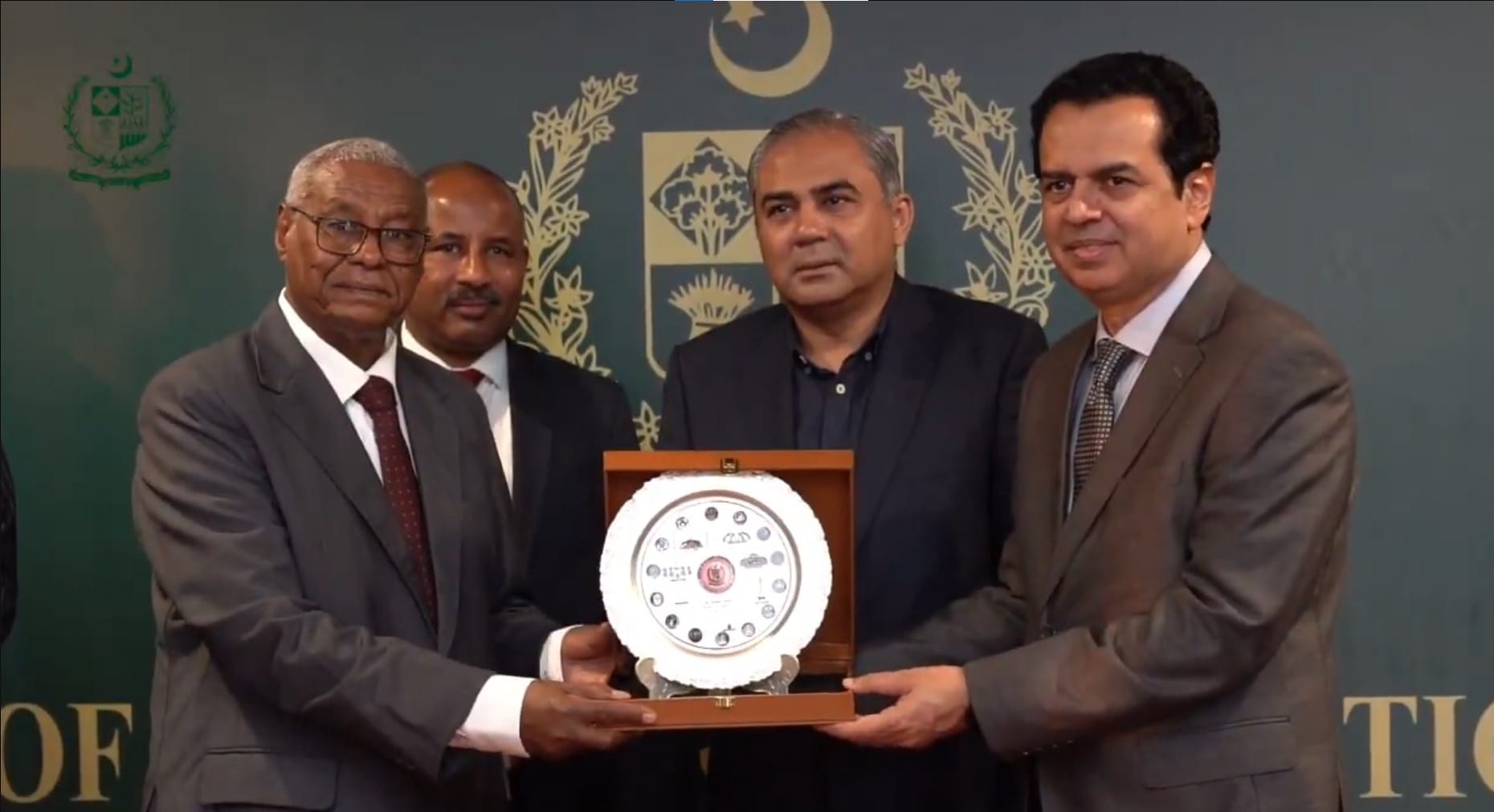
Pakistan’s Interior Ministry said in a statement that the agreement came during delegation-level talks between Pakistani Interior Minister Mohsin Naqvi and his Sudanese counterpart, General Babiker Samra Mustafa Ali, who is currently visiting Pakistan. Pakistan’s Minister of State for Interior Affairs, Talal Chaudhry, also attended.
The talks were part of a series of meetings the Sudanese minister held during his visit to Pakistan. On Friday, November 10, 2026, he met with Pakistan’s Chief of Defence Forces and Chief of Army Staff, Asim Munir, to discuss ways to strengthen bilateral cooperation. The day before yesterday, he also met with Prime Minister Shehbaz Sharif and praised Pakistan’s support for Sudan.
Pakistan’s Growing Role in the Sudanese Crisis
The visit and the recently signed security cooperation memorandum between the two sides highlight Pakistan’s growing role in Sudan, particularly during the ongoing war.
Since April 15, 2023, Sudan has been experiencing a devastating war between the Sudanese army, led by General Abdel Fattah al-Burhan, and the Rapid Support Forces, led by General Mohamed Hamdan Dagalo. The war has caused the world’s largest humanitarian crisis, and all United Nations, regional, and international efforts to stop it have failed.
Pakistan is one of the most prominent supporters of the Sudanese army. Press reports cited by Reuters in January 2026 said that Pakistan was close to concluding a $1.5 billion arms deal with the Sudanese army.
According to the Washington Institute for Near East Policy’s, the deal includes Karakoram-8 aircraft, more than 200 drones, air defense systems, and possibly JF-17 multirole fighter aircraft, jointly produced by Pakistan Aeronautical Complex and China’s Chengdu Aircraft Corporation.
Last August, around 100 Pakistani Mohafiz-V armored vehicles appeared in a military parade in Khartoum, the first sign on the ground that implementation had begun.
The armored vehicle is produced by HIT Armour, part of Pakistan’s state-owned Heavy Industries Taxila (HIT). It was designed on a modified Toyota Land Cruiser LC79 chassis and can carry eight people, making it suitable for troop transport, military convoy escort, reconnaissance, and internal security operations.
Reports suggest that Saudi Arabia brokered the agreement or may be financing it, although there has been no official confirmation. Neither Islamabad nor Port Sudan has officially confirmed the details of the deal.
Analysts believe the deal could help the army regain air superiority over the Rapid Support Forces, but warn that it could intensify the arms race and prolong the war in Sudan. Those conclusions appear likely to be correct, as the Sudanese army continues to reject all attempts to stop the devastating war.
The “Mecca Agreement” Comes to the Fore
Since Saudi Arabia, Türkiye, and Pakistan signed the “Mecca Mutual Defense Agreement” on August 7, 2026, the first signs have emerged in Sudan that the agreement may amount to more than a shared “trilateral” political umbrella.
According to a report published by Le Monde last August, Sudan became the first arena in which the three countries’ growing military ties took concrete form, through an arrangement that combines Saudi financing with Turkish and Pakistani weapons for the benefit of the Sudanese army.
The Mecca Agreement stipulated that an armed attack on any one of the three countries would be considered an attack on all of them. It also provided for expanded military cooperation, defense industry collaboration, training, and strategic coordination. The signatories affirmed that the agreement was defensive and did not target any particular country.
Although Sudan is not a party to the “trilateral” Mecca Agreement, the agreement provided strategic cover for the Pakistani deal, worth about $1.5 billion, to become part of a broader, more enduring partnership instead of remaining a one-off deal. Analysts believe Sudan could be the first practical test of this trilateral coordination. The latest visit raises new questions about the reach of the agreement and its impact on the ongoing war in Sudan.
In addition to providing military support to the Sudanese army and preparing to support it in policing and combating online fraud, Pakistan has eased some of the isolation facing the Port Sudan authorities, particularly after the United States formally withdrew its recognition of their legitimacy.
On September 22, 2026, the U.S. State Department issued a statement through spokesperson Tommy Pigott saying that the Sudanese army, the Rapid Support Forces, and their respective leaders do not represent a legitimate and constitutional government of Sudan. This came as media reports said that Washington had withheld a visa for army chief Abdel Fattah al-Burhan to attend the United Nations General Assembly in order to pressure him to accept a 90-day truce.