
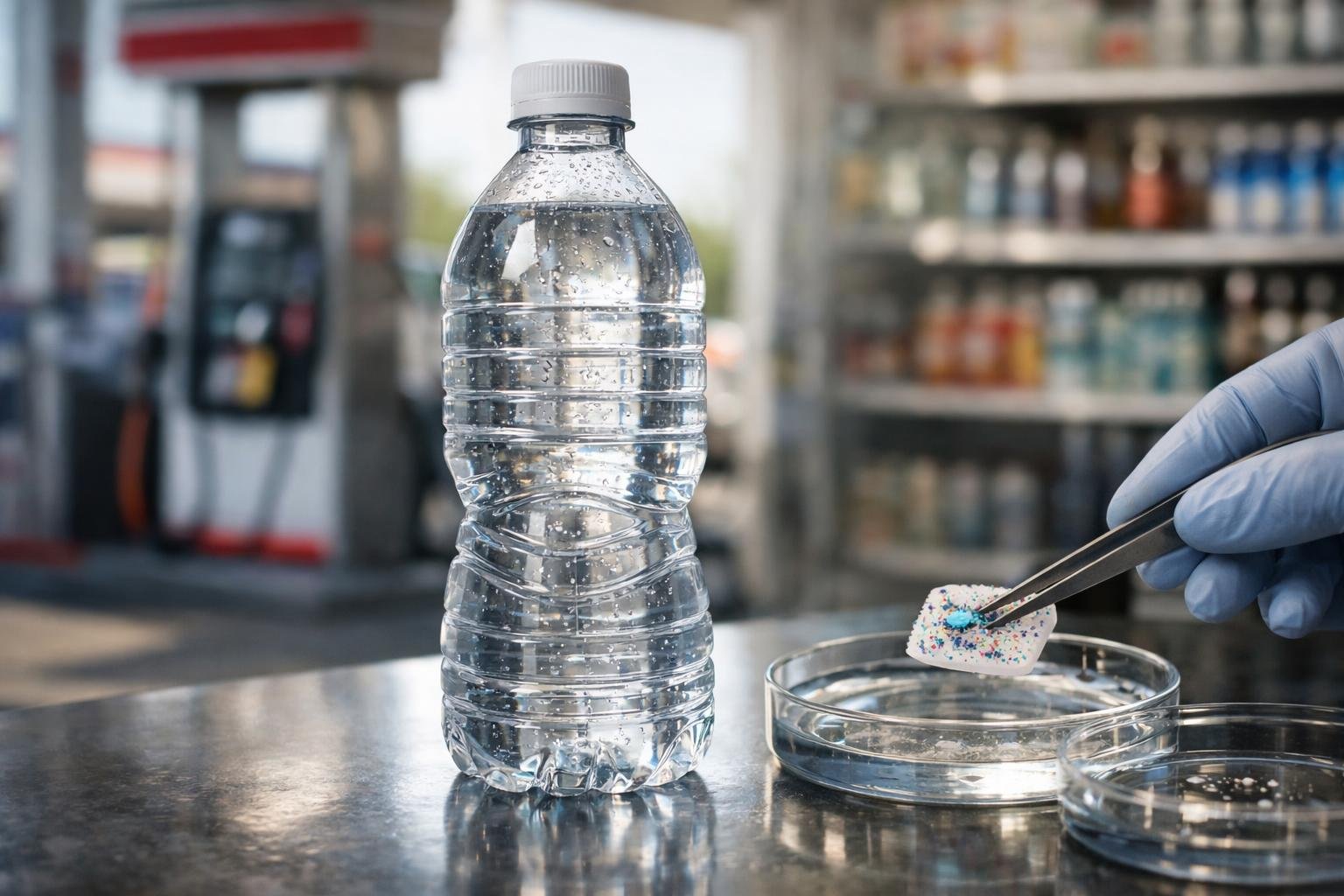
A familiar bottle on the shelf now carries a less familiar warning. A new Columbia University study peered far closer than past tests and found levels of tiny plastic particles in popular bottled water that left researchers, by their own admission, stunned. The revelation doesn’t just tweak consumer preference; it unsettles trust in a product many people consider a daily staple.
What the Columbia team found
Using an advanced imaging technique built to spot the nearly invisible, the team detected not just microplastics but vast numbers of even smaller nanoplastics—particles so small they can slip past many standard filters. In three widely sold U.S. brands, they counted an average in the hundreds of thousands of plastic particles per liter, with the majority falling into the nano range.
“The numbers were higher than we anticipated,” a researcher involved in the work reportedly noted. Past methods, which focused on larger fragments, were finding counts orders of magnitude lower—not because the particles weren’t there, but because the tools weren’t suited to see the truly tiny.
The team emphasized what their method does and does not prove. It detects specific plastic signatures, quantifies them precisely, and distinguishes them from other debris. It does not, on its own, establish immediate health effects.
Why microplastics matter
Microplastics are small, but nanoplastics are the headliners here—measured in billionths of a meter. Because of their size, they can potentially move in ways larger particles cannot, interacting with cells and tissues more readily. Early toxicology suggests possible links to inflammation and oxidative stress, but definitive human health outcomes remain under active study.
“This should be a wake‑up call,” said one public health advocate who tracks plastic risk research. The safest position is informed caution: acknowledge what we now know, and be honest about what we still don’t.
Which brands, and why it’s tricky
The researchers did not publicly name the tested brands, a common practice to avoid litigation and keep focus on the phenomenon rather than a single label. That might frustrate shoppers, but it highlights a deeper truth: shedding can occur across many product lines, because the root causes are often structural.
Most bottles are made from PET plastic, a material that can shed fragments under stress—filling, capping, shipping, and storage. Cap liners, bottle necks, and even friction during transport can release particles. Heat makes shedding worse; think warehouse pallets in summer or a bottle left in a car. The supply chain is long, and opportunities for particle generation are many.
One industry representative put it this way: “We’re compliant with current standards.” That may be true and still insufficient, because standards lag behind what newer instruments can actually measure.
What you can do now
Personal risk can’t be zeroed out, but it can be reduced. Practical steps, based on current evidence and common‑sense hygiene, include:
- Choose tap water when possible, and use a certified filter (look for NSF/ANSI performance marks appropriate to your concern). Prefer reusable stainless or glass bottles; avoid leaving plastic bottles in heat or direct sunlight. If you buy bottled water, opt for glass or aluminum when available. Don’t refill single‑use plastic bottles repeatedly; they’re not designed for long‑term wear.
Remember, filtration won’t catch every nano‑particle, but it can reduce certain contaminants and larger fragments. Small steps, scaled across millions of households, add up to meaningful change.
How regulators and brands may respond
Expect regulators to ask hard questions: Do current safety thresholds reflect the real-world exposure modern tools reveal? Should labels disclose particle counts or materials that most commonly shed? Policymakers typically move slower than science, but scrutiny is already rising.
Brands, for their part, have credible levers to pull. Tighter process controls during filling and capping. Alternative cap liners and less abrasive bottle designs. More rigorous temperature control across transport and storage. Independent audits that test for nano‑ as well as microplastics. “Transparency builds trust,” as one sustainability lead likes to say.
The bigger picture
The bottled water boom was built on purity, portability, and perceived safety. This new evidence challenges one of those pillars, not because water isn’t treated, but because plastic itself can become an unexpected ingredient. That reality doesn’t vanish with a marketing tagline.
For consumers, the path forward is pragmatic and curious. Ask brands for third‑party testing. Support policies that modernize water quality standards. Invest in durable reusables and local water infrastructure. “We can’t manage what we don’t measure,” the saying goes—and now that measurement is possible, managing should finally catch up.
In the end, the bottle we reach for may still be convenient, but convenience needn’t come with invisible baggage. The science is sharpening the view, the stakes are broadly shared, and the moment is ripe for solutions that are smarter, clearer, and built to last.
