
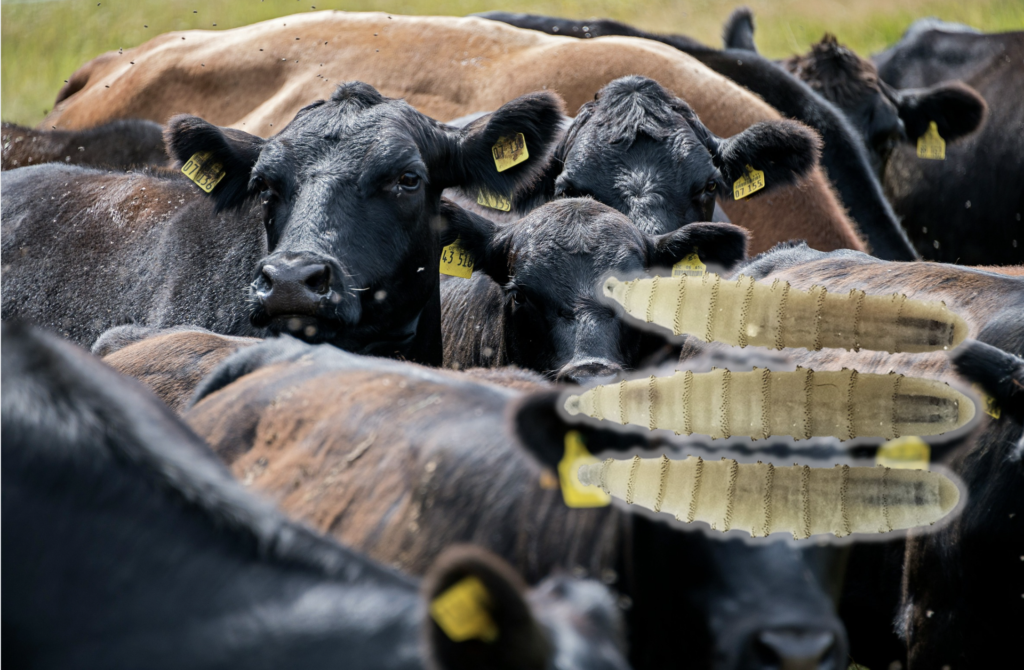
Alarms persist in Texas over screwworm cases in the Lone Star State; the United States Department of Agriculture announced that three more cases have been confirmed, including one outside the main focus, underscoring the difficulty of stopping a resurging infestation that could devastate the country’s cattle industry.
The screwworm is, in fact, the larva of a fly that feeds on living flesh rather than decaying matter. These flies lay their eggs in open wounds of animals such as cattle, although wildlife, pets, and even, occasionally, humans can be affected. The government runs a program to rear sterile males and release them in large numbers from airplanes so they mate with wild females; this strategy kept the pest contained in the southern tip of Panama for decades.
So far, there are five confirmed cases: three calves and a goat in Texas, and a dog from the neighboring town of Lea, in New Mexico. The dog, which the Department of Agriculture had initially reported as a Texas case, resides in New Mexico and was reclassified as the first case in that state; the animal’s travel history is currently under investigation.
The screwworm gets its name from the habit of its larvae of burrowing into wounds, according to the USDA.
The first two screwworm cases were detected in the first week of June in calves located a few miles apart in southern Texas. On June 8, a case was announced in a calf in La Salle County, southwest of San Antonio, and another in a goat in Gillespie County, west of Austin.
Experts expect that new cases could emerge in the coming days and weeks, but that does not mean the screwworm is spreading rapidly, said Edward Burgess, an entomologist at the University of Florida who studies this fly.
The agency and the U.S. cattle industry have been working against the clock to prevent an outbreak since the screwworm presence was detected in Mexico in late 2024. The USDA has been releasing sterile flies in southern Texas since February and is working both to increase sterile-fly production at plants outside the United States and to build a sterile-fly factory in Texas at a cost of $750 million.
According to the Associated Press, so far, the reappearance of the screwworm has not significantly affected beef prices, which are already near record levels due to the smaller U.S. cattle herd. Although the parasite attacks live cattle, it does not infest meat or fruit. Additionally, there is a dozen government-approved medicines to treat livestock.
For now, Canada temporarily suspended on Friday the import of cattle, horses, and other farm animals from Texas.