
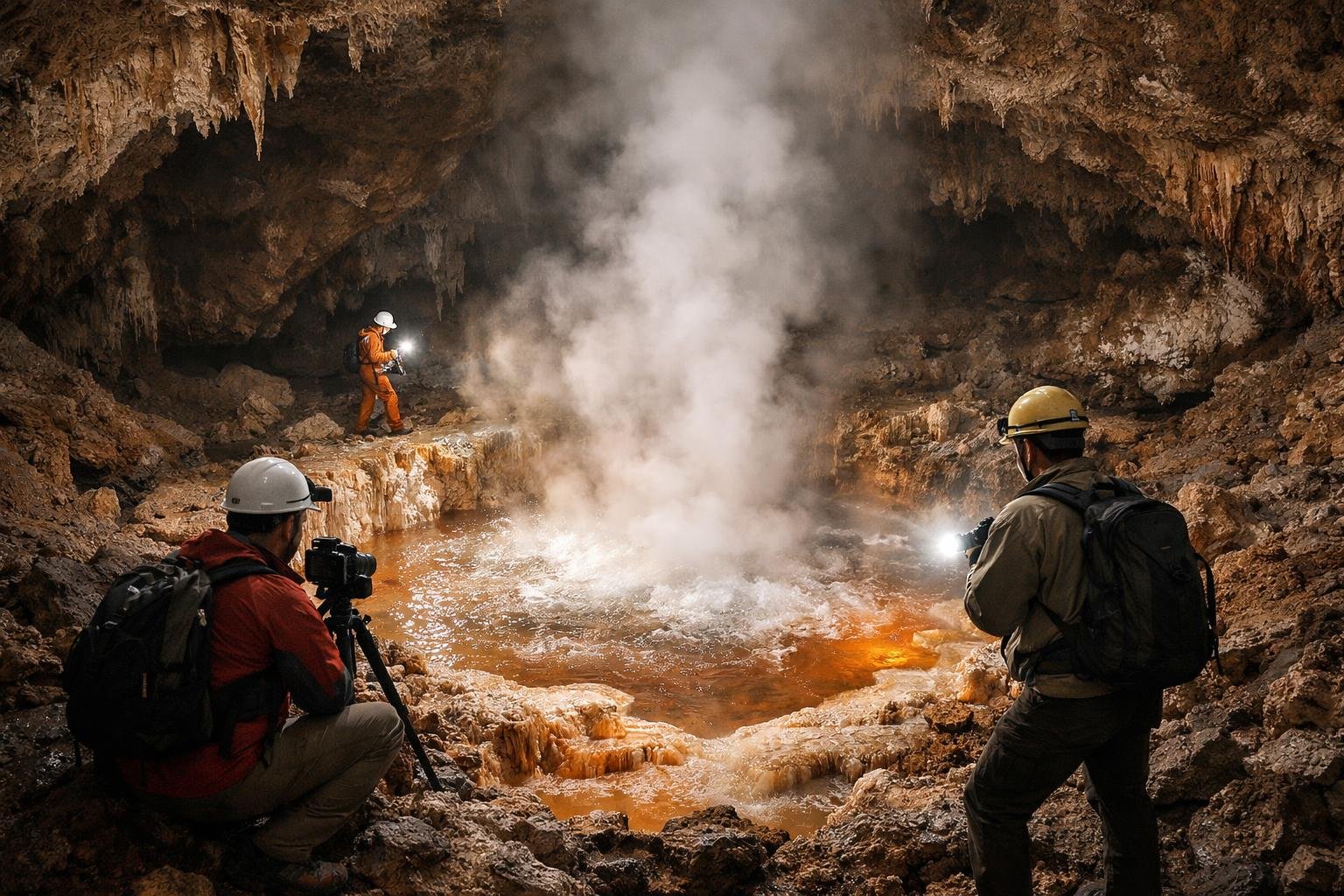
The first hint was a whisper of steam, a breath rising from a borehole that should have been silent. Then instruments caught the pulse—heat moving like a thread through stone. At roughly 1,050 feet below the Nevada desert, researchers found a hydrothermal cavity, chiseled and reworked by circulating fluids for over 100,000 years. “We opened a door,” a field geologist said, “and the Earth answered in warm, mineral-laced air.”
This underground room is not a void of emptiness but a workshop, where heat, water, and rock have bargained for epochs. Its walls gleam with thin veils of silica and carbonate, its ceiling spangled with crusts that grew grain by grain. Step inside—carefully—and you find a timeline etched in crystal and a habitat humming at the very edge of life.
A window into Earth’s plumbing
The discovery sits within the Great Basin’s tangled faults, where the crust is stretched and leaky. Hydrothermal systems ride those fractures, letting deep fluids climb and cool. This cavity is a node in that network, a place where heat lingers and chemistry changes voice.
Fluids infiltrate, leach metals, and return them as glistening coatings. Pressure flickers, rock shifts, and the cavity breathes—slowly, but surely. “It’s a lung in stone,” the drilling lead remarked, “expanding and contracting with tectonic whispers.”
Dating an ancient heartbeat
Proving that this cavity stayed active for more than a glacial cycle meant weaving several clocks together. Uranium-thorium ages from carbonate films bracketed the earliest pulses, while fluid inclusion thermometers captured snapshots of past temperatures. Stable isotope ratios—oxygen and hydrogen—mapped shifting sources, from meteoric water to deeper, more saline reservoirs.
Across the records, pauses appeared, but the thread of circulation never snapped. In one sample set, ages clustered around 130,000 years; in another, growth resumed near 70,000. “It’s not continuous like a line, but persistent like a drumbeat,” a geochemist noted.
Life in the hot dark
Where heat and minerals meet, microbes often follow. Swabs lifted from mineral rinds carried DNA fragments hinting at chemolithotrophs—organisms that dine on chemistry, not light. Iron-oxidizers and sulfate-reducers may cycle elements, painting the walls with nano-scale textures that mimic frost or lace.
“Every droplet is a pantry,” a microbiologist said, “stacked with redox snacks.” The team will culture isolates at controlled temperatures, tracing how enzymes hold their shape in heat and how biofilms seed mineral growth.
Minerals that write in stone
The cavity offers a ledger of conditions written in aragonite needles, silica skins, and iron-oxyhydroxide smears. Layer by layer, they register episodes of hotter pulses, cooling pauses, and gas-rich bursts. Some bands are clouded, packed with trapped bubbles; others are glassy, like stilled water.
- Silica layers mark hotter, silica-rich surges, while carbonate laminae point to degassing and rising pH.
- Iron-rich stains suggest redox swings as fluids mixed with oxygenated seepage.
- Microlaminations act as seasonal or millennial ticks, a cadence of supply and stillness.
To the trained eye, these textures are equations—inputs of heat, pressure, and time that solve to crystal.
Risks, rewards, and responsibility
Beneath the desert, the same heat that nurtures minerals can also drive hazards. Open voids may focus seismic energy, and any new boreholes could nudge pressures in delicate ways. The team mapped stress fields with microseismic arrays, choosing gentle sampling over aggressive pumping.
Yet the upside is as tangible as the risks. Such cavities are testbeds for geothermal ideas, places to refine circulation models and sensor designs. “If you understand a small system well,” one engineer argued, “you scale the lessons without scaling the damage.”
What the desert keeps, what it shares
The desert appears austere, but below, the architecture is generous—arches of mineral, corridors of heat, and thin films of life that neither sun nor wind could build. This find invites a slower science, one that listens to drips, counts growth rings in stone, and treats samples like stories rather than loot.
There’s also the human horizon. The site lies within landscapes long read by Indigenous communities, whose knowledge of springs, seeps, and sacred waters predates modern maps. Collaboration here is not just ethical; it’s useful, aligning groundwater records with oral histories and seasonal paths.
Beyond the borehole
Next steps are deliberately unhurried. Researchers will log microclimate cycles, test noninvasive imaging, and return cores to labs where microscopes turn rough surfaces into navigable cities. A set of open datasets—chemistry, isotopes, and microbes—will invite outside eyes, amplifying insights without multiplying footprints.
“Patience is a tool here,” the field chief mused. “The cavity has worked for a hundred millennia. Our job is to ask good questions, then get out of its way.” And with that, they sealed the borehole for the night, leaving the underground heartbeat to keep its time.
