
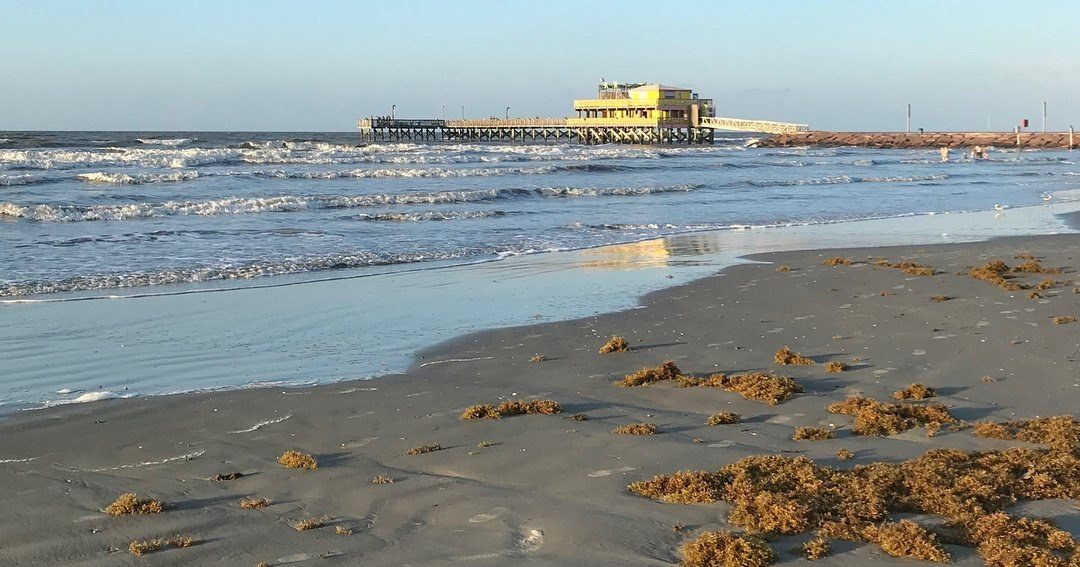
The accumulation of sargassum on the Galveston coast has drawn the attention of visitors due to its volume and odor. Experts say the phenomenon is common in spring, although it can affect the beachgoing experience and cause health concerns when it decomposes.
The presence of sargassum in Galveston has increased in recent weeks, with accumulations visible along the shore and reports from visitors who say they have not seen piles so tall in previous years.
Sargassum, a brown marine alga that typically washes ashore on the Gulf coast during spring and early summer, is part of a natural cycle. In large quantities, it can change the look of the beach, produce a strong odor and complicate coastal maintenance work.
Visitors report taller mounds near the shore
In recent days, residents and tourists have found thick layers of sargassum on Galveston’s sand. Some people who visit the island frequently described the accumulation as unusual in its depth and extent.
The odor has also been noticeable in some areas. When sargassum remains on the sand for several days and begins to decompose, it can emit a strong smell, similar to rotten eggs or decomposing organic matter.
Although the scene can be unpleasant for those who arrive to walk, swim or spend the day by the sea, local experts note that the arrival of sargassum tends to increase during this time of year.
Sargassum tends to increase from spring to early summer
Extreme weather scientist Hal Needham, based in Galveston, explained that the arrival of sargassum responds to a natural cycle that intensifies during the spring and moves into the early summer months.
According to that assessment, the accumulation observed this year remains within a pattern similar to last year. The difference for many visitors lies in the amount visible on the beach and in how currents, winds and tides concentrate the material at certain points.
Sargassum floats on the sea in patches of varying sizes. In open water, it can provide habitat for fish, sea turtles and other marine species. When it reaches the coast in large quantities, it can cover sand, affect water access and create inconveniences for bathers and tourism-related businesses.
EPA warns of skin and respiratory irritation
The United States Environmental Protection Agency says that sargassum accumulation events can have health effects when the material decomposes or when people come into direct contact with it.
Sargassum can harbor small organisms capable of irritating the skin. In the decomposition stage, it can also release hydrogen sulfide and ammonia, two gases associated with respiratory, cardiovascular and neurological discomfort in more intense or prolonged exposures.
People with asthma, respiratory conditions, older adults, children and those with chronic illnesses may be more sensitive to these gases. Exposure can also cause irritation in the nose and throat, coughing, headaches, nausea or dizziness.
The general recommendation for visitors is to avoid handling large accumulations, not walk barefoot on decomposing mounds, and to move away from areas where the odor is too strong.
NOAA updates its monitoring tool with daily reports
The National Oceanic and Atmospheric Administration updated its Sargassum Inundation Risk tool to provide daily reports on the location of the algae and the risk of reaching certain coastlines.
The system, known by its acronym SIR in English, uses satellite data to identify patches of sargassum in the ocean and estimate the potential arrival to coastal areas of the Caribbean, the tropical Atlantic and the Gulf.
NOAA clarifies that the tool is not an exact forecast. The final arrival of sargassum depends on local conditions such as currents, wind, waves and tides. Still, the reports help researchers and coastal communities monitor the movement of the algae more frequently.
Previously, reports were published weekly. The new daily update provides more detail to track the risk of arrival at beaches during the peak growth season.
Galveston only removes sargassum when it reaches certain thresholds
The Galveston Park Board indicated that the accumulation must reach certain height and depth thresholds before staff can remove it or relocate it.
When removal is necessary, the sargassum can be moved toward the dunes to help nourish the beach. That management approach helps reduce nuisances in public-use areas without completely eliminating a material that also plays natural roles in the coastal ecosystem.
Sargassum can help form and protect dunes when properly integrated into the sand. In smaller amounts, it contributes to reducing erosion and supporting natural beach processes.
Conditions can change from week to week. Sargassum can accumulate quickly with certain winds and currents, and it can also decrease when wave action redistributes or moves it to other stretches of the coast.