
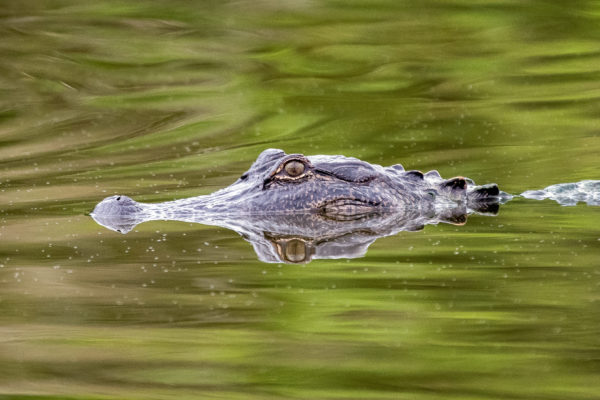
Spring tends to bring more alligator sightings in Southeast Texas. Texas Parks and Wildlife indicates that between March 1 and May 30 the most active stage of reproduction and nesting concentrates.
In recent days, alligator sightings have been reported at Galveston Island State Park and also in suburban areas such as Sienna, a familiar signal for those living in the Houston area and Southeast Texas. This is not out-of-season behavior. According to Texas Parks and Wildlife, alligators spend much of the winter with very little activity and reappear in March, when their most active period of the year begins.
Between March and May alligators move more
Texas Parks and Wildlife explains that from March 1 to May 30 the peak of reproduction and nesting occurs. During that period, females tend to stay near their territory, while males can move across much broader areas. The agency also notes that individuals between four and five feet tend to move in search of new space, which helps explain why in spring they may appear in places where they are not typically seen the rest of the year.
Movements can also increase when environmental conditions change. Texas Parks and Wildlife warns that droughts, heavy rains, or other extreme events can push alligators to relocate. In a region like Houston, where channels, wetlands, ponds, and bayous coexist with subdivisions and parks, these relocations tend to be more visible to residents and visitors.
Seeing one on the shore does not mean it is hunting
One of the points that causes the most confusion is seeing a still alligator on the shore of a lake or creek, sometimes with its mouth open. Texas Parks and Wildlife indicates that, in many cases, the animal is simply sunning itself to regulate its body temperature. The agency clarifies that an alligator resting on the shore is normally not hunting at that moment.
That does not mean it should be disregarded. The official recommendation is to always keep a distance of at least 30 feet. If the animal hisses, it is a warning sign that the person is too close. In that case, the correct action is to back away slowly. Texas Parks and Wildlife reminds that alligators can move quickly over short distances, both on land and in the water.
The young and nests change the risk this season
The season also coincides with greater defense of nests and young. The state agency warns that a female may lunge toward a person if she perceives that her nest or her young are at risk, though she typically returns to the nest area when the threat moves away. The recommendation is to avoid piles of branches, grass, or dirt near the water and not to approach groups of small alligators.
Texas Parks and Wildlife also asks not to touch or attempt to pick up the young. Even if they seem small and harmless, the mother is often nearby and will respond to protect them. That is one of the reasons the agency insists on observing them only from a distance and avoiding any attempt to move or interact with them.
Pets, fishing and walks by the water require extra care
In Houston-area neighborhoods and parks, one of the most common risks is not a direct confrontation between a person and an alligator, but rather the pets. Texas Parks and Wildlife notes that dogs and other small animals can be seen as easy prey. The recommendation is to keep them on a leash no longer than six feet, away from the shore, and not to allow them to drink or enter the water in areas where alligator habitat exists.
The agency also urges closely supervising children when they play near the water and to avoid swimming at night or at dawn and dusk, when alligators are more active. For those who fish, the guidance is to cut the line and move to a new spot if an alligator shows interest in the hook or the catch. It also recommends not leaving fish remains on the shore or in the water.
Feeding them is illegal and creates problematic alligators
Texas Parks and Wildlife warns that many of the so-called “nuisance alligators” appear after someone has fed them, either directly or indirectly. When an alligator associates people with food, it loses its natural fear and may approach recreational or residential areas more closely. This type of behavior often leads to relocating the animal or even euthanizing it.
Feeding them is prohibited in state parks and constitutes a Class C offense, with fines of up to $500. The same logic applies to throwing fish remains into the water. Even if it does not appear to be intentional feeding, Texas Parks and Wildlife notes that the result ends up being the same.
When to report an alligator
Not every sighting requires an immediate call. If the animal does not approach or pose a threat, the general guidance is to keep your distance and leave it alone. But if an alligator advances toward a person on land or in the water, comes out of the water to approach, or remains in a spot that could pose a risk, the recommendation is to report it to park staff or the proper authorities. Texas Parks and Wildlife also indicates that any potentially dangerous specimen should be reported to the department, a local game warden, or 1-800-792-1112.
Texas considers the American alligator a protected species. Its coexistence in Southeast Texas is not new, but in spring it becomes more visible. In this season, the most useful guidance remains the same: look from afar, keep children and pets away from the shore, and let the animal continue on its way.
