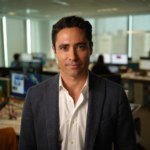
A 33-year-old billionaire with a scholar’s restraint, Arthur Mensch has become France’s most intriguing figure in AI, an understated builder challenging Silicon Valley with a European vision rooted in rigor, openness, and sovereignty. The cofounder and CEO of Mistral AI projects calm authority—more research seminar than showman—yet his start-up has jolted the global market, forcing the American giants to take notice.
[Image: Arthur Mensch in the offices of Mistral AI, Paris, January 2025. BERTRAND GUAY / AFP]
A quiet face for a high-stakes revolution
On French television, Mensch defended entrepreneurs with illiquid wealth in the debate over a new wealth tax, speaking with a measured tone that signaled technocratic confidence rather than bravado. He argued for fiscal fairness without sacrificing national competitiveness, positioning himself as a bridge between policy ambition and industrial reality. That balance mirrors his company’s stance: pragmatic, transparent, and unapologetically European.
From Paris-Saclay prodigy to AI founder
Mensch’s path runs through Paris-Saclay, one of Europe’s densest hubs of talent, where he studied at École Polytechnique, Télécom Paris, and the École normale supérieure. He blended deep mathematics with cutting-edge machine learning, completed a celebrated PhD in data science for neuroscience, and earned a reputation for brilliance without ego. Colleagues describe a scientifically honest “bulldozer” who could solve almost anything, yet chose humility over hype.
After a stint at DeepMind in Paris, he watched ChatGPT ignite the industry, then left to pursue a different path. The bet was bold: build world-class models while keeping key assets open, and do it from Paris rather than the Bay Area. He recruited cofounders Guillaume Lample and Timothée Lacroix, veterans of Meta, to launch Mistral AI in 2023.
Open models, clear principles
Mensch has made “openness” his operational ethos, releasing powerful models with transparent documentation and lean engineering that prizes efficiency over spectacle. At school he publicly shared experiments to advance the community, and he still favors research-grade clarity over marketing fog. He says he did not want to build opaque technology inside a gated American platform, and Mistral’s releases reflect that conviction.
“In the long run, the way we access information should not be controlled by a few black boxes,” he has said—an ethos that informs both product design and policy stance. His consumer-facing assistant, Le Chat, partners with the AFP to improve factual grounding, a move meant to distinguish reliability from viral novelty.
A European answer with global velocity
In barely two and a half years, Mistral has raised almost €3 billion, including a recent €1.7 billion round with €1.3 billion from Dutch chip titan ASML. The company is valued near €12 billion, while Mensch reportedly holds at least 8%—a stake that makes him one of France’s wealthiest tech leaders. Funding is not an end in itself: it fuels data center capacity, model training, and continent-scale deployment.
What sets Mistral apart is not just capital, but the union of high performance, cost efficiency, and open-by-default interfaces. Mensch wants an “energy-sober” AI stack that can compete on inference costs while limiting wasted compute, a strategy aligned with Europe’s energy constraints and climate goals.
- Mistral builds compact, high-utility models designed for real-world latency and cost per token.
- The company favors open weights, transparent benchmarks, and reproducible research artifacts.
- Le Chat partners with AFP to boost answer factuality and reduce hallucination risk.
- Infrastructure choices reflect France’s energy mix and data sovereignty priorities.
Resistance to regulatory complacency
Mensch backs smart rules but calls parts of the EU AI Act counterproductive for European innovators. He argues that overbroad constraints can freeze the very capabilities Europe must master to remain economically relevant. His critique is not anti-regulation; it is a plea for calibrated governance that protects citizens while enabling strategic autonomy.
“What happens if two or three American companies completely control how we access information, and shape how people think around the world?” — Arthur Mensch
The man behind the metrics
Colleagues emphasize Mensch’s team-first instincts, crediting cofounders and “people stronger than me” at every turn. Away from the camera he is a devoted parent, a runner who finished the Paris marathon under 3:30, and a cyclist who prizes sustained effort over quick wins. That rhythm carries into company culture: fewer announcements, more shipping, and relentless iteration.
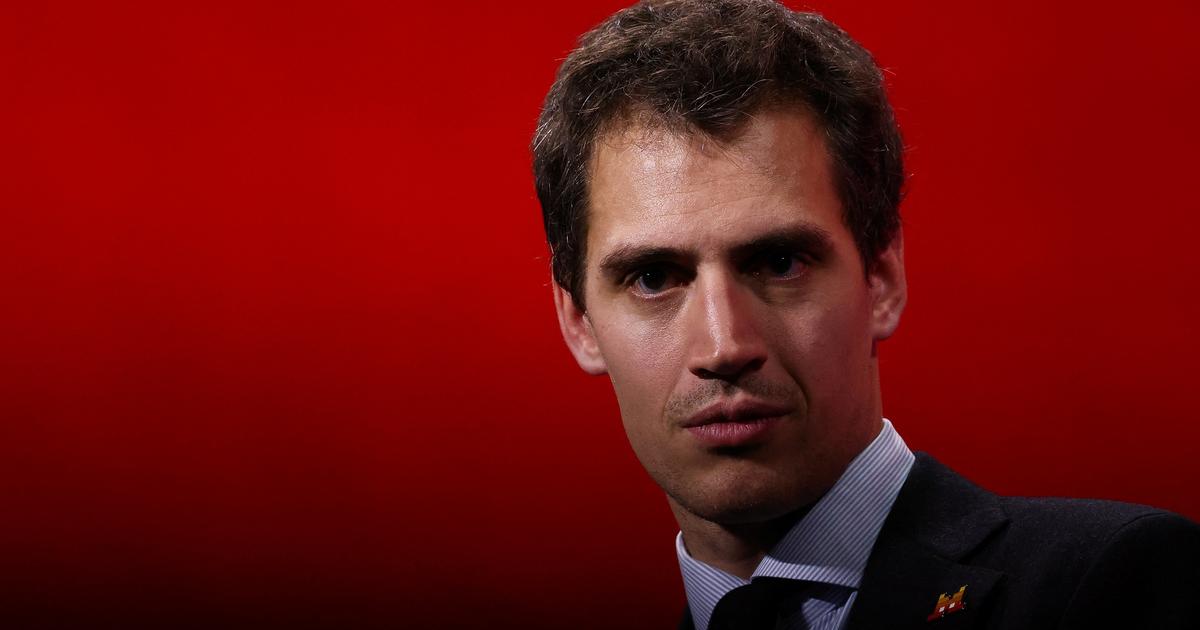
[Image: Emmanuel Macron, Demis Hassabis, and Arthur Mensch at an AI summit in London, July 2025. LUDOVIC MARIN / AFP]
Why his rise matters
Mensch represents a different archetype for European tech: academically rigorous, operator-minded, and fluent in public-interest arguments without losing competitive edge. He is building a European champion able to sell globally while staying anchored in Paris, proving that frontier AI does not have to be a Silicon Valley monopoly. In a field crowded with mythmakers, his advantage may be credibility—the quiet certainty that open, efficient, and European can still mean world-class.