
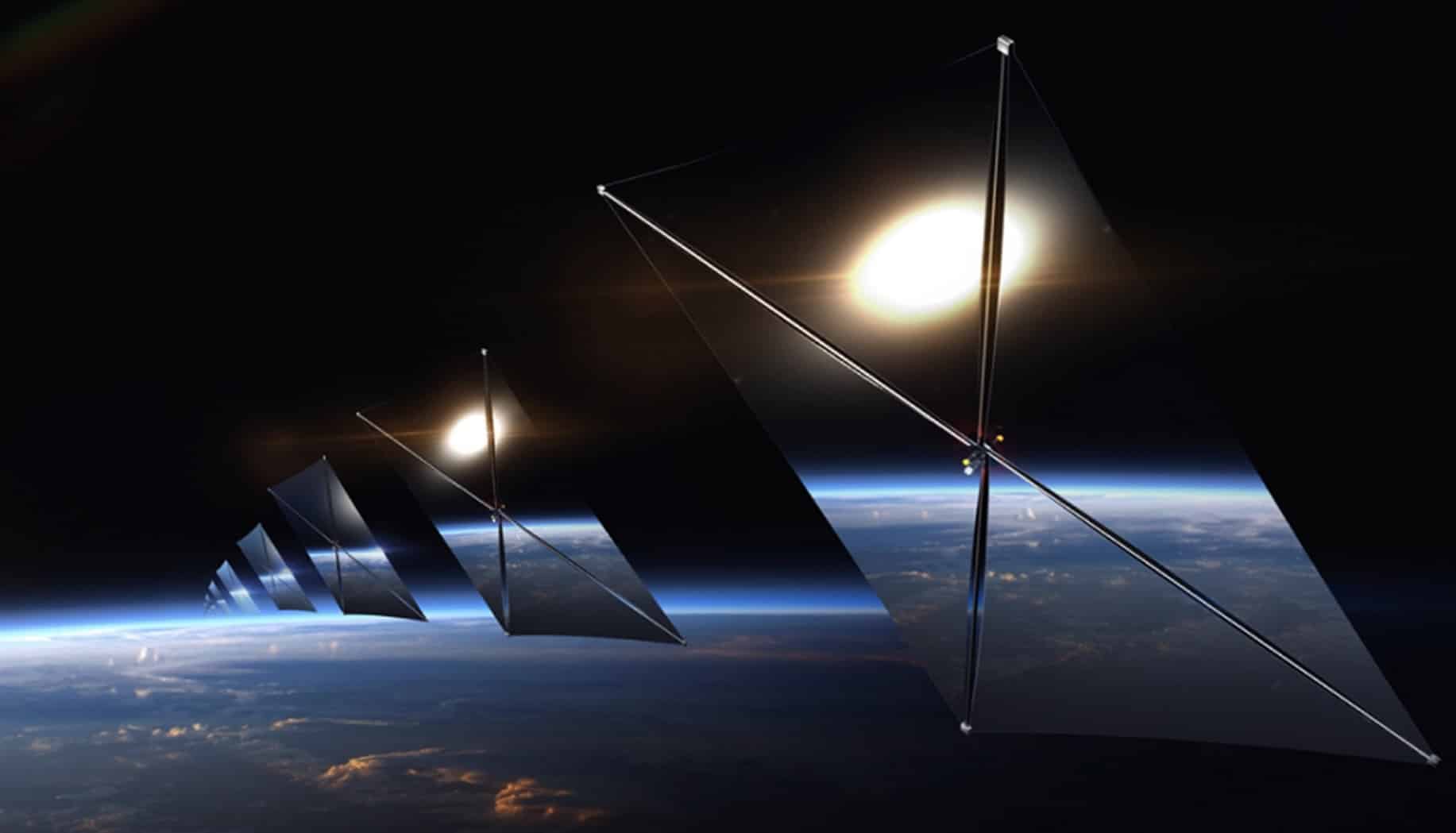
The audacious plan to light up the night
Picture a night sky streaked with artificial glows, as if the world refused to turn off. That’s the vision of a California start-up proposing to loft some 4,000 giant mirrors into orbit to redirect sunlight onto Earth’s darkened regions. The promise sounds seductive: extend evening light for farming, reduce streetlamp energy use, and squeeze more power from solar panels after dusk. Each reflector, roughly the size of a tennis court, would bathe a swath up to five kilometers wide with light up to four times brighter than a full moon.
Reflect Orbital, founded in 2021, has already applied to the U.S. FCC to launch an experimental satellite called EARENDIL‑1 as soon as early 2026. If approved, the company envisions scaling to a vast constellation by 2030. The scheme relies on sun‑synchronous orbits that track the Sun’s angle, allowing mirrors to steer glints onto predefined targets at predictable times.
Why scientists are sounding the alarm
A single mirror could create a bright, moving glare that registers as a major source of light pollution. Multiply that by the thousands, and the sky fills with streaks cutting across telescope fields, contaminating exposures and swamping faint signals. Astronomers already battle similar issues from mega-constellations, where even accidental reflections degrade images and waste precious observing time.
Concerns extend far beyond astronomy. Sudden flares could distract pilots on approach. Wildlife that depends on darkness—from migrating birds to nocturnal pollinators—might face disoriented rhythms and disrupted ecosystems. Reentry remains another risk: degraded hardware can shed debris and metals in the upper atmosphere, while on‑orbit collisions add to the mounting congestion circling the planet.
“A single California company, with a few million dollars and approval from one agency, could change the night sky for the entire planet. That’s terrifying.”
That stark warning captures a growing fear: our shared sky can be altered by private ventures faster than governments can adapt the rules.
Physics and feasibility hit reality checks
Steering thousands of precision reflectors is not a trivial engineering exercise. Maintaining orientation and timing under atmospheric drag, solar pressure, and space weather demands robust control and continuous calibration. Low Earth orbit is already crowded; each new satellite compounds collision probabilities and complicates space traffic management.
History adds humility. In the 1990s, Russia’s Znamya reflector experiments struggled with deployment and control, ultimately failing to deliver practical illumination. Even if the mirrors work as designed, the economics of reflected sunlight look shaky. Off‑angle, diffused beams are orders of magnitude weaker than midday sun, capping the real energy benefit while inflating costs per kilowatt‑hour compared with mature ground solar and wind.
Urban lighting is another sticking point. Cities need consistent, aimable illumination without drifting patches or surprise flares. Swapping predictable LED grids for roaming sky mirrors could introduce safety hazards rather than savings.
How responsible innovation could proceed
Ambition need not eclipse stewardship. If orbital illumination advances, it should be paired with firm, transparent guardrails that protect science, wildlife, and the public interest.
- Adopt strict, enforceable brightness and reflectivity limits, independently verified before large‑scale deployment.
- Mandate global environmental impact assessments, including sky‑brightness modeling and wildlife impacts.
- Cap constellation sizes and require on‑orbit deorbit plans with minimal atmospheric residue.
- Coordinate scheduling with observatories via shared ephemerides, avoiding key survey windows and targets.
- Fund mitigation—sensor filters, software to remove streaks, and dark‑sky protections—as a condition of licensing.
- Prioritize lower‑risk alternatives: grid storage, demand response, efficient LEDs, and smarter urban design.
The stakes for our shared night
Humanity’s view of the cosmos is both fragile and precious. Once the sky is saturated with moving glints, the loss to astronomy—and to simple human wonder—could be profound and effectively irreversible. Innovation thrives when it widens our choices without narrowing our horizons. Lighting Earth from orbit may solve a marginal problem while creating larger, enduring harms.
We still have time to choose a wiser path. That means rigorous testing, honest accounting of trade‑offs, and policy that treats darkness as a finite, shared resource. Safeguarding the quiet night is not resistance to progress; it is the condition that allows discovery—and imagination—to flourish.