
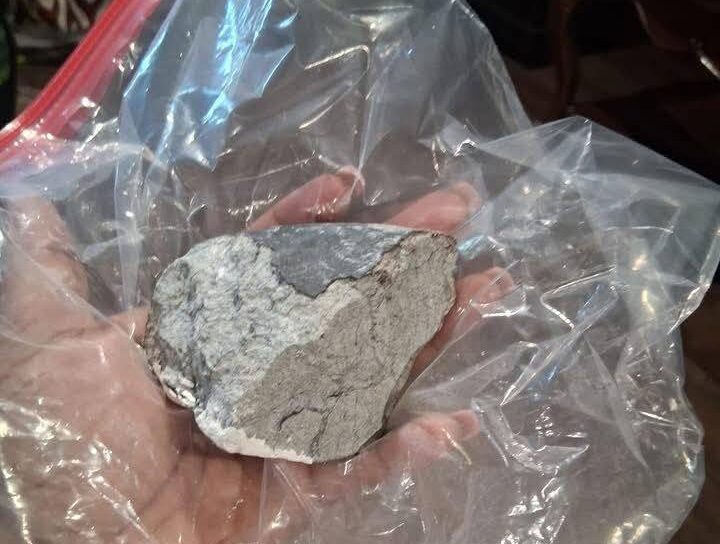
Meteor in Houston: a meteor crossed the sky over the Houston area Saturday afternoon and produced a thunderous bang heard in various parts of the region.
A meteor in Houston was the cause of the loud bang reported by several residents on Saturday afternoon, March 21. According to the analysis released by NASA, the object became visible around 4:40 p.m. at about 49 miles in altitude over Stagecoach, a community located northwest of the metropolitan area. From there it moved southeast before fragmenting over the northern part of the city.
NASA indicated that the space rock traveled at nearly 35,000 miles per hour and broke apart at about 29 miles altitude over Bammel, west of Cypress Station. The agency attributed the ground-noise to the pressure wave generated by that fragmentation. The federal analysis also describes the object as an asteroid-origin fragment, with a diameter of approximately 3 feet and a weight close to one ton.
The energy released during the breakup was estimated at 26 tons of TNT, according to official event data. NASA reconstructed the trajectory using eyewitness reports collected by the American Meteor Society and with detections from the Geostationary Lightning Mappers aboard the GOES satellites. The official event record was identified as 20260321-214010.
Radar located possible meteorite falls north of Houston
In addition to confirming the meteor’s passage, NASA noted that the Doppler radar showed meteorites falling between Willowbrook and Northgate Crossing. That strip lies within the northern and northwestern sector of the Houston urban area, and coincides with the final phase of the trajectory reconstructed by the agency. The data distinguishes between the meteor visible in the atmosphere and the fragments that managed to continue their descent after fragmentation.
Reports from the American Meteor Society also show that the phenomenon was seen from various points in Texas. The event record gathered more than a hundred observations, with testimonies from Houston and other cities in the state. In several of those reports, witnesses described an intense fireball, of short duration, visible shortly before five in the afternoon.
As of Sunday, there was no public balance from NASA on official recovery of fragments in the radar-indicated zone. The information available was limited to the trajectory, fragmentation altitude, energy released, and the probable location of meteorite falls.
A fragment impact on a home was also reported
Alongside the astronomical analysis, it was also reported that a possible meteorite pierced the roof of a house in the Houston area. The available information indicates that the object passed through part of the house’s structure and did not leave people injured. Emergency authorities who attended the scene linked the finding to the phenomenon observed that same afternoon over the region.
That report appeared after residents from different sectors of the metropolitan area mentioned hearing a sharp bang or a brief vibration under clear skies. The timeline matches the event time confirmed by NASA, around 4:40 p.m. on Saturday.
The meteor’s trajectory in Houston was short and ended over Bammel
NASA’s official map places the visible start of the event at coordinates northwest of Houston and the final breakup point over Bammel. The path was descending toward the southeast. The technical report places the altitude at 78.9 kilometers at the start and 46.7 kilometers at the end of the luminous arc, with a calculated speed of 15.6 kilometers per second.
The agency also thanked in its report the information provided by the American Meteor Society, which received the initial testimonies. Such records are usually key to quickly reconstructing the trajectory of bright objects seen from the ground, especially when they coincide with atmospheric detections and radar readings.
NASA indicated that the meteor in Houston was a bright fireball, the category used for especially bright fireballs. In this case, the crossing over the Houston area ended with fragmentation at altitude and with a probable zone of fragment fall to the north of the city.
