
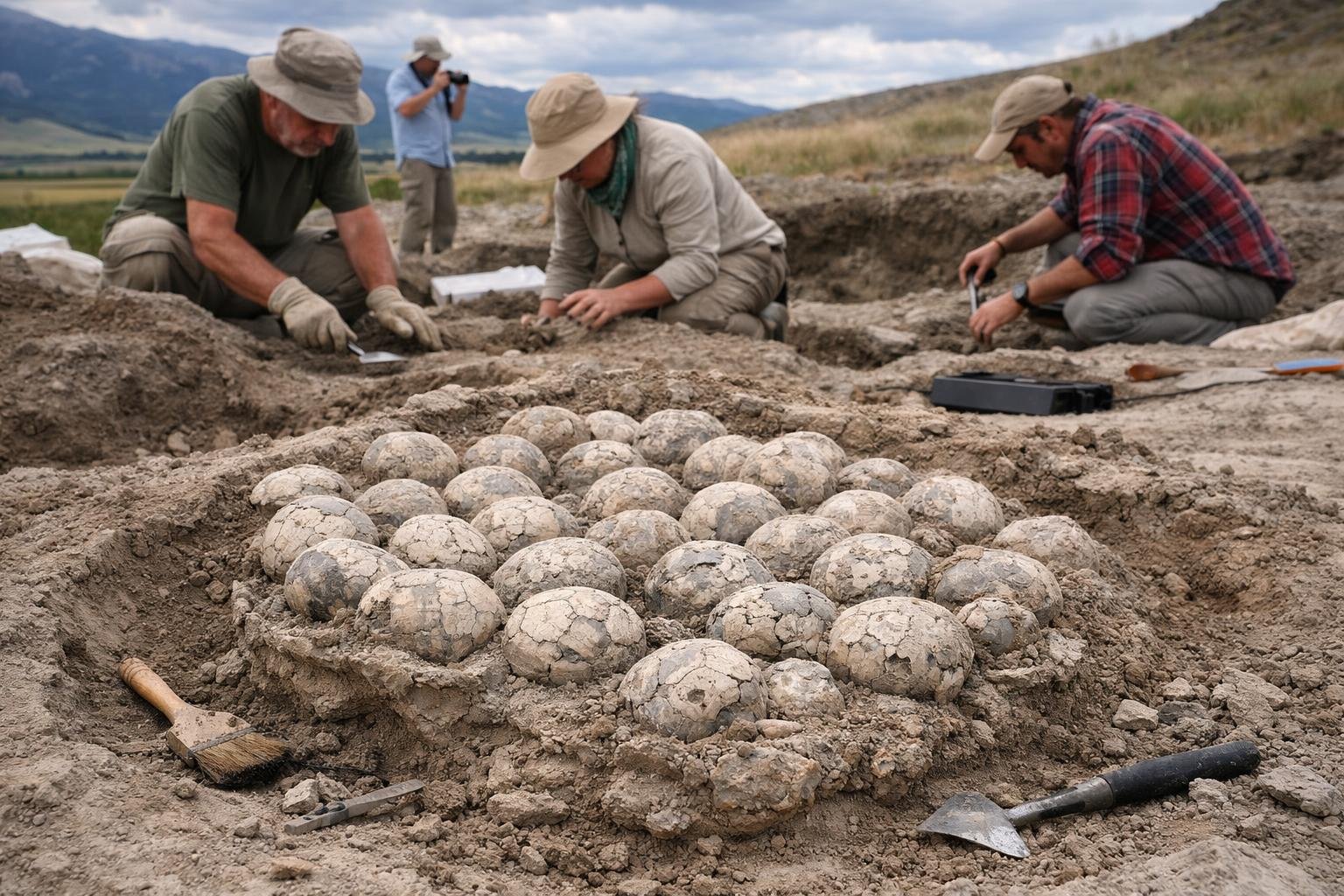
A sweep of wind over sagebrush and stone, a glint of curved texture in the dirt, and a weekend hike turned into a scientific headline. The quiet hills outside Bozeman hid a layered story, and a team of dedicated amateurs followed the clues. What they uncovered—carefully, methodically, and with growing awe—was a dense cluster of ancient eggs, their surfaces still faintly patterned with time.
A lucky find, then hard work
It began with a misstep on a crumbly slope and the familiar ping of rock against a rounded shell. “We didn’t rush; we just marked the spot and called for backup,” said group organizer Noah Ellison, who leads a local fossil club. The team, equipped with brushes, GPS tags, and a field journal, spent days expanding the perimeter, logging each fragment with pin-drop precision.
Word spread quickly through the community, drawing in trained volunteers with plaster jackets, consolidant, and respectful discipline. “You get one chance to do this right,” Ellison added, “and if you do it right, the site keeps talking.”
Reading the rocks like a diary
The nest layer lies in buff sandstone, capped by thin seams of clay and iron-tinged silt, a telltale signature of seasonal floodplains. At first glance, the eggs appear to be elongated and slightly asymmetrical, suggesting a small theropod or a mid-sized hadrosaur. Field notes point to consistent spacing and partial clustering, as if arranged in shallow scrapes and covered with plant matter.
Preliminary stratigraphy places the bed in the Late Cretaceous, roughly 75 million years old—an era of shifting rivers, lush conifers, and the steady drumbeat of herbivore and predator. “The sediment is whispering of a calm interval between floods,” said volunteer mapper Serena Cho, “the kind of pause that lets a nest stay just dry enough.”
What the eggs may reveal
If confirmed, this many eggs from a single horizon could map out behaviors from nest spacing to incubation strategy. Shell thickness and pore density—best measured with micro-CT and scanning electron microscopy—could hint at whether parents brooded the clutch or relied on warm vegetation. Embryonic bone, if present, might identify the species, and even expose growth rates through histological bands.
“Think of eggshell as a biological logbook,” noted field volunteer and biology teacher Ava Srinivasan. “Every ridge, pore, and curve is a sentence written by climate, chemistry, and instinct.” With more than 80 discrete specimens, researchers can compare intact shells, crushed mosaics, and sediments trapped between layers.
Why this cache matters
- A rare window into Late Cretaceous nesting behavior and parental care
- Geochemical data that ties climate patterns to reproductive timing
- A regional map of species distribution near the heart of Montana
- A proof-of-concept for rigorous, trained amateur science
The careful choreography of a dig
Extraction moves slowly—centimeters a day, not meters. Volunteers wick consolidant into delicate surfaces, wrap blocks in plaster, and log context with photos, tags, and sketches. Any piece that shifts gets a temporary splint, any crack a numbered note. The site is taped off and quietly monitored to deter collectors, and coordinates remain under wraps until cataloging is complete.
“Fieldwork is a contract with the future,” said Cho. “You leave more information than you take.”
Citizen science, properly done
This find didn’t happen by accident; it sprang from training sessions on land ethics, site triage, and basic sedimentology held by local educators and former field techs. The group’s code is simple: notify land managers, document before digging, and never remove a fossil without proper authorization. That discipline earned them a standing collaboration with regional researchers, who provide oversight and lab time.
“Amateurs bring eyes, stamina, and a stubborn curiosity,” Srinivasan said. “Pair that with protocols, and you get credible, publishable data.”
A quiet echo of ancient lives
Around the nest layer, the team recorded fossil wood, freshwater mollusks, and faint ripple marks—the soft punctuation of a once-breathing landscape. Traces of charcoal hint at periodic fires, which might have cleared ground for nests or reset the plant succession. A few meters downslope, a fragment of crocodylian armor winked from the matrix, a reminder that hatchlings had more than weather to worry about.
“It’s humbling,” Ellison murmured. “You can almost feel the heat of a Cretaceous sun on these eggs.”
What happens next
The plaster jackets will head to a regional prep lab, where vibration-free benches, micro-needles, and patient hands will do the slow, invisible work. Samples will undergo non-destructive scanning, isotopic assays for oxygen signatures, and comparative shell-microstructure studies. If embryonic material surfaces, it will be stabilized, imaged, and compared with existing collections.
Data will pass through peer review, travel to public talks, and, if landowners agree, return as an exhibit that teaches without sensationalizing. The aim is not a splashy relic, but a durable dataset that speaks to behavior, climate, and deep time.
A community stitched into the strata
On departure days, the hills look the same, yet altered by attention. Orange flags flicker like tiny prayers, and neatly backfilled trenches blend into soil and shadow. The team leaves with field logs, plastered blocks, and a sense that patient curiosity still changes the world—one measured brushstroke at a time.
“We didn’t set out to rewrite a chapter of prehistory,” Ellison said with a careful smile. “We just kept our eyes open, followed the evidence, and treated the past like a guest who deserved our very best manners.”