
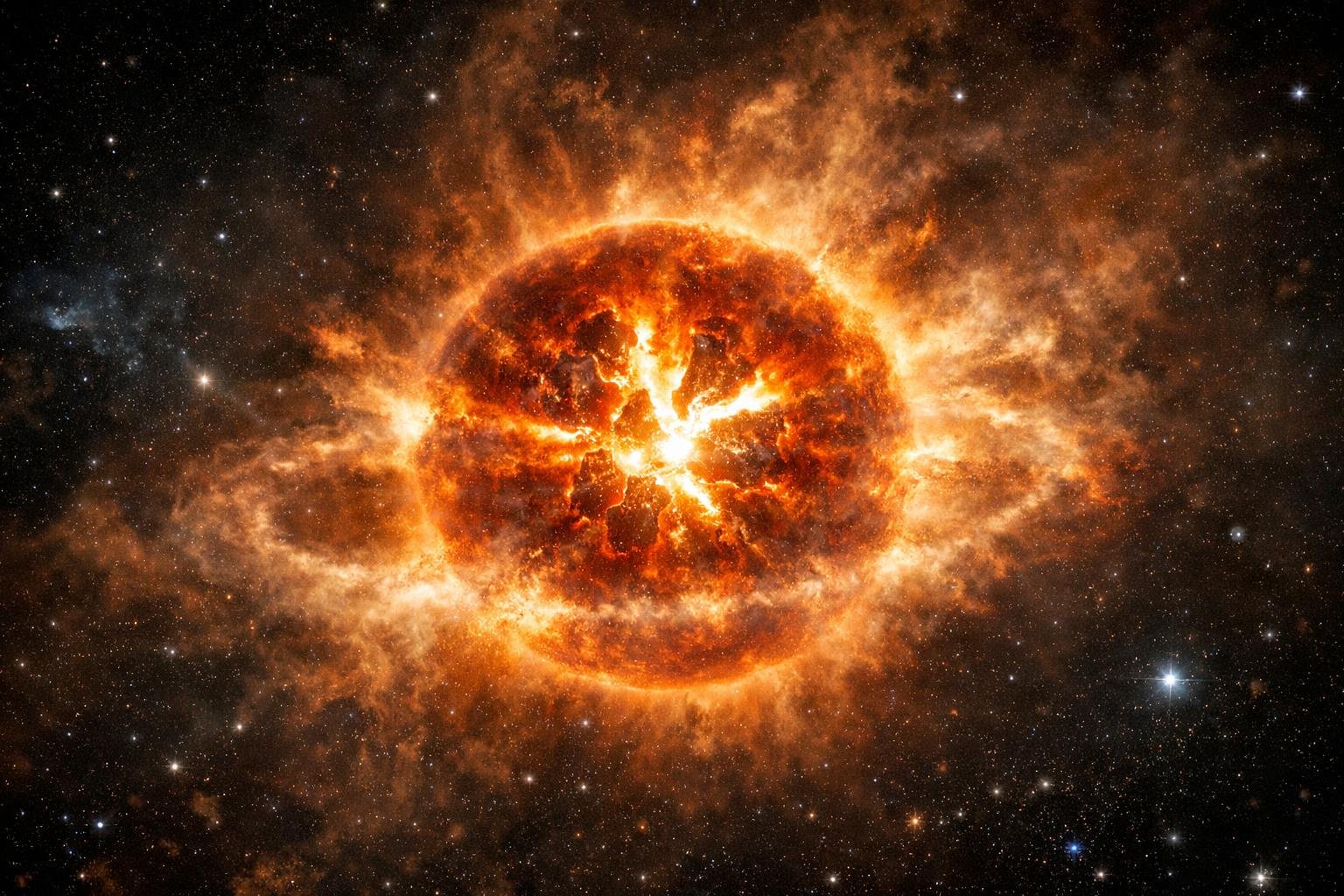
A distant, fading sun has sparked a jolt of curiosity: its inner layers appear to be arranged in a way that defies the equations astronomers rely on. In delicate ripples of light, the star is sending hints that its core may be stratified, twisted, or stifled by forces that our textbooks don’t fully capture.
For years, astronomers have read the faint pulses of evolved stars like seismologists reading earthquakes. This time, the patterns don’t line up. The data suggest a deep architecture that’s sharper, slower, and more complicated than expected.
The signal that wouldn’t behave
The star’s shimmering oscillations—pressure waves and gravity modes—carry fingerprints of its interior. In normal models of late-life stellar evolution, these fingerprints should blend smoothly as the core contracts and the envelope swells. Instead, the observed frequencies split, stall, and cluster in ways that point to barriers inside.
“Something is blocking the usual mixing,” one researcher noted. “It’s as if the star’s heart has erected a wall the models don’t include.” Those barriers could be sharp chemical gradients, a buried magnetic field, or layers rotating at radically different speeds.
Rotation that refuses to fade
Standard theory predicts a dying star should shed angular momentum, coupling its core to its bloated outer layers and slowing down the inside. Yet the oscillation patterns hint that the core remains stubbornly swift, while the envelope stays slothful. The result is a shear zone that looks too strong and too persistent.
If true, the star is telling us that internal friction mechanisms—magnetic torques, internal waves, or circulation—are weaker than we’ve assumed. That would force a rewrite of how red giants and supergiants redistribute spin as they age.
Chemistry in razor-thin layers
Models also expect gradual mixing, smoothing out composition gradients left by nuclear burning. But the data imply knife-edge transitions between helium-rich and hydrogen-rich zones. Such sharp interfaces act like mirrors for gravity waves, trapping energy and skewing the oscillation spectrum.
“Those layers look too crisp to be accidental,” another team member said. “Either mixing is suppressed, or new physics is tightening the boundaries.” A fossil magnetic field, perhaps inherited from the star’s youth, could pin layers in place.
Magnetism, waves, or something stranger?
Three prime suspects have emerged, each with unsettling implications:
- A buried, large-scale magnetic field that damps gravity modes, stiffens layers, and resists angular-momentum coupling
- Inefficient angular-momentum transport by internal gravity waves, letting the core spin ahead
- Exotic mixing regimes—like double-diffusive “semi-convection”—that create ultra-thin strata and trap energy
None of these ideas cleanly match all the clues, which is exactly what makes the case so compelling.
Why this matters beyond one star
A late-life star is a factory for the Universe’s heavy elements. If its innards move heat, chemistry, and angular momentum in unfamiliar ways, then our predictions for stellar lifetimes, supernova timing, and remnant spins could all be off. That cascades into the birth rates of neutron stars, the spins of black holes, and the chemical makeup of future planetary systems.
Even subtle changes in internal transport can shift when a star reaches critical instabilities, altering how it sheds mass and seeds the interstellar medium with carbon, oxygen, and slow-neutron-capture elements.
How the mystery was read in starlight
The team combined space-based photometry—pinpointing brightness wiggles—with ground-based spectroscopy that measured surface motions. Together, they reconstructed a rough portrait of the interior: a rapidly rotating core, sharp composition steps, and oscillations that appeared partly silenced by something hidden.
Crucially, certain gravity-mode doublets were missing or warped, a hallmark of magnetic interference or extreme structural sharpness. The pattern persisted across multiple epochs, arguing against a fleeting flare or instrumental quirk.
What would it take to explain it
Theorists now face a two-front challenge: build models with stronger magneto-rotational coupling and more realistic mixing physics, then verify them against a growing sample. That means simulating 3D turbulence, fossil-field evolution, and non-linear wave breaking—phenomena long treated as “effective” knobs rather than first-principles processes.
On the observational side, polarimetric measurements could reveal fields, while longer-baseline asteroseismology would map the mode forest in finer detail. If multiple dying stars show the same fingerprints, we’ll know this isn’t just a curious outlier.
A new map for the late stages of starlight
The broader message is humbling: nature keeps more ledgers than our equations. When a star nears its finale, it does not merely fade; it rearranges itself in ways that store and release energy with exquisite, layered intent. Listening to those layers—through light that quivers by parts per million—turns a quiet red giant into a loud teacher.
If this reading holds, textbooks will gain new chapters on buried magnetism, stealthy shear, and stratification as crisp as a fault line. The cosmos, ever the tinkerer, has just handed us a blueprint drawn in vibrations—and dared us to read it well.