
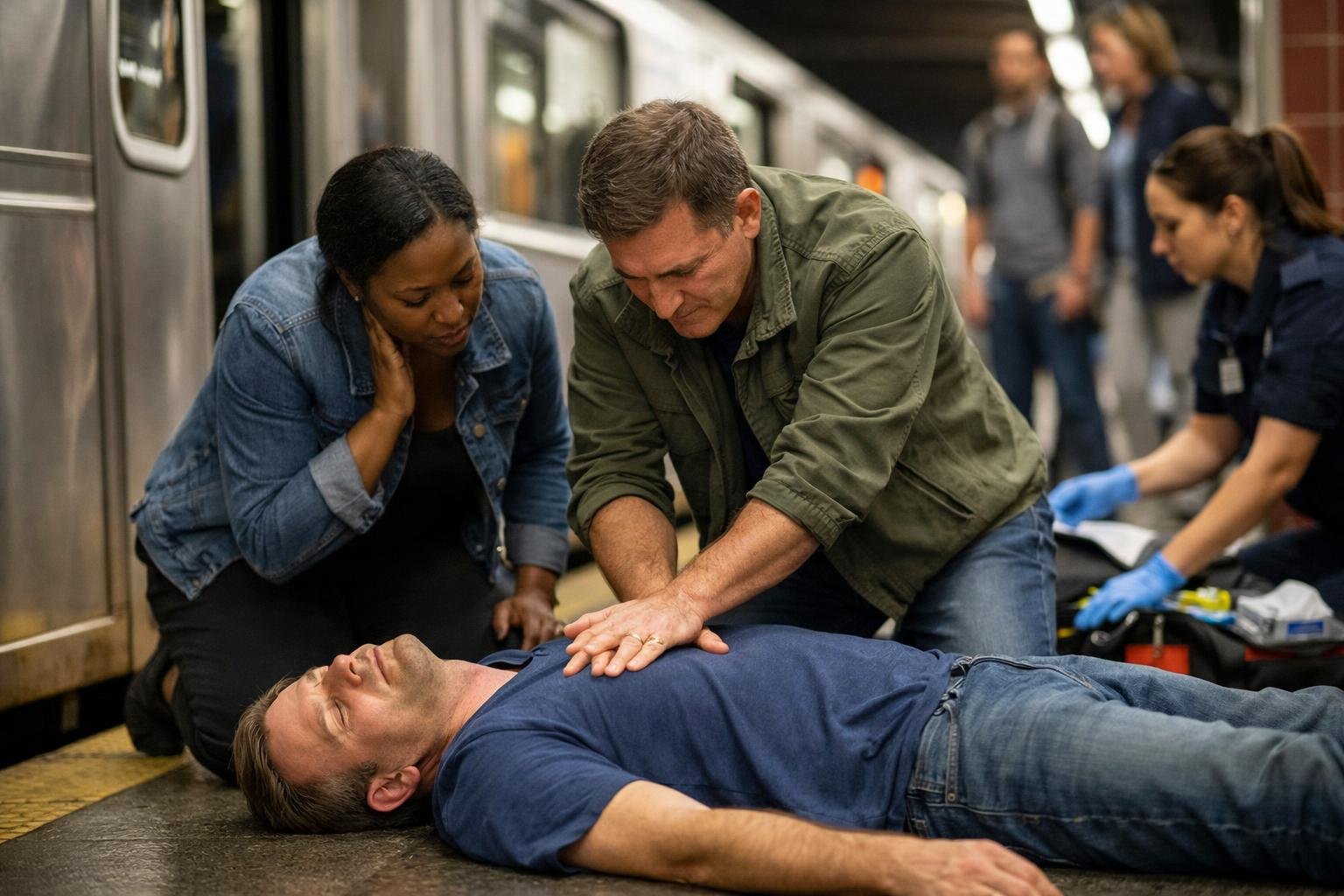
The morning train was packed, the kind of commute where strangers share elbows and silences, not stories. When he went down—mid-car, mid-sentence—the car lurched, and so did every set of eyes. For a split second, the city seemed to hold its breath. Then came the familiar swirl of panic: someone shouted for help, someone fumbled with a phone, someone stared at the floor.
“I thought he’d stand back up,” a fellow rider said later, voice thin with shock. “But he didn’t. And I realized I didn’t know what to do.”
The minute that matters
On a train, in a café, at home—the line between ordinary and emergency is perilously thin. When the heart stops, the clock starts, and it ticks with a cruel precision. Every minute without action erodes the odds; every minute with action can tilt them back.
What action? Not a complex hospital procedure. Not a rare medicine. Just two hands and a rhythm. “If someone had started compressions right away,” one transit worker whispered, “this story might read very differently.”
The skill that changes outcomes
Most of us carry a computer in our pocket, but not the confidence to use our hands when it counts. Cardiopulmonary resuscitation—CPR—sounds like a medical mystery until you watch it once, learn it twice, and practice it a third time. The essential version most bystanders can do is “hands-only” CPR: no mouth-to-mouth, just firm, fast compressions in the center of the chest.
Experts say that immediate bystander CPR can dramatically improve a person’s chance of survival. Not by magic; by buying the brain oxygen, by keeping the heart’s plumbing primed until professionals arrive. “It feels scary,” a paramedic told me, “but the worst thing is waiting.”
What to do in those first moments
Emergencies tangle the mind; a simple plan untangles it. If someone collapses and isn’t responding, and you can’t detect normal breathing, act. Call emergency services immediately or ask someone to do it while you start compressions. If an AED—an automated external defibrillator—is nearby, send a person to get it.
Here’s a compact, bystander-friendly guide to hands-only CPR:
- Place the heel of your hand on the center of the chest, put your other hand on top, lock your elbows, and press hard and fast—about two compressions per second—letting the chest rise each time. Keep going until help arrives or the person recovers.
That’s it. Not comfortable, not gentle—just essential. The AED, when it arrives, speaks in clear prompts. Open it, stick the pads where the pictures show, and let the machine analyze while you keep going.
Why we hesitate—and how to move anyway
We fear doing it wrong. We fear breaking a rib. We fear stepping into a role that feels too big for us. But standing still is a larger risk. “I thought I’d hurt him,” said one witness, “but the medic told me the only mistake is stopping.” The body can heal a cracked rib; it cannot heal minutes without oxygen.
There is something deeply civic about putting your hands to work for a stranger’s heartbeat. It’s a contract we rarely sign but always honor: I will help you breathe until your body remembers how to do it.
Making cities braver, not just smarter
Trains could carry more than ads for snacks and new shows. They could carry quick CPR infographics at eye level. Stations could map AEDs like they map exits—big arrows, bright icons, no guessing in a moment of panic. Workplaces can do quarterly refreshers with ten minutes of practice and one cheap manikin.
Most of all, we can choose to learn the most democratic medical intervention on Earth. In an hour, a community center can turn a roomful of neighbors into a low-tech, high-impact safety net. “You don’t need a white coat,” an instructor told me. “You need steady hands.”
What you can do before tomorrow’s commute
- Take a one-hour hands-only CPR class this week; many are free at community centers or fire stations.
- Find the nearest AEDs where you live, work, and ride; note them like you note the exit signs.
- Add ‘CPR’ and emergency numbers to your phone’s lockscreen; when seconds matter, fewer taps mean more time.
- Talk to your family or roommates tonight: “If someone drops, who calls, who compresses, who grabs the AED?”
We install apps to save time; we can install a skill to save a life. On another morning, another car, another city, someone will go silent. The air will feel thick, the seconds will get loud. If you are there, remember this: your hands are not empty. They are the oldest tools we have—and in that minute that matters, they are enough to keep a story going.
