
Rethinking the Quantum Chill
For decades, the supposed “price of admission” to quantum performance was extreme cold. The prevailing assumption said qubits only behave in orderly fashion near absolute zero, under intense magnetic control and pristine isolation. That requirement locked quantum devices inside complex cryostats, far from everyday electronics and mainstream manufacturing.
Now comes a strikingly different approach: a flexible, tunable conjugated polymer that preserves quantum coherence at room temperature. Instead of ions or superconducting circuits, this strategy leverages organic molecular design to stabilize quantum spins in ambient conditions. The result challenges the rigid “freezer first” mindset and hints at compact, printable quantum layers on conventional chips.
“Room-temperature quantum is no longer a distant dream; it’s a materials engineering problem we can iterate,” whispers the quiet confidence of a new discipline finding its footing in practical chemistry.
Why Cold Became the Rule
Qubits are exquisitely sensitive to environmental noise. Any stray vibration, photon, or thermal fluctuation can scramble fragile quantum states. Superconducting circuits dodge this sensitivity by operating at cryogenic temperatures, where thermal agitation is minimal. Trapped ions use vacuum isolation and precise fields to keep decoherence under strict control. Even diamond color centers, stars of room-temperature coherence, demand meticulous preparation and specialized environments.
That is why “extreme cold” felt inevitable—a necessary shield against decoherence’s relentless attack. A soft, printable polymer flips the script, confronting noise not by cooling, but by molecular design.
A Conjugated Polymer With Quantum Poise
The breakthrough arises from a donor–acceptor conjugated polymer engineered to shepherd unpaired-electron spins with calm precision. A donor unit based on dithienosilole partners with an acceptor derived from thiadiazoloquinoxaline to steer charge and spin along a controlled backbone. This molecular choreography tempers the jitter that dismantles quantum coherence.
A single silicon atom induces a subtle twist in the donor unit, preventing tight stacking that would drive destructive spin–spin interactions. Long alkyl side chains add steric bulk, promoting solubility while discouraging aggregation and parasitic coupling. The upshot is a processable, printable, high-spin polymer that retains measurable coherence at room temperature—no dilution refrigerator required.
From Lab Film to Working Device
Crucially, this material behaves as a p-type semiconductor, forming thin films compatible with standard fabrication. That means researchers can cast, print, or spin-coat quantum-active layers onto established device platforms. Co-located charge transport and spin coherence allows circuits that both compute and store quantum information in the same molecular lattice.
Imagine CMOS transistors cohabiting with quantum overlays, where classical signal paths intertwine with spin-based elements. This hybrid vision trades cryogenic plumbing for ink, reel-to-reel processing, and additive manufacturing.
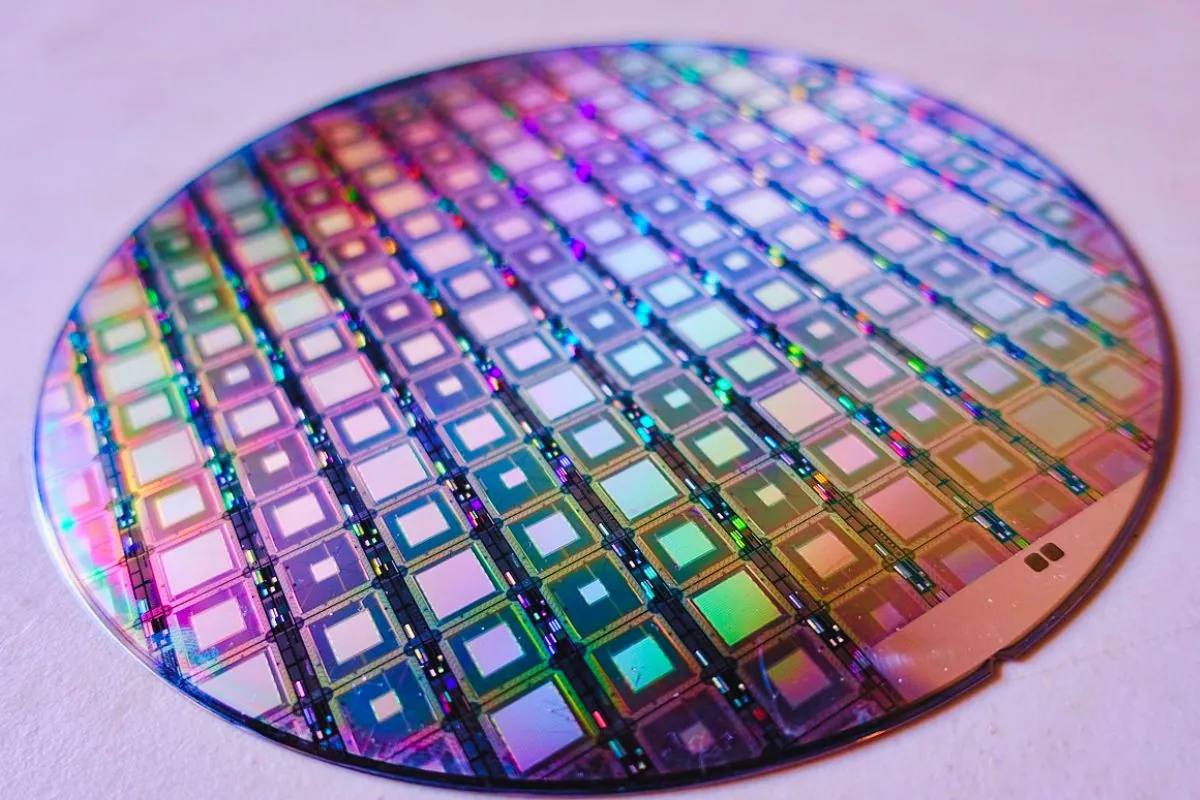
Image: Un zoom sur une plaquette de puces d’ordinateur quantique (D-Wave).
Promises, Caveats, and a Roadmap
The field should temper excitement with rigor. Today’s coherence times, while impressive for an organic polymer, remain short for error-corrected quantum computing. Still, they already hint at high-impact near-term uses: quantum-enhanced sensing, local quantum memory, and molecular-scale spintronic components.
Progress will likely come from iterative chemistry—tuning donor/acceptor pairs, backbone planarity, and side-chain sterics to balance charge mobility and spin isolation. Device architectures that gently funnel spins while suppressing decohering couplings will be equally decisive.
- Targeted applications: quantum sensors, room-temperature memories, and hybrid spintronic–CMOS interfaces
- Materials knobs: donor/acceptor chemistry, backbone twist, and side-chain engineering
- Device strategy: thin-film stacks, low-noise contacts, and resonant spin readout
- Metrics to watch: coherence time, spin polarization, and on-chip scalability
Industry Stakes and Market Momentum
Removing the cryogenic bottleneck could compress quantum hardware from refrigerator racks to board-level devices. That shift favors miniaturization, portable form-factors, and integration with existing semiconductor toolflows. It reframes quantum as a materials-and-manufacturing challenge, not a refrigeration feat.
Analysts already see multibillion-dollar opportunity across computing, communications, and advanced sensing. Estimates point to a market in the tens to low hundreds of billions of dollars over the coming decade, as quantum moves from lab curiosity to practical, layered functionality. When quantum elements are as printable as OLED stacks, deployment dynamics change—from bespoke cryostats to mass-produced modules.
The Quiet Revolution in Plain Sight
There’s a deeper lesson in this polymer’s ascent: quantum progress may come from clever chemistry as much as from heroic cryogenics. Each molecular knob—donor strength, acceptor alignment, torsional twist, and side-chain bulk—offers a lever to stabilize elusive quantum behavior. If this materials playbook holds, the next wave of quantum innovation may arrive not as colder refrigerators, but as better ink.
“Engineering coherence is about making the quantum state the easiest place to be,” goes the simple, resonant idea that seems to guide this new era.
