
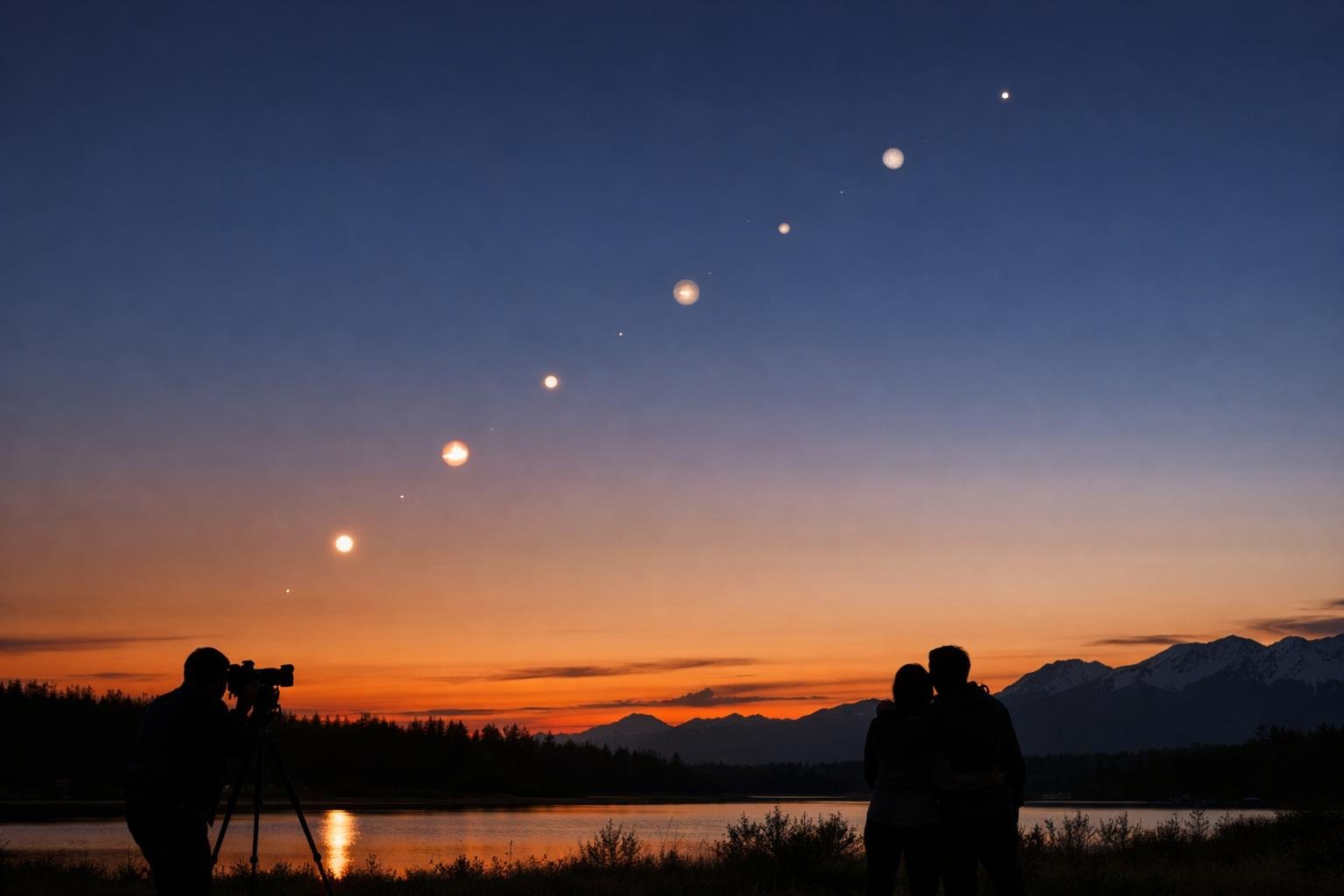
The evening sky is about to put on a rare show. For a brief window after sunset, several bright planets will gather along a gentle arc, easy to spot with patient eyes and clear weather. You won’t need a telescope—just a comfortable view, a bit of darkness, and a dash of curiosity. “Look up, breathe, and let the sky surprise you,” as one veteran stargazer likes to say.
What you’ll see
Expect a string of bright worlds—Venus, Mars, Jupiter, and Saturn—arranged along the ecliptic, the same broad band the Moon traces each month. Depending on haze near the horizon, Mercury may flicker low, a quicksilver point that sets early. The brightest beacon will be Venus, glowing like a steady lamp well before the fainter stars appear.
Each planet will hold its own color, a subtle but telling clue. Mars leans rusty, Jupiter more creamy, and Saturn a soft, buttery gold if seeing is steady. “Even a small change in tone can help your brain separate planets from nearby stars,” notes a planetarium astronomer.
When and where to look
Head outside about 30 to 60 minutes after sunset, when the glow is fading but the horizon is still defined. Face the western half of the sky, then trace a slow curve upward toward the south, following that planet-studded line. In darker locations, the view deepens for another hour before the lowest planets slip away.
Most of the country will get a solid look, weather permitting and light pollution aside. Farther north, the arc sits a bit lower, so find an unobstructed view with trees and buildings at your back. In high-latitude states, patience buys a better angle as twilight grows bluer.
Why this alignment happens
The planets orbit the Sun in nearly the same plane, so from Earth they seem to draw a line across the heavens. When several swing to the same side of the sky, we get a compact, photogenic arrangement. It isn’t a rigid string, but it feels astonishingly orderly—a reminder that celestial mechanics favors elegant rhythms.
These gatherings are not once-in-a-lifetime events, yet each has its own geometry, brightness, and timing. “Think of it as a cosmic choreography, with Earth in the front-row seat,” says a community educator who leads neighborhood star walks. Tonight’s pattern favors naked-eye viewing, which makes it especially welcoming.
How to spot each world
Start with the brightest anchor you can find—usually Venus—then step along the arc from west to south. Give your eyes ten minutes to adapt, and resist checking your phone unless you use a red filter. If you can’t be sure which point is Mars, let the color help; it’s subtle, but it is truly there.
A simple smartphone app can overlay planet names, though it’s not required. Trust slow looking, not frantic scanning. The planets don’t twinkle like stars, a handy tell when the air starts to shimmer.
Quick tips for the best view
- Find a dark, low horizon; arrive early to pick your spot, and wait for the glow to fade. Bring a light jacket, a comfy chair, and turn off bright screens. Use binoculars only after the Sun is fully down.
Photographing the moment
You can capture the scene with a phone on a steady surface or small tripod. Tap to lock focus, lower the exposure, and take several short frames rather than one noisy shot. A silhouette of trees or buildings adds pleasing scale without drowning the sky.
If you own basic binoculars, a quick sweep will reveal star clusters and sharpen Saturn’s golden disk. You won’t resolve the rings, but the planet’s steadiness feels distinctly planetary. Jupiter may hint at tiny moons, like a line of faint beads.
What to tell kids and first-time viewers
Keep it playful and simple: these are neighboring worlds orbiting the same Sun as we do. They look aligned from our vantage, not physically huddled in space. “It’s like watching distant lanterns along a curved path,” one teacher told an excited third grader tonight.
Invite questions about distance, color, and motion. Promise a return visit on another clear evening, because repetition deepens wonder. The sky rewards slow attention, and so do the people who share it with you.
If clouds roll in
Don’t despair if weather wins; alignments stretch across several nights, though not exactly the same way. Try again tomorrow, a little earlier or a little later, adjusting for your horizon. The sky keeps generous hours, and it loves second chances.
Tonight, let a quiet walk become an interplanetary errand. Stand still, look up, and join a nationwide moment powered by nothing but human eyes. The universe is busy—and it’s inviting you outside.
