
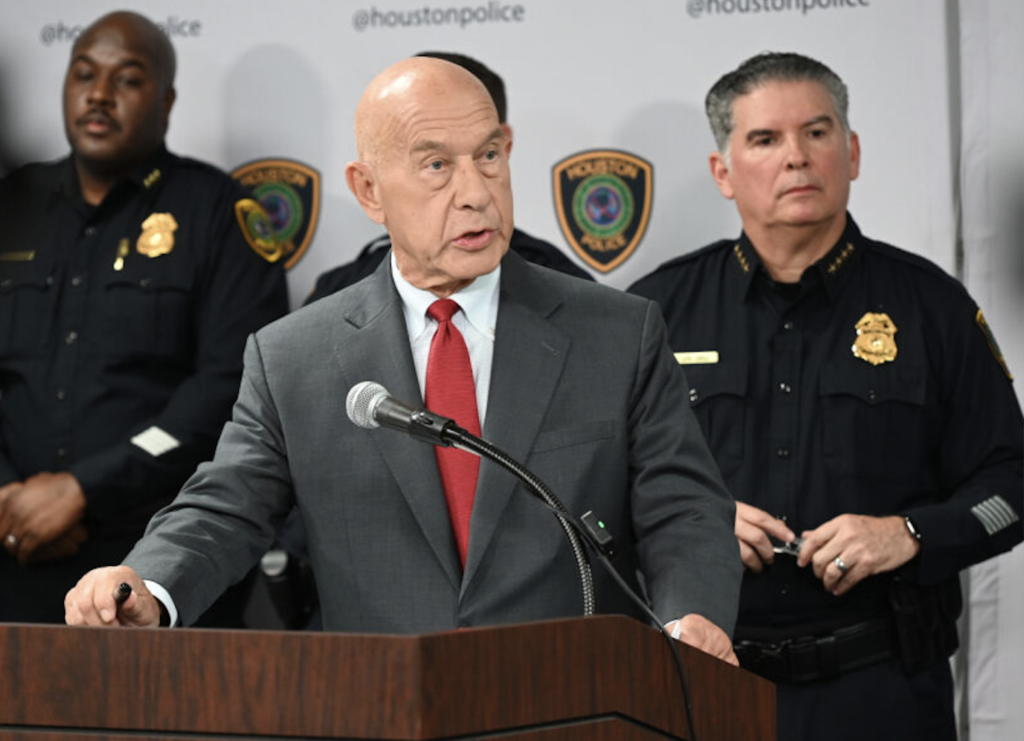
The Mayor of Houston Lost the Houston Police Officers’ Union Backing After Voting in Favor of an Ordinance Limiting HPD’s Coordination with ICE
Mayor John Whitmire lost one of his strongest political backings after voting in favor of an ordinance that limits the Houston Police Department’s coordination with U.S. Immigration and Customs Enforcement in cases tied to civil immigration orders. The Houston Police Officers’ Union announced that it would not back him for a second term and extended that decision to the council members who supported the measure.
The rupture came on the same day that the Houston City Council approved, 12–5, an ordinance prohibiting officers from stopping people or extending traffic stops solely on administrative immigration orders. The measure also requires periodic reports from the municipal administration about local cooperation with federal immigration authorities.
Until that vote, Whitmire had maintained a close political relationship with the police union, one of the most influential forces in Houston’s municipal elections. That alliance is now paused by a single decision, but on a topic that is particularly sensitive: the role of local police in the face of federal immigration enforcement.
The ICE Vote Triggered a Break with a Key Ally
The union made clear that the grievance goes beyond the ordinance itself and extends to the mayor’s political pivot. According to public information about the union’s reaction, its leaders expected Whitmire to stay aligned with the police stance that defended the policy announced in March, under which officers could wait up to 30 minutes for ICE to respond to a notice related to civil immigration orders.
The new ordinance eliminated that guidance. Whitmire voted in favor and defended the measure as a formalization of practices that, according to his administration, were already consistent with HPD’s operations. The union does not share that reading and considers that the change alters how officers respond to these cases.
The political distance matters because this is not a minor endorsement. In the 2023 mayoral contest, the police union backed Whitmire in a high-profile race. That endorsement was seen as a sign of strength in a city where municipal elections are often influenced by alliances among unions, business groups, and local leaders.
The closeness had been reinforced even more in 2025, when Whitmire and the union appeared together to announce an $832 million contract that raised officers’ salaries by more than 36% over five years. At that moment, the relationship looked like one of the strongest on the local political board.
The Conflict Mixes Immigration, Public Safety, and Electoral Calculus
The loss of the union’s backing does not occur in a vacuum. Over the past year, the city has faced a heated debate over the degree of cooperation between HPD and ICE, especially after data showing increased interaction between the two agencies in cases tied to administrative immigration orders became public.
The debate escalated as activist groups, community organizations, and some City Council members growingly criticized what they see as legal and public-trust risks when local police operate in scenarios that resemble federal immigration enforcement more than traditional public safety duties.
Whitmire found himself caught between two pressures. On one hand, his political career has long linked him to hardline crime policies and deep ties within police bodies. On the other, his administration faces a city where immigration is a politically explosive issue and where the use of police in civil immigration matters meets resistance in broad segments of the community.
Political analysts cited in the local public debate have noted that this episode opens space for attacks from both sides. From the right, the idea could take root that Whitmire has lost the police. From the left, it could be argued that his administration had already ceded too much to law enforcement before this vote. That crossroads places him in a more uncomfortable position ahead of 2027.
The Decision Also Reshapes the Map of Support for a Reelection
The loss of the police union’s backing comes after another round of political wear and tear. In December, the Harris County Democratic Party reprimanded Whitmire and withdrew future endorsements for political decisions that had already caused friction within his own party, including the handling of immigration-related issues.
That precedent matters because it paints a more complicated map for any reelection bid. Whitmire retains clear advantages, including his level of public recognition, the weight of the mayoralty, and a political brand built over decades. But the image of a mayor in tension with both Democratic factions and the police union changes the board.
The union also announced that it would withdraw endorsements from the eleven council members who voted in favor of the ordinance. That decision could influence future municipal careers, especially in districts where the support of police organizations weighs as a sign of order, institutional backing, and fundraising ability.
For now, the ordinance has been approved and the political cost began to move immediately. Whitmire chose to back a measure his office presented as compatible with HPD’s practice, but the outcome was the public loss of one of his most loyal allies. In Houston, where relationships among the mayor, police, unions, and the immigrant community rarely stay quiet for long, that rift can continue to produce consequences long after the vote.