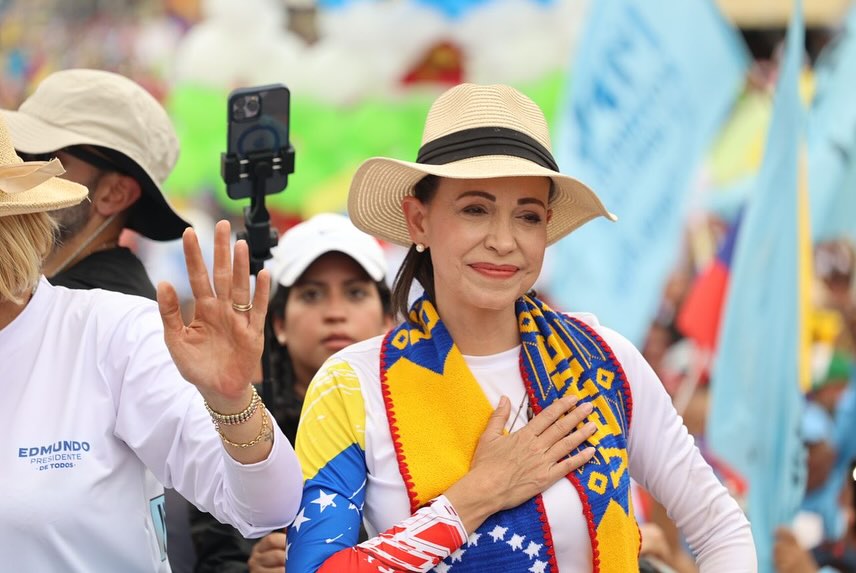
The Venezuelan opposition leader María Corina Machado will participate in CERAWeek 2026, the energy conference to be held in Houston from March 23 to 27. Her visit places the city at the center of a conversation that blends oil, geopolitics, and the possible role of locally present companies in a potential revival of the Venezuelan energy sector.
Houston will once again serve as the global showcase for the energy industry next week, but this time with a political element especially sensitive for the Latino community and for the city’s business ecosystem. María Corina Machado will not be just another international appearance at CERAWeek. Her presence arrives at a moment when the future of Venezuela, its oil, and the relationship with the United States are moving again.
Machado appears on CERAWeek’s public agenda as the leader of the Venezuelan democratic movement and as the Nobel Peace Prize winner for 2025. Although the exact time of her intervention has not yet been published, her inclusion confirms that Venezuela will be one of the topics that will cross the energy and geopolitics debates in Houston during the upcoming edition of the conference.
CERAWeek will turn Houston into a focal point for discussions about Venezuela
CERAWeek is one of the world’s most influential energy forums, and each year it brings together executives, officials, investors, and sector specialists. The 2026 edition will take place in Houston from March 23 to 27, with a clear focus on geopolitical competition, energy security, and the decisions that are redefining global investment.
In that setting, Machado’s presence adds a political layer that goes beyond the event’s technical agenda. Her visit comes as the Venezuelan situation again affects international energy decisions and as Washington opens new avenues for business activity in that country. That makes Houston a natural place for that conversation, not only because it hosts the conference but also due to its weight within the continent’s oil industry.
Venezuela’s oil weighs again in the energy conversation
After Nicolás Maduro’s capture by U.S. forces in January, Venezuela entered a new political phase led on an interim basis by Delcy Rodríguez. Since then, the U.S. government has moved several pieces to permit more economic activity linked to the Venezuelan energy sector.
The most recent step arrived on March 18, when the Treasury Department broadly authorized transactions with PDVSA, the Venezuelan state oil company. The measure aims to spur investment, raise production, and stabilize energy markets, although it maintains legal limits and conditions. It also extended Citgo’s temporary protection against creditors, a decision relevant to the region’s energy map and to interests tied to the Gulf Coast.
Venezuela still holds the world’s largest proven oil reserves, but its infrastructure bears years of deterioration, lack of investment, and operational problems. That combination makes the country, at the same time, a strategic opportunity and a high risk for any company considering entering or expanding there.
Companies with a presence in Houston view the opportunity with caution
The relationship between Houston and Venezuelan oil is not abstract. Large companies with a strong presence in the city, as well as service, trading, and refining firms linked to the Gulf energy corridor, closely watch any signal that foreshadows a lasting change in Venezuela. That is why Machado’s participation in the conference not only carries symbolic weight. It can also influence the tone of business conversations next week.
Even so, opening does not mean an immediate return. Recent industry information shows that several companies are still evaluating political risks, legal certainty, collection capacity, and the real size of the investment necessary to recover fields, refineries, and export networks. Interest exists, but caution as well.
That balance between opportunity and prudence will likely be one of the main axes observed at CERAWeek. If Houston is the city where many of the hemisphere’s energy decisions are made, the Venezuela conversation had to land here.