
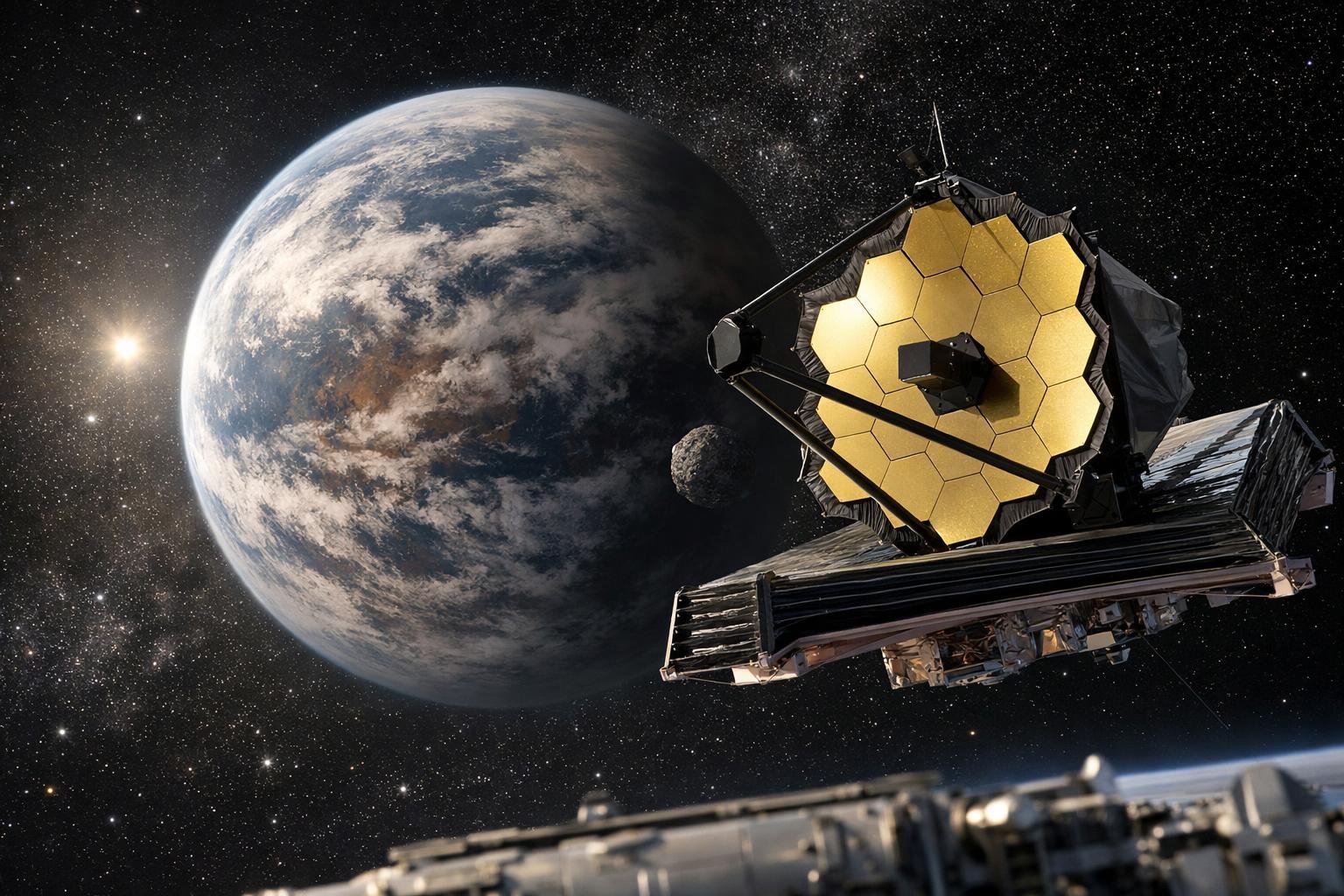
About 124 light-years away, a super-Earth called K2-18 b is turning into one of astronomy’s most compelling mysteries. Sitting in the temperate zone of a cool red dwarf, this world appears to carry a substantial atmosphere — thick enough to trap heat, scatter starlight, and leave chemical fingerprints. The James Webb Space Telescope is now prying into that envelope, searching for the subtle patterns that reveal what the air is actually made of.
A world between categories
K2-18 b doesn’t fit neatly into our Solar System’s playbook. With a radius about 2.6 times Earth’s and a mass around 8–9 Earths, it straddles the line between a super-Earth and a mini-Neptune. That size regime is tricky: too large to be a simple rocky planet, yet too small to be a gas giant.
It circles a small M-dwarf star every 33 days, receiving a level of starlight that could, in principle, allow liquid water under the right conditions. But “habitability” is a moving target. What matters is not just where the planet orbits, but what the atmosphere does with the incoming energy.
Researchers often describe K2-18 b as a “Hycean candidate” — a world with a hydrogen-rich atmosphere overlying a possible ocean. That label is still a hypothesis, not a verdict, but it captures the planet’s unique promise.
What Webb is measuring
When the planet crosses its star, a sliver of starlight filters through the atmosphere. Webb breaks that light into a spectrum, looking for wavelengths absorbed by specific molecules. Each compound leaves a distinct signature, like a barcode stamped into the haze.
Early Webb observations showed features consistent with methane (CH4) and carbon dioxide (CO2), and a lack of strong ammonia signals. That combination hints at a hydrogen-dominated atmosphere with carbon-bearing gases, potentially stable at moderate temperatures. A tentative murmur of dimethyl sulfide (DMS) has been floated in the literature, but the evidence is extremely preliminary — the sort of hint that demands more data and rigorous checks.
“Hydrogen-rich” does not automatically mean habitable. A thick H2 envelope can push pressures sky-high at the surface, transforming any ocean into a deep, dark, high-pressure realm. Still, methane and CO2 together are scientifically juicy, because they let models constrain the planet’s temperature, metallicity, and the overall depth of that atmosphere.
Could it be an ocean world?
The Hycean idea imagines a planet with a warm, hydrogen-draped sky above a water-rich interior. If the atmospheric pressure and temperature sit in the right window, the upper layers could be temperate while the deeper ocean becomes supercritical or stratified by exotic ices.
That is a narrow, precarious balance. Too much hydrogen and the greenhouse effect may overcook the ocean. Too little, and stellar flares from the M-dwarf could strip lighter gases, leaving a denser, steam-laden or even heavier atmosphere. Webb’s spectra help decide which scenario is plausible, by nailing down molecular ratios and cloud or haze content.
As one researcher phrased it in simple terms, we are “learning to read the weather of alien skies,” one transit at a time. The trick is disentangling overlapping signals, instrumental noise, and the restless variability of a cool, active star.
Why a dense atmosphere matters
A substantial atmosphere is a planet’s thermostat and its shield. It redistributes heat, softens temperature extremes, and guards the surface from high-energy radiation. On the flip side, a massive hydrogen layer can bury any rocky crust under crushing pressure, hiding geochemical cycles we associate with habitability.
For K2-18 b, the atmosphere’s bulk composition — hydrogen, methane, carbon dioxide, traces of water vapor — will set the stage for everything else. Clouds complicate the picture, flattening spectral features and making it harder to measure abundances precisely. But even flat spectra tell us something: that aerosols or high clouds are altering the path of light.
What comes next
Webb will keep collecting transits with multiple instruments, each sensitive to slightly different wavelengths. Better coverage refines the “barcode,” sharpens molecular detections, and cuts down on false positives. Ground-based observatories will track the host star’s activity, helping separate stellar noise from planetary signals.
Expect the story to evolve from “is there an atmosphere?” to “what is the atmosphere like?” and finally to “how does it change?” That progression will unfold across several cycles of observations, not overnight headlines or single-shot discoveries.
Key questions the community is pushing toward:
- What precise mix of hydrogen, methane, carbon dioxide, and water best fits the full Webb spectrum, and how do clouds or hazes reshape that view?
K2-18 b is reminding us that the universe loves in-betweens — worlds that are neither Earth nor Neptune, but something new. By peeling back their atmospheres, Webb is building the first atlas of climates beyond the Solar System. Whatever we find here will echo across dozens of similar planets, turning one enigmatic spectrum into a broader, testable theory of small, warm, hydrogen-rich worlds.
