
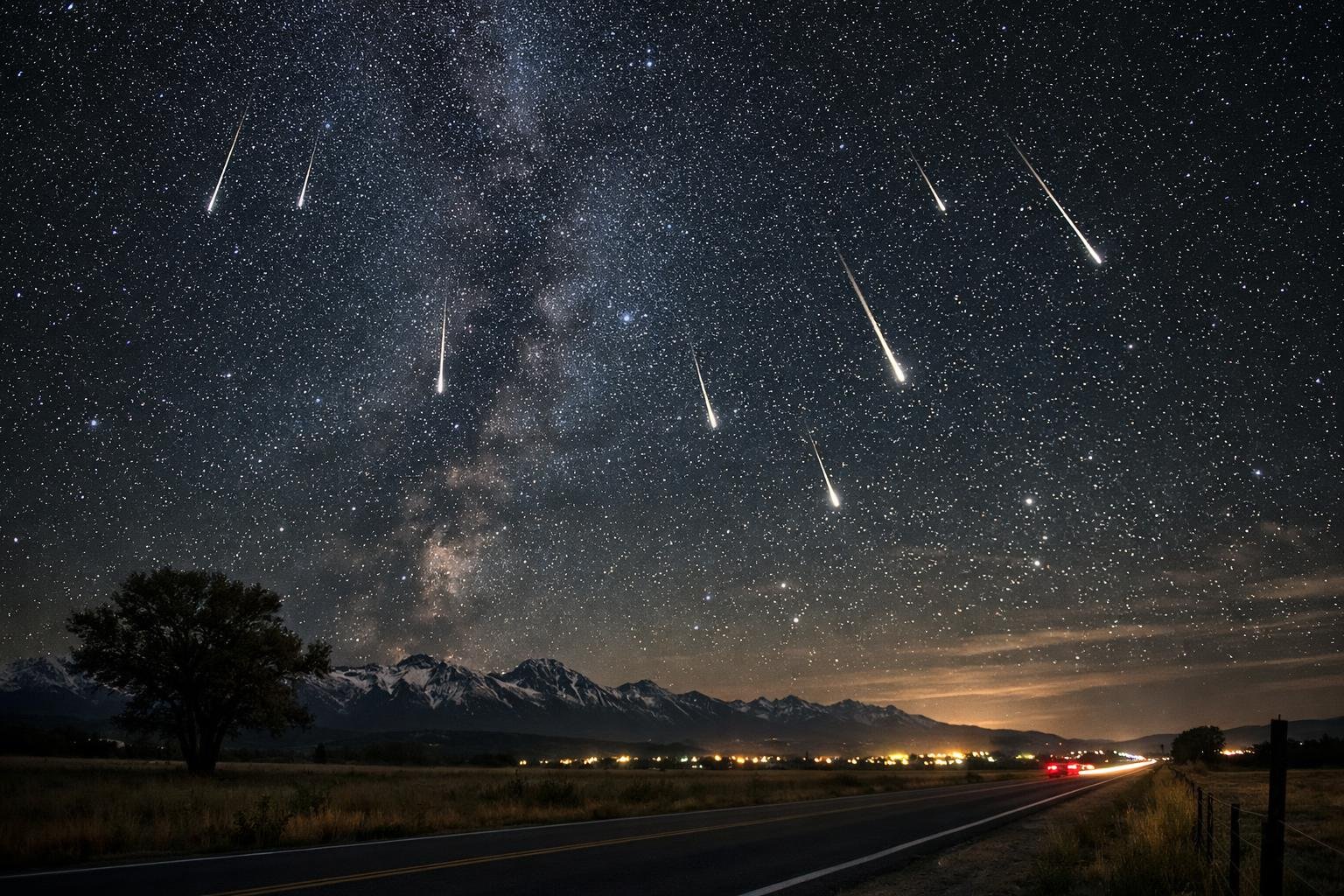
Every clear night holds a small promise, but tonight’s sky offers a rarer spectacle worth a late bedtime. The Camelopardalids favor patient observers, rewarding those who show up with open eyes and tempered expectations. As many stargazers like to say, “Patience is the price of admission.”
What you’re watching
This display comes from comet 209P/LINEAR, a dim traveler shedding dust that Earth occasionally intersects. These grains hit our atmosphere at relatively slow speeds, making the meteors softer, lingering, and sometimes subtle. Think “whispers of light” rather than a roaring storm.
In 2014, forecasters hinted at a breakout burst, but the sky delivered a quieter-than-hyped show. That unpredictability still applies: the Camelopardalids can flicker between modest and meager, yet they keep observers returning for that one surprise streak. As one old field note goes, “A shower’s best virtue is its power to humble.”
Best time to look tonight
The later the night, the better the odds. The radiant climbs higher after midnight, and the hours before dawn usually bring the most action. If the Moon is bright where you are, wait for moonset or use a building or tree to block its glare. If the Moon is out of the way, start after 12 a.m. and aim for the 2–4 a.m. window.
- East: 1–4 a.m. local, with a lean toward the 2–3 a.m. hour
Central: 12–3 a.m. local, centering on 1–2 a.m. sweet spot
Mountain: 12–3 a.m. local, best around 1–2 a.m. peak
Pacific/Alaska: 12–3 a.m. local, drifting into pre-dawn quiet
Where to watch across the U.S.
Northern states get the radiant a bit higher, but all of the contiguous U.S. can watch if the sky is clear. The radiant sits in Camelopardalis, the Giraffe, a faint northern constellation near Ursa Major and Draco, but you don’t need to pinpoint it with precision.
Pick a site with wide, dark horizons—state parks, rural pullouts, lake shores, or high-elevation vistas. Aim your gaze 45–70 degrees up toward the north and overhead, not directly at the radiant. Meteors can appear anywhere, so keep your view broad and let motion catch your eye.
How to prep for a better view
Let your eyes adapt for 20–30 minutes and avoid bright phone screens; a dim red filter helps. Bring a reclining chair, warm layers, a hat, and a thermos so you can stay still and watch comfortably. A gentle breeze can steal heat, so insulate from the ground with a pad or blanket.
Check a reliable cloud forecast and light-pollution maps to dodge city glow. If you can only steal 15 minutes, take them—meteors happen on their own clock. As the adage goes, “Look up, let your eyes adjust, and breathe.”
What you might see
Expect a modest sprinkle: perhaps a handful of meteors per hour, with the possibility of brief flurries or long quiet stretches. The shower’s slow entry speed can produce delicate, drifting trails and the occasional brighter streak. Don’t expect a firehose; expect a postcard—small, well-timed, and memorable.
If rates lag, stay relaxed. The beauty here is cumulative—silence, stars, and a sudden silver scratch across the dark. “The sky owes us nothing, and that’s what makes each line of light feel earned.”
Quick tips for casual astrophotography
Use a sturdy tripod and a wide lens (14–24 mm on full frame, or 10–18 mm on APS-C). Open up to f/2.8–f/4, set ISO 1600–3200, and expose for 10–20 seconds depending on your sky’s brightness and focal length. Fire continuous frames with an intervalometer, and aim 45 degrees from the radiant to capture longer trails.
Keep focus on a bright star using live view, then tape the focus ring. Shoot RAW for cleaner edits, and shield the lens from dew with a hood or gentle warmth. Even one clean meteor can make the whole session feel golden.
Safety and simple etiquette
Choose legal, accessible spots, park safely, and respect local quiet hours. Use low red lights, pack out what you bring, and keep your group’s light discipline tight so neighbors can preserve dark vision. If you meet other watchers, a whispered “Clear skies” goes a long way.
Final sky check
Before you head out, verify your local forecast, moonrise or moonset times, and the darkest direction from your spot. The show rewards those who simply show up. Bring a friend, make a plan, and give the sky a little time—because every meteor is a brief, burning yes against the dark.
