
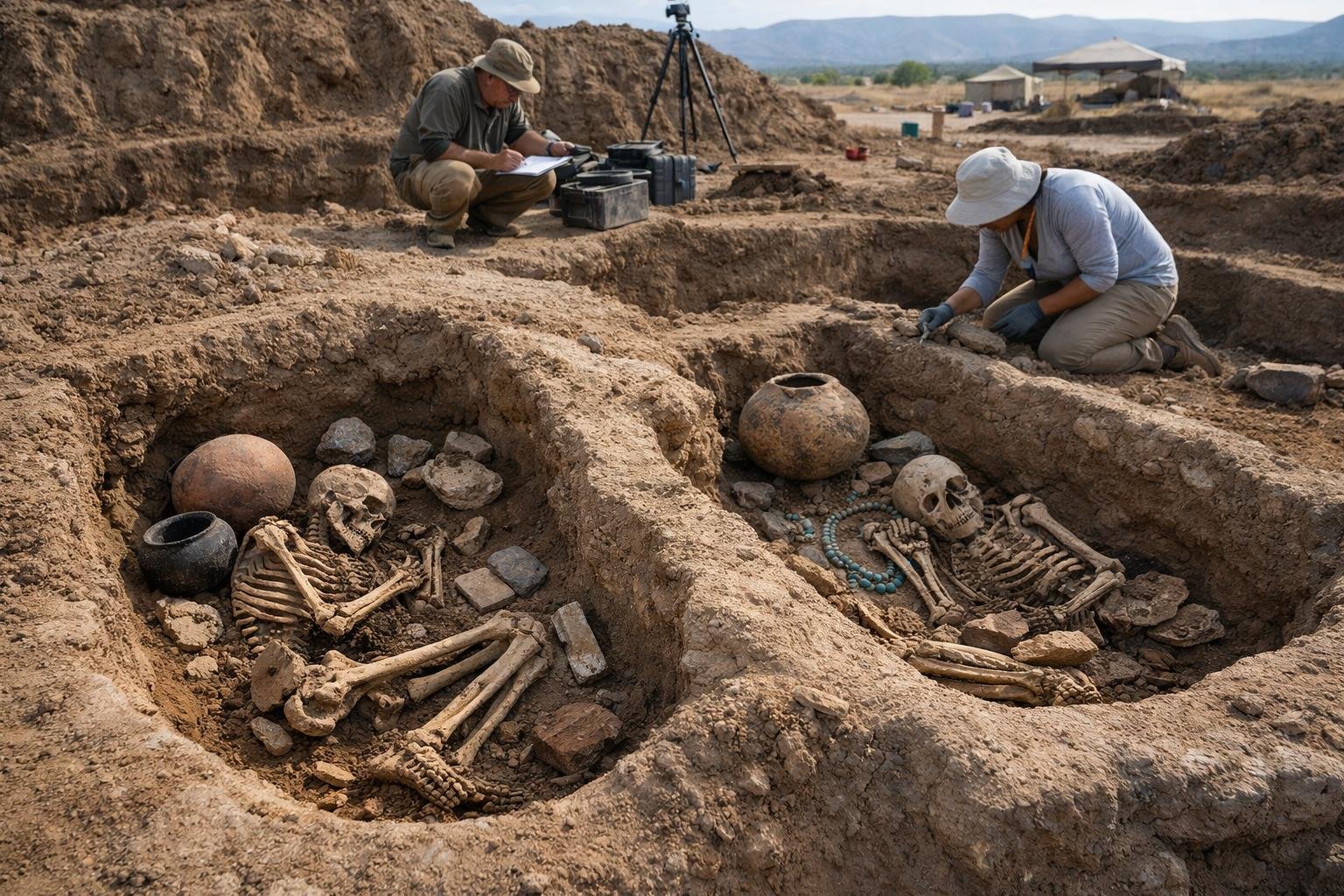
They were supposed to be simple, almost invisible in the archaeological record—modest resting places from a distant time. Yet these 4,200-year-old burials in New Mexico are anything but quiet, and their details are forcing researchers to rethink ritual itself. Unearthed along a terrace overlooking a dry wash, the graves look deliberate, layered, and deeply social. “We can’t keep telling the old story,” a field note reads, “because the earth is telling another one.”
What was placed with the dead
Carefully built, stone-lined chambers hold more than bones. They hold choices—what to take across a threshold and what to leave behind. Early analyses, if they hold, suggest a curated array of objects that cut across the old categories of “humble forager” and “stratified farmer.”
- Worked shell ornaments, likely exchanged over long distances
- Obsidian flakes and finished tools in multiple colors
- Ochre-stained baskets, their impressions preserved in sediment
- Atlatl weights, beads, and shaped bone pins
- Plant bundles with traces of aromatic resins
Each item reads like a sentence, and together they form a language of care, memory, and travel. Instead of a sparse toolkit tucked into a shallow pit, we see curated deposits and repeated visits—signs that the living returned to these places to add, remove, and reframe the story of their dead.
Timelines, disturbed—in a good way
The burials appear to date to the Late Archaic—before pottery, before villages as we commonly imagine them. That alone is striking, because elaborate interments are usually tied to later, agricultural societies. Here, the architecture of death arrives early: nested chambers, stone collars, and carefully sealed caps. Charcoal lenses hint at episodic burning—not catastrophic, but ceremonial—as if each reopening marked a rite of remembering.
There are hints, too, of early crops edging into the picture. Pollen and microbotanical residues may point to the first teasing presence of maize, not as a staple yet, but as a ritual guest. If confirmed, these data tangle timelines that once felt linear, replacing them with braided histories of exchange, experiment, and belief.
People, not caricatures
Perhaps most disruptive is who is buried with what. Infants and elders appear side by side, and grave goods do not line up neatly with expected gendered roles. One small interment includes a fine projectile point paired with textile fragments; another, a robust adult, carries adornments typically framed as “domestic” in older literature. The message is plain: status, identity, and care were mapped along axes we have not yet fully grasped.
“We keep trying to file the past into tidy drawers,” a researcher reflected, “but the drawers are the wrong shape.” In these graves, personhood seems distributed—across tools, pigments, scents, and the shared labor of building and reopening a place of the ancestors.
A landscape of connections
The materials whisper of movement. Obsidian can be sourced; shell can be traced; ochre carries a signature. Even within a modest radius, such diversity implies relationships radiating out like spokes. Rather than isolated bands, we may be looking at seasonal gatherings where stories, spouses, and ceremonies were exchanged.
These tombs act like anchors in that moving world—fixed points where a group could reassemble itself, stitch fragments of memory, and reaffirm obligations that stretched beyond the horizon. The dead, in this telling, are not an ending but a pivot—a way to make an ever-shifting life feel coherent, accountable, and shared.
The science tightening the picture
Nothing here rides on spectacle alone. The next months will be about slow work. Radiocarbon dates will bracket events; isotopes will hint at diet and mobility; microCT scans will map bones without disturbance; proteomics may fish proteins from residues that look like dust. Sourcing studies will compare obsidian chemistry to known flows, while lipid analysis tests whether plant bundles carried food, medicine, or something closer to spell.
If the patterns hold—repeated reopening, curated offerings, cross-cutting identities—it will be hard to keep calling Archaic burials “simple” with a straight face.
Why this shifts the ground under our feet
Archaeology often moves in increments: another date, another shard, another caution. But once in a while, a site rearranges the furniture in our heads. These New Mexico tombs complicate old binaries—mobile versus settled, everyday versus ceremonial, egalitarian versus stratified—and invite us to read the in-between as the main text.
They suggest that memory was not a side project, but the hinge of social life; that exchange was not only economic, but ritual; that continuity did not require villages, only places to return and rebind. Most of all, they remind us that the deep past was peopled by minds as subtle, contradictory, and inventive as our own.
“Ritual isn’t an add-on,” one excavator remarked. “It’s the operating system.” Standing over stone-lined chambers four millennia old, it’s hard to argue with the evidence—and harder still to look at the landscape without imagining the gatherings, the fires, the murmured promises that kept a moving world together.