
The Museum of Fine Arts, Houston (MFAH) commemorates the 250th anniversary of the founding of the United States with a selection of more than 70 works of art that reflect the American experience across the campus and the collections, spanning from antiquities to modern and contemporary art from around the world.
Beginning July 1, 2026, visitors to MFAH’s main campus and its two decorative arts houses, Rienzi and Bayou Bend Collection and Gardens, will be able to trace their own tour, both indoors and outdoors, guided toward the artworks and accompanied by new audio guides and informative panels that analyze each piece from this historical and cultural perspective.
These stories span MFAH’s encyclopedic collections: in the early 20th century, Houston philanthropist Annette Finnigan donated a set of antiquities to the museum; in the context of the national anniversary, the vases, ornaments and oil lamps that Finnigan collected in Corinth and other places connect this Texas suffragist with the early democracies of ancient Greece.
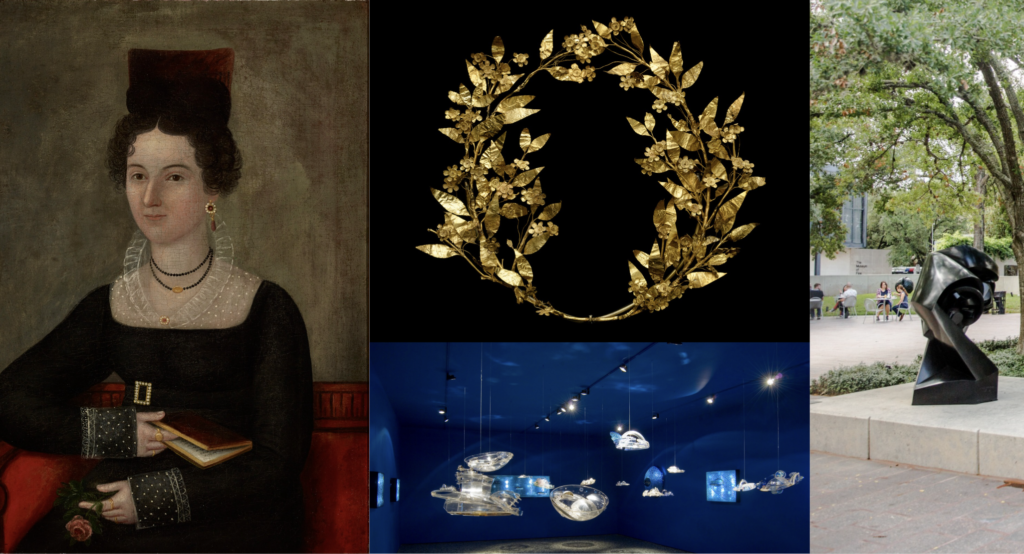
A painting from the early 19th century, by the Baltimore-born artist Joshua Johnson, and displayed in the American Art galleries, constitutes a new acquisition: it is an elegant female portrait by one of the earliest Black painters whose career as a portraitist is on record.
The piece “Lady on a Red Sofa” by Joshua Johnson, painted between 1820 and 1825, is from the MFAH collection and is on display for the celebration. Photo courtesy MFAH

A Greek crown is part of the MFAH collection, its origins go back centuries and it is a true treasure. Photo courtesy MFAH

“Hydrospatial City” by Gyula Kosice is also considered one of the pieces to celebrate the country’s independence. Photo courtesy MFAH

On the museum’s exterior, visitors can visit the Cullen Sculpture Garden. Photo courtesy MFAH
“Hydrospatial City” is a utopian vision of life beyond Earth created by Gyula Kosice, an Argentine artist of Czechoslovak origin. Kosice developed this installation of room-sized proportions over three decades, from 1946 to 1972.
In 1982, while American space exploration continued, Kosice presented the work to NASA engineers in Houston, underscoring his belief in the capacity of art to imagine and shape future alternatives for humanity.
Isamu Noguchi designed the museum’s sculpture garden, inaugurated in 1986. This space, which houses modernist sculptures by artists such as Auguste Rodin, Joan Miró, Henri Matisse and many others, pays homage to the legacy of the Japanese-American sculptor.
His own experiences with discrimination gave him a profound sense of solidarity toward Japanese Americans interned during World War II, prompting him to voluntarily enter an internment camp; he later stated: “I deliberately became part of a rootless humanity.”
Gary Tinterow, director and holder of the Margaret Alkek Williams Chair at MFAH, comments: “On the occasion of the nation’s 250th anniversary, we saw a unique opportunity to examine our collections and select objects that reflect the diversity of people who have contributed to the identity of our country.”
More information at www.mfah.org.
Details
What: Commemoration of the United States’ 250th anniversary.
Where: The Museum of Fine Arts, Houston (MFAH)
More information: www.mfah.org.
