
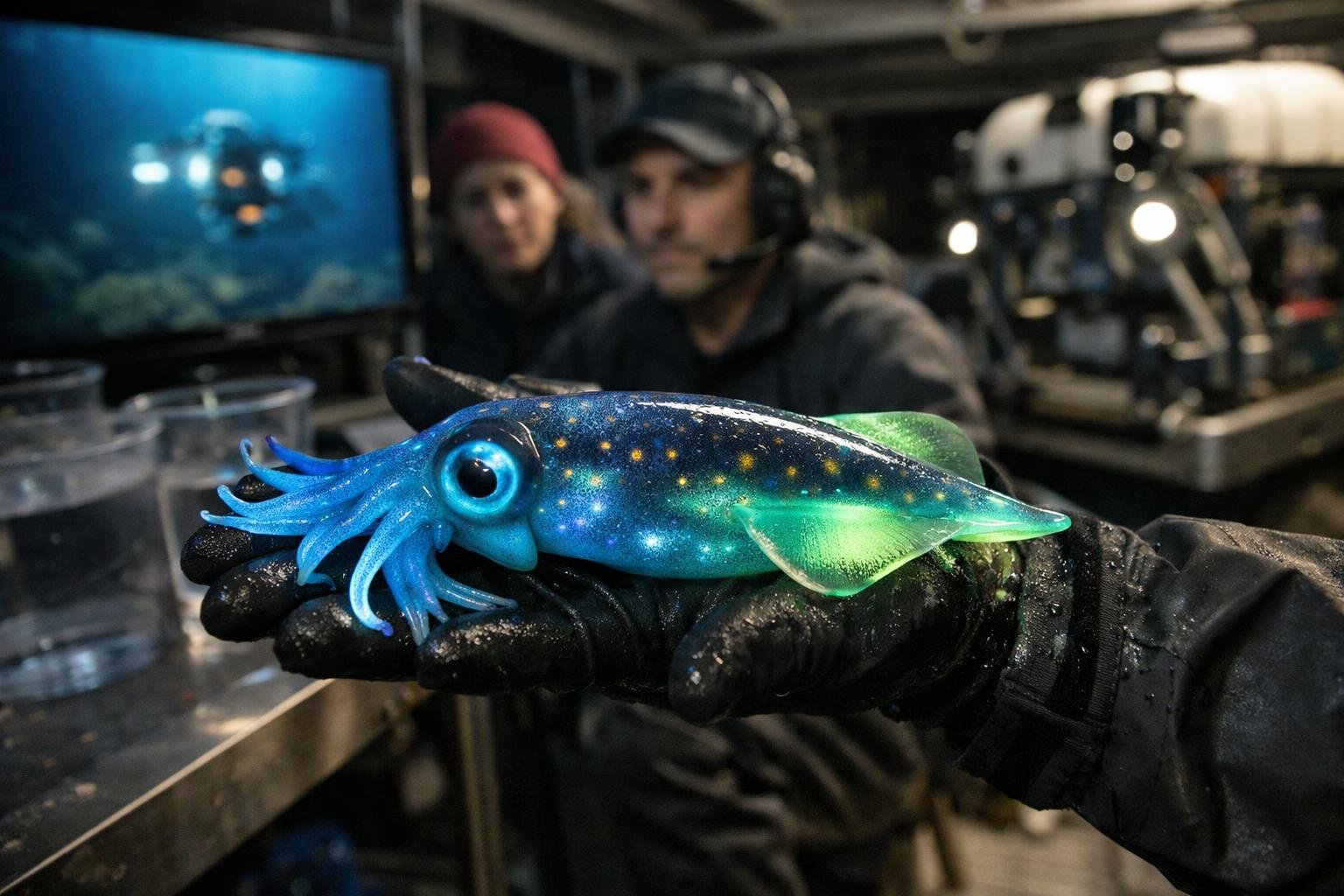
The deep Pacific just got stranger, and marine science feels electrified. A team trawling near a mid-ocean ridge returned with a glimmering cephalopod that shouldn’t exist—not in that place, not at that depth, not with those traits of light and shape. The find has sent ripples through the research community, raising urgent questions about evolution, ecology, and the limits of what we think we know.
A glow where none was expected
The squid emerged from a haul at nearly four kilometers down, where sunlight never reaches and most bodies are built for economy, not display. Its bioluminescence is subtle yet deliberate—pulses of blue-green flares playing across filigreed skin like coded breath. “It’s like a lighthouse trying to be polite,” said Dr. Maya Lopez, a deep-sea ecologist on the expedition. “Every blink feels intentional, as if it’s saying just enough to be heard.”
What unsettles biologists is the squid’s mosaic of features: photophores arranged along unusual axes, chromatophores that seem to modulate the glow in real time, and a mantle that shimmers with faint, diffuse halos. “We keep checking for malfunctions in our cameras,” joked Dr. Theo Raines, “but the animal keeps answering back with light we can actually map.”
Anatomy of a phantom
The newcomer is slender, with elongated fins that sweep like banners and arms patterned with minute organs of light. Under low stress, it flickers at the mantle’s edge; under disturbance, waves of illumination race along the arms as if relaying an alarm. The beak is fine, the eyes are huge, and an odd crescent of photophores sits beneath each eyelid, a placement rarely seen in known lineages.
Genetic barcoding returned a surprise: familiar cephalopod markers, yes, but a branch so distinct that databases shrugged in silence. “It sits near families we recognize, then takes a detour,” said Raines. “Imagine walking a well-known trail, only to find it ends at a door you didn’t know was there.”
Light as language
At hadal depths, light is currency, not ornament. The squid’s synchronized pulses hint at communication, camouflage, and predator confusion rolled into one grammar. Researchers suspect counter-illumination—matching the faint ambient glow to erase its own shadow—but the patterns look too intricate for a single job.
- Possible functions include coordinated feeding, species-specific signaling, mate recognition, or decoy flashes to mislead predators.
“Bioluminescence is a sentence,” said Lopez. “We’re trying to learn the alphabet while the speaker keeps whispering.”
How the team caught the light
Documenting this performance required inventive tools: ultra-low-light cameras, red-spectrum illumination to avoid startling the animal, and pressure-stable containers that keep tissues from collapsing on ascent. Even then, the footage looked ghosted until software stacked frames and teased out rhythms hidden in the dark noise.
A remotely operated vehicle trailed silently, allowing long observations without the confounding churn of props. “The first time we saw the sequence, we all just stopped,” said the vehicle’s pilot, Hana Keller. “It was orderly and a little playful, like someone tapping a code against the hull of the world.”
What the anomaly could mean
If the squid represents a genuine lineage, it challenges assumptions about deep-sea uniformity. We’ve long sketched this realm as monochrome, its life sculpted by scarcity and stasis. Yet here is a body investing in costly light, choreographed with a precision that implies culture of habitat and interaction.
The find could redraw food webs, suggesting previously hidden encounters between light-sensitive predators and prey. It might even guide bio-inspired engineering—soft robotics tuned to silent signaling, energy-efficient illumination, or materials that diffuse light like living skin. “Evolution keeps inventing, even in the dark,” said Lopez. “We should expect novelty, not treat it as an error.”
Why skepticism is part of the thrill
Not everyone is ready to declare a new species. Some caution it could be an unusual morph of a known taxon, altered by diet, environment, or developmental timing. Others point to the deep sea’s habit of producing lookalike forms with different histories. Healthy doubt is the discipline’s metronome.
Still, the morphological matrix and genetic signals are pointing in the same direction. “I don’t gamble,” said Raines, “but I’d put a modest chip on this being truly new.”
What comes next
The team plans targeted surveys along adjacent ridge systems, deploying baited landers and time-lapse arrays to map distribution and behavior. Tissue samples will undergo transcriptomic analysis to link gene expression with light production, while modeling will explore how the pulses propagate in complex currents.
Public engagement is already underway. A curated set of clips—dim, patient, quietly astonishing—will appear in an open archive, inviting classrooms, coders, and artists to help parse the patterns. “This is a community puzzle,” Keller said. “Let’s see what fresh eyes can hear.”
In a realm where pressure would crush steel and silence feels almost solid, an animal writes with light. It is small, it is distant, and it is rearranging what we think is possible. The abyss, once again, is not empty—it’s editing the edges of our map.