
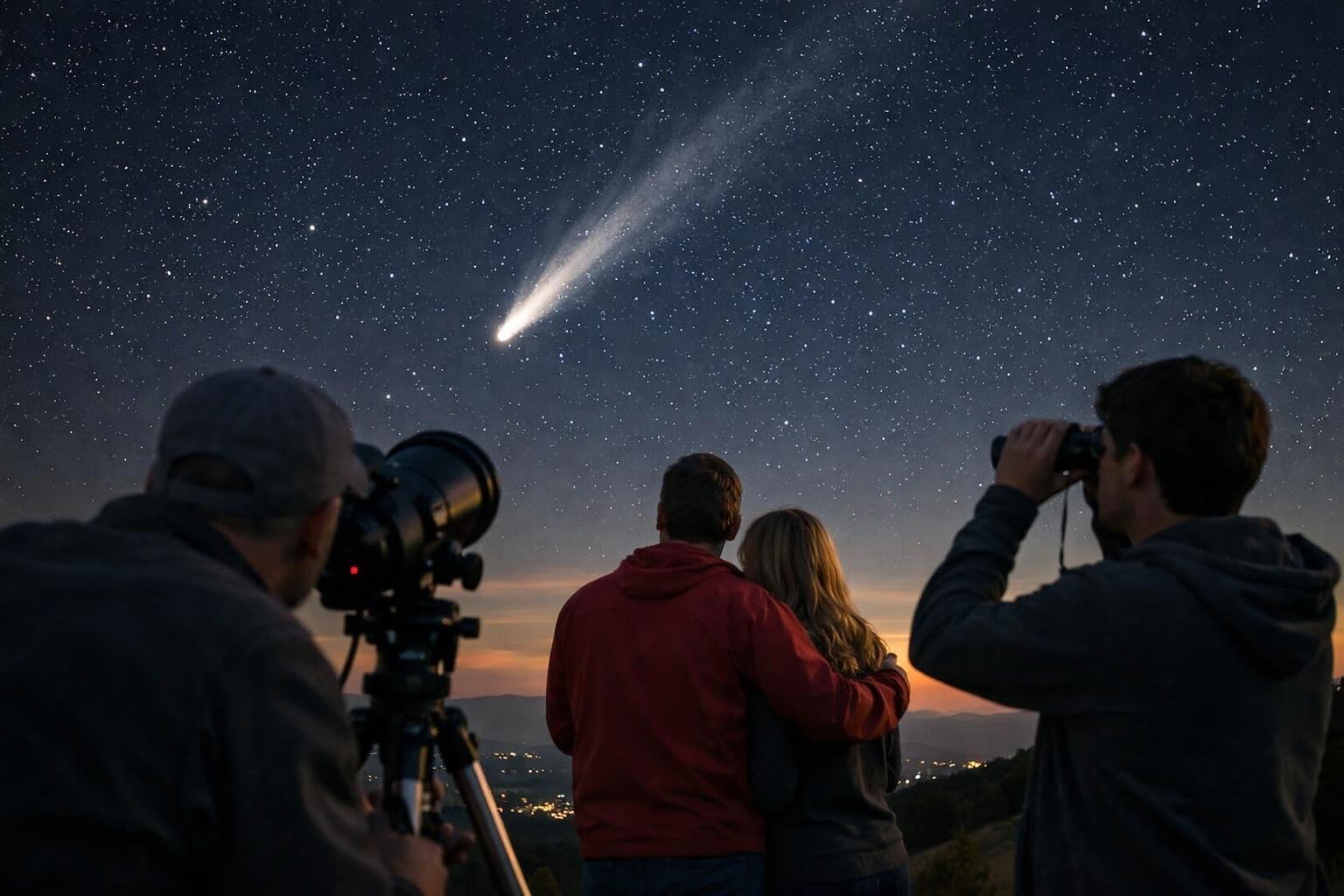
The next few nights will give the United States a rare, naked‑eye rendezvous with a long‑period comet, a chance to step outside and feel the solar system moving. Expect a faint, living glow, not a billboard in the sky. As comet chasers like to say, “Comets don’t read our scripts,” but when they show up, they reward the patient.
What you’re looking for
This visitor is a dirty‑ice relic from the outer reaches, shedding dust that sunlight turns into a tail. Unlike a planet’s pin‑sharp dot, a comet is a gentle smudge, with a roundish “coma” and a fan of dust pointing away from the Sun. “Think ‘smudge with a tail, not ‘neon spear,’” is a good mental model that keeps expectations sane**.
When to head outside
Go out about 60–90 minutes after local sunset, once the bright twilight fades but before the comet sinks too low. It will sit modestly above the horizon, so earlier is not better if the sky is still bright—aim for that sweet window when stars start to pop. If the Moon is up, wait until it’s lower or sets, because moonlight flattens contrast and steals faint detail.
Where to look from
Pick a site with a wide, uncluttered horizon and minimal glare. A hill, field, or lakeshore that faces your target skyline beats a street hemmed by buildings and trees. Turn off nearby lights, shield your phone’s screen, and give your eyes 15–20 minutes of dark adaptation; your pupils and brain will do the heavy lifting.
How to spot it with the naked eye
Start with a slow, patient sweep along the low sky, using “averted vision”—glance slightly to the side of the glow instead of staring straight at it. Look for a diffuse, star‑sized blur that stays put as your eyes scan. If you think you see it, look away, then back; if it returns, you’ve probably nailed the coma.
Binoculars are your secret superpower
Even if it’s technically naked‑eye, a small pair of binoculars (7×50 or 10×50) turns a faint puff into a satisfying object. Brace your elbows on a railing or car roof to calm the shake. With glass, you’ll likely see a brighter core, a more defined coma, and a hint of tail extending several degrees into the dark.
Your simple plan for Friday night
- Check a live sky chart app (Stellarium, SkySafari, or Heavens‑Above) for exact position relative to bright stars and planets.
- Arrive 30 minutes before prime time to set up, get dark‑adapted, and scan the likely patch.
- Start naked‑eye, confirm with binoculars, then go back to the unaided view once you’ve “locked on.”
- Take a quick phone‑through‑binoculars snapshot as a keepsake, then put the tech away and enjoy the moment.
Photographing the visitor
You don’t need an observatory to make a memorable photo. Mount a camera on a steady tripod, use a 24–85 mm lens, high ISO (800–3200), and 5–15‑second exposures before stars trail too much. Focus manually on a bright star, then compose with the comet just off‑center to include foreground silhouette. Take a quick bracket of exposures—one a bit shorter, one a bit longer—and review at full zoom.
Weather, safety, and comfort
Thin clouds can mimic a comet, so cross‑check with a forecast map before you drive. Bring a light jacket, bug spray, and a red‑filter flashlight to preserve night vision. Park safely off the road, respect private property, and kill interior lights so you and others keep your dark eyes.
What you’ll actually see
From a dark site, expect a small, cottony haze with a brighter center and a broad, subdued tail. In suburbs, the same haze may be subtle to the eye, obvious in binoculars, and surprisingly clear in short photos. The tail points away from the Sun, so its angle changes as nights pass. “If last night’s view was fine, tonight’s will be different,” and that’s part of the charm.
Tips to beat light pollution
If you’re stuck under city glow, block stray lamps with a building edge, visor, or held‑up hoodie. Let your eyes rest between scans, and revisit the field after five quiet minutes—faint details grow with patience. Even one good dark‑sky drive can transform a marginal puff into an unmistakable visitor.
Keep following its journey
Comets move night by night, often climbing, dimming, or sprouting more structure. Mark the spot with a bright star or planet as a reference ruler, and log a few simple notes about size, brightness, and tail length. Share what you see—“The more eyes on a comet, the better the story”—and step back to feel that ancient, human thrill of watching a traveler made of ice and time sweep past our small, blue world.
