
A celestial goddess seen with fresh eyes
Across ancient Egypt, the sky goddess Nut arches over the world like a protective, star-studded vault. New research by astrophysicist Or Graur argues that artists sometimes painted on her body a visible trace of the Milky Way. Drawing on Egyptology and astronomy, he identifies what may be the earliest visual allusions to our galaxy’s dark, rifted spine.
Graur surveyed 125 portrayals of Nut across a corpus of about 555 coffins, charting patterns in celestial motifs and unusual graphic accents. His analysis, published in the Journal of Astronomical History and Heritage, suggests a nuanced, nonliteral link between Nut and the galaxy that arcs over Egypt’s desert nights.
The wavy curve and the Great Rift
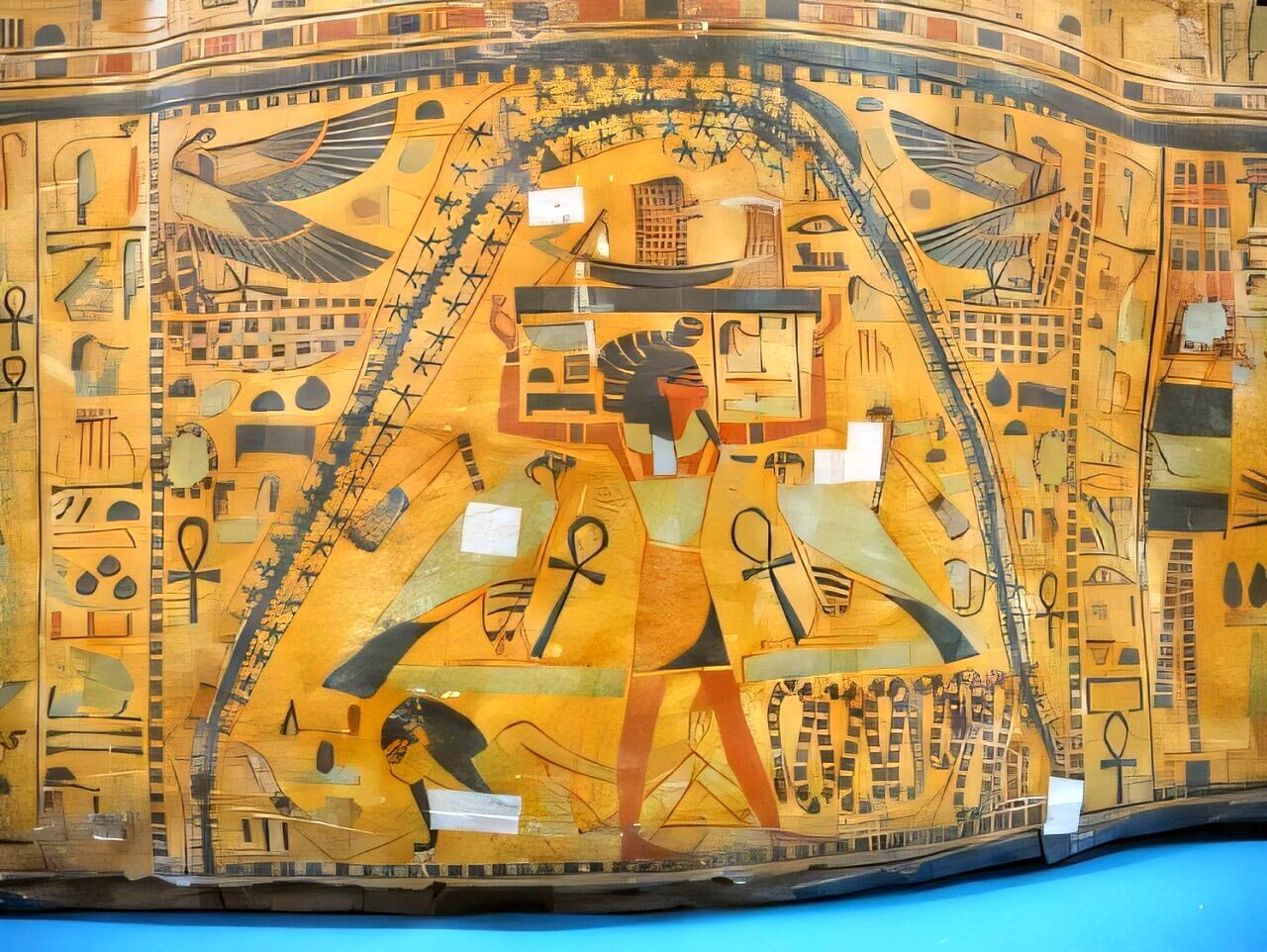
One depiction stands out on the coffin of Nesitaudjatakhet, a singer of Amun-Re who lived about three millennia ago. A sinuous, black, undulating band runs from the soles of Nut’s feet to the tips of her fingers, with stars painted in roughly equal numbers above and below. For Graur, the form echoes the Milky Way’s dark lane, the so‑called Great Rift.
“The wavy band plausibly traces the Great Rift—the dust-filled seam that parts the Milky Way’s diffuse glow,” he argues, noting the striking resemblance when compared with modern night-sky photography. The motif’s clarity supports a deliberate reference to a familiar, seasonal band of luminous light.

Reading the sky in royal tombs
Similar undulating bands appear in several royal tombs, strengthening the case that artists encoded a real celestial feature. In the burial chamber of Ramses VI, twin arched figures of Nut are separated by thick, wavy, golden curves running from head to lower back. The bands divide day and night books in a cosmological ceiling of striking conceptual clarity.
In the tomb of Seti I, black wavy lines also structure the astronomical ceiling, set between rows of yellow semicircles that partition the sky registers. While not ubiquitous, these curves form a small, coherent cluster—rare enough to be meaningful, yet consistent with an observationally grounded symbolism.

Texts, seasons, and evolving interpretations
Earlier work by Graur drew on Pyramid Texts, Coffin Texts, and the Book of Nut, alongside simulations of the ancient Egyptian night sky. He proposed a seasonal reading: in winter the Milky Way emphasized Nut’s outstretched arms, while in summer it traced her vertebral axis. The new visual evidence reframes that model without discarding its observational core.
Crucially, the study argues that Nut and the Milky Way are not simply identical. Instead, the galaxy is one of several celestial adornments—like stars and solar disks—that can appear on Nut’s body to signal her role as the living sky. As Graur notes, “Images add a dimension that the texts alone only hinted at.”
Method, cautions, and what to watch next
The project balances art-historical scrutiny with sky-aware comparisons, minimizing anachronism while respecting Egyptian religious context. Rare motifs are treated cautiously: scarcity can signal either innovation or specific ritual functions. Corroboration across media—coffin lids, tomb ceilings, and cosmographic schemes—strengthens the interpretive case.
Future work will broaden the cross-cultural catalogue of Milky Way myths, mapping convergences and differences in how societies read the night sky. Museum collections, improved dating, and high-resolution imaging may reveal additional wavy bands—or clarify when artists chose other cosmic signs.
Key takeaways
- Nut’s body sometimes bears a distinctive, wavy, dark band consistent with the Milky Way’s Great Rift.
- The motif appears on a named coffin and in several royal tombs, suggesting an intentional cosmic reference.
- Texts and seasonal skies support a flexible, observationally informed reading of Egyptian cosmological art.
- Nut is not the Milky Way itself; the galaxy functions as one celestial adornment among many on the divine sky goddess’s form.
A living dialogue between sky and symbol
For ancient viewers, the luminous river overhead was a nightly companion, and its dark rift a visible, navigable signpost. Egyptian artists turned that familiarity into sacred language, weaving cosmic structure into the protective curve of a goddess’s body. In these images, observation and myth converge, letting the Milky Way mark time, ritual, and the eternal path of the sun.
That quiet dialogue still speaks to modern eyes. When we recognize the galaxy’s dark seam on a painted coffin or royal vault, we glimpse how a distant civilization mapped the heavens onto human meaning—an ancient act of looking up, rendered in line, color, and enduring wonder.
