
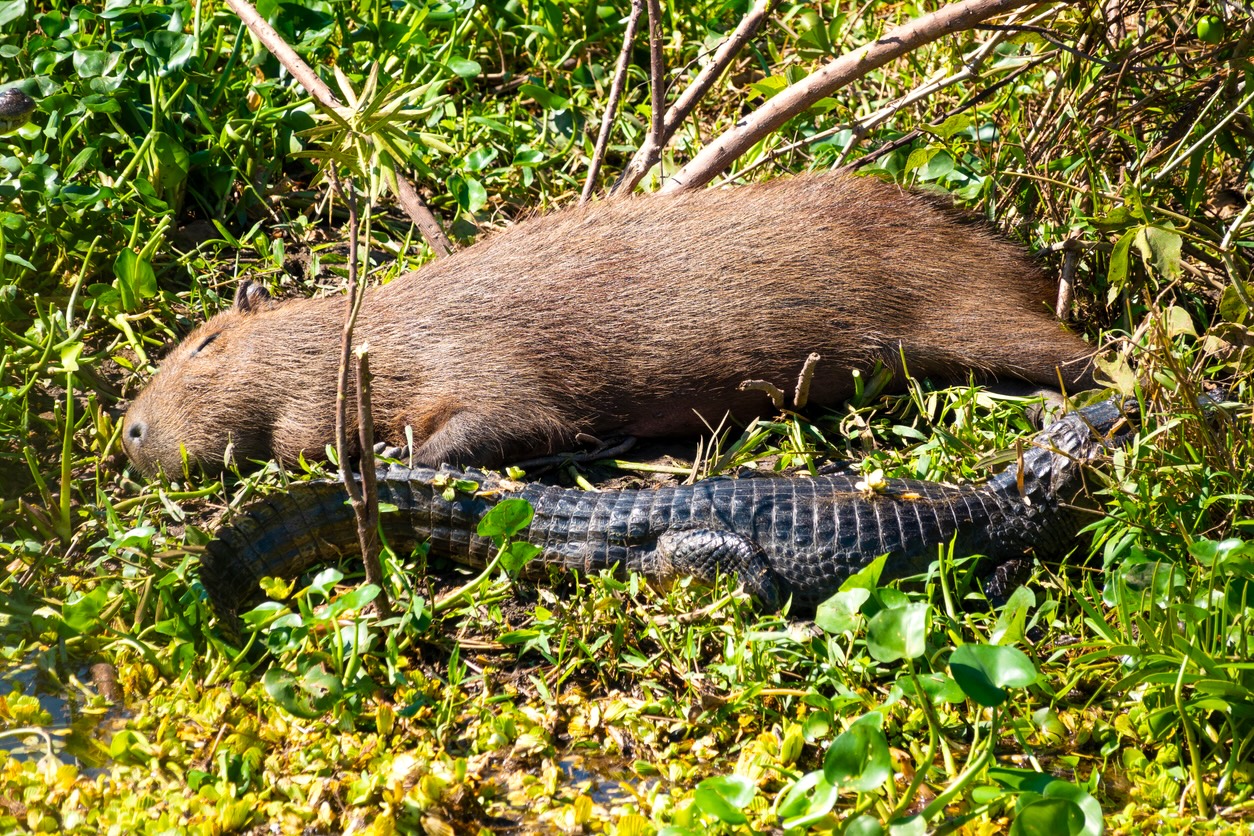
At first glance, the scene looks impossible. A massive caiman, one of South America’s most efficient predators, lies motionless on a riverbank while a group of capybaras sleep calmly just a few feet away, completely unbothered by the danger that should, in theory, terrify them. Photos and videos of this unlikely coexistence regularly go viral, leaving viewers around the world asking the same question: why don’t the caimans attack?
The answer is far more complex and fascinating than simple luck or coincidence, and it reveals how survival in the wild is often shaped by strategy rather than constant aggression.
A relationship shaped by energy, not mercy
Contrary to popular belief, wild predators do not attack every potential prey they encounter. For caimans, hunting is an energy calculation, not an emotional response, and every attack carries risks, including injury, wasted effort, or exposure to larger threats. Capybaras, despite their gentle appearance, are large, strong, and often surrounded by alert group members, making them a far less attractive target than smaller, weaker prey.
A wildlife biologist studying wetland ecosystems explains it clearly: “Predators survive by choosing battles they are almost guaranteed to win, not by attacking everything that moves.” In many situations, a resting capybara simply does not meet that criterion.
Why capybaras are not an easy meal
Capybaras are the largest rodents on Earth, and their size alone changes the predator-prey dynamic. An adult capybara can weigh as much as a human child, and attacking one requires a significant investment of energy, especially if the animal is healthy and alert. Unlike solitary animals, capybaras live in groups, which increases vigilance and reduces the chances of a successful ambush.
More importantly, capybaras are semi-aquatic, just like caimans, which means they can escape quickly into the water, where the outcome of a chase becomes less predictable. From a caiman’s perspective, this uncertainty often makes the effort simply not worth it.
The power of familiarity and routine
In many wetland regions, capybaras and caimans share the same territories year-round, which creates a form of mutual familiarity. Over time, predators learn which individuals or species are worth targeting and which are not, especially when food is abundant.
Capybaras that regularly occupy the same riverbanks become part of the landscape rather than an immediate opportunity, and this familiarity reduces aggressive reactions. The absence of hunger often matters more than the presence of prey, a fact that challenges how humans imagine predator behavior.
Capybaras understand the rules of survival
Capybaras are not reckless. Their calm behavior near caimans is based on constant awareness rather than ignorance of danger. They choose resting spots carefully, remain close to escape routes, and rely on group dynamics to detect threats early.
Their stillness is not trust, but strategic confidence, built on understanding when a predator is likely to act and when it is not. If a caiman shows signs of hunting behavior, capybaras react instantly, disappearing into the water within seconds.
When attacks actually happen
It is important to understand that this peaceful coexistence is conditional, not absolute. Young, sick, or isolated capybaras are far more vulnerable, and caiman attacks do occur, especially during periods of food scarcity or environmental stress.
What appears to be friendship is actually a temporary truce, maintained only as long as the balance of risk and reward favors restraint. The moment conditions change, so does the behavior.
A powerful illusion of harmony
The image of capybaras sleeping beside caimans feels astonishing because it contradicts the simplified narratives humans often impose on nature. In reality, the wild is governed less by constant violence and more by efficiency, calculation, and adaptation.
As one ecologist puts it: “Nature is not cruel or kind. It is practical.” That practicality is exactly why capybaras can rest peacefully beside one of their most dangerous neighbors.
What this teaches us about the natural world
This unlikely scene is a reminder that survival is not always about dominance or fear, but about understanding patterns, limits, and opportunities. Capybaras survive not because caimans are merciful, but because both species have learned when conflict makes sense and when it does not.
The next time you see a capybara sleeping calmly next to a caiman, you are not witnessing a miracle, but a moment of perfect ecological logic, where restraint, awareness, and balance quietly prevail over instinct.