
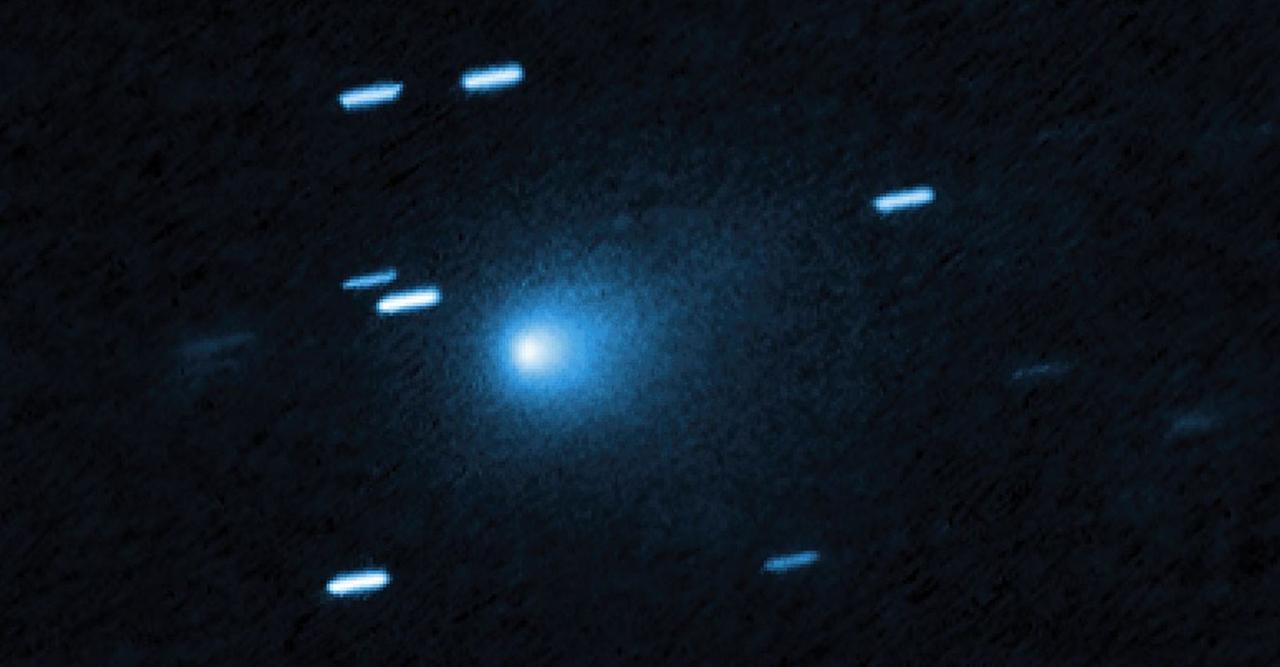
In 2017, astronomers detected something unprecedented passing through our cosmic neighborhood: an object from beyond the Solar System. Named ʻOumuamua, this mysterious visitor has since become one of the most debated discoveries in modern astronomy. Unlike anything observed before, it challenged existing theories and raised a fundamental question: what exactly are we looking at?
A discovery that changed everything
The object was first spotted by researchers using the Pan-STARRS telescope in Hawaii. Initially classified as a comet, then as an asteroid, it quickly became clear that ʻOumuamua did not behave like either.
Its trajectory alone was enough to spark interest. It was moving too fast to be bound by the Sun’s gravity, confirming that it originated from another star system. This made it the first known interstellar object ever detected passing through our Solar System.
But that was only the beginning of the mystery.
An object unlike any other
Observations revealed highly unusual characteristics. The object appeared elongated—possibly cigar-shaped or flattened like a pancake—and exhibited no visible tail, unlike typical comets.
Even more puzzling was its acceleration. As it moved away from the Sun, it slightly sped up, a behavior usually explained by outgassing in comets. However, no gas or dust was detected.
Scientists proposed several explanations: hidden hydrogen emissions, an unusual composition, or even a fragment of a larger celestial body. Yet none of these theories fully accounted for all observations.
This is where speculation began to expand beyond conventional models.
Natural phenomenon or something else?
Some researchers suggested that ʻOumuamua might be composed of exotic materials, such as frozen hydrogen or nitrogen ice, which could explain the lack of visible emissions.
Others proposed more unconventional ideas. Among them was the hypothesis that the object could be artificial in origin—perhaps a piece of technology or debris from another civilization. While this idea gained media attention, most of the scientific community remains cautious, emphasizing that no direct evidence supports an artificial origin.
The debate highlights a broader issue: when faced with something truly unknown, science must balance imagination with rigor.
Why this discovery matters
Regardless of its true nature, ʻOumuamua represents a turning point. It proves that material from other star systems can—and does—enter our own.
This opens new possibilities for understanding planetary formation beyond the Solar System. Future detections may provide clearer answers, especially with more advanced telescopes now in operation.
More importantly, it reminds us of how little we still know. Even in our own cosmic backyard, objects can appear that defy expectations and resist easy classification.
For now, this interstellar visitor remains exactly what it first seemed to be: a cosmic enigma, briefly passing through, leaving behind more questions than answers.

What was the point of this article?