
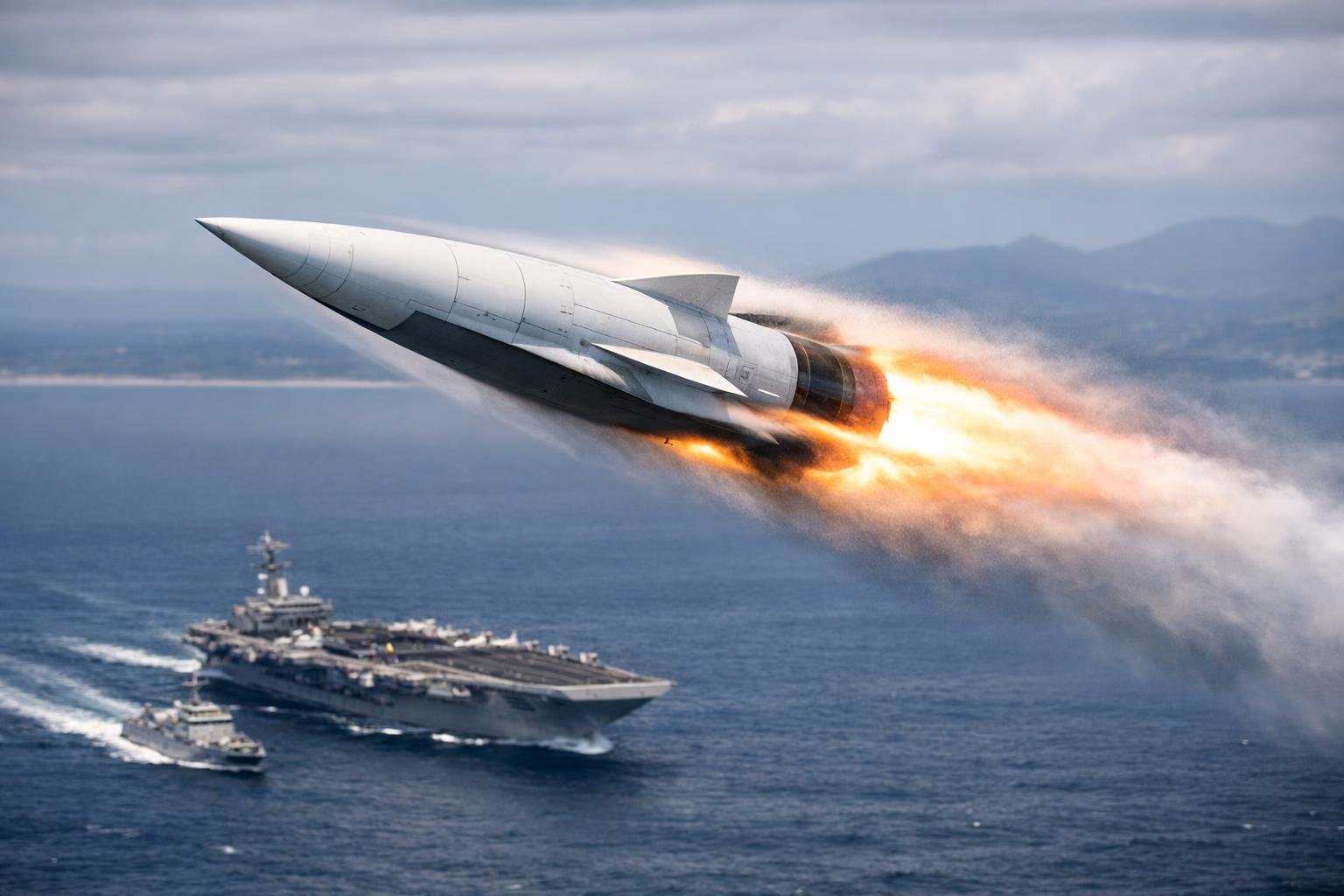
A burst of speed, a veil of plasma, and a shifting trajectory—that’s the new reality shaping the next era of deterrence. China’s latest hypersonic system, reportedly cruising around Mach 7, compresses the timeline for detection and response, and forces U.S. defenses to rethink old assumptions. “Hypersonics don’t make you invincible, but they make the defender’s problem brutally hard,” one analyst often notes. In practical terms, that means less warning, tighter windows, and far more stress on command-and-control loops.
What Mach 7 Actually Means
At Mach 7, the vehicle is moving at over two kilometers per second, covering vast distances in minutes, not hours. That speed turns detection errors into misses, and tracking gaps into blindness. “The physics is merciless,” as a former missile-defense official put it.
Unlike classic ballistic missiles that follow largely predictable arcs, hypersonic systems can glide and maneuver within the atmosphere. That combination of altitude, speed, and maneuverability expands the envelope where intercept becomes dicey.
Glide, Maneuver, and the Puzzle for Radars
China’s approach appears to mix boost-glide vehicles with advanced aerodynamics, producing a profile that is neither purely ballistic nor a low-flying cruise missile. Gliding at high altitude but below space, these vehicles can swerve laterally and adjust pitch, complicating fire-control solutions. The result is a moving target that shifts where the defender least expects it.
That mid-course maneuvering breaks “track continuity,” forcing sensors to re-acquire a hot, fast, and sometimes cluttered signature. And the surrounding plasma sheath at hypersonic speeds can degrade communications and sensor returns, adding still more uncertainty.
Why Interception Is So Tough
Traditional U.S. systems—Aegis with SM-6, THAAD, and GMD—were architected mainly for ballistic threats. They can engage high-arc targets or endo-atmospheric missiles, but hypersonic gliders occupy the messy space between. Timing, geometry, and cueing all get harder.
- The flight path is less predictable, forcing wider search areas and diluting firepower.
- The time-to-impact is short, compressing decision cycles and launch windows.
- The thermal and plasma environment can complicate tracking and seeker performance.
- Maneuvering reduces the effectiveness of pre-planned intercept points.
Claims, Reality, and the Signal in the Noise
Chinese state-linked media have signaled rapid advances in hypersonics, while open-source imagery points to fielded systems like the DF-17. The 2021 report of a fractional orbital test with a hypersonic glide component underscored the ambition of these programs. Still, precise performance figures are scarce, and independent verification is limited by secrecy.
Analysts caution that “hypersonic” bundles different technologies and missions—from anti-ship profiles to regional strike and strategic deterrence. In other words, not all hypersonics are equal, and context matters enormously.
The U.S. Counter-Game
Washington is investing in space-based sensors tuned for warm, maneuvering targets, seeking persistent “from birth to death” tracking. That means stacked layers: low Earth orbit constellations, improved ground radars, and cooperative cueing across services and allies. The goal is to shrink the kill-chain latency so interceptors can be launched with enough confidence.
On the shooter side, programs target faster, more agile interceptors and new effectors—think high-power lasers, electronic warfare, and possibly “left-of-launch” tactics. “You won’t stop every shot, but you can complicate the math and raise the costs,” a retired program manager said.
Naval Implications in the Pacific
Carrier strike groups face special risk, given hypersonic anti-ship profiles and complex sea clutter. Aegis ships will lean heavily on distributed sensors, tighter networks, and cooperative engagement to keep the bubble intact. Expect more emphasis on deception—decoys, emissions control, and unpredictable postures that deny an easy solution.
For land-based assets, the challenge is similar: bolster hardening, mobility, and redundancy while enhancing rapid relocation and dispersion. The more targets move and deceive, the less valuable hypersonic speed becomes.
Arms Racing and Risk
As hypersonics mature, the line between conventional and nuclear signaling can blur at speed. Compressed timelines raise the risk of miscalculation, while ambiguous payloads complicate escalation control. Strategic stability depends on both enhanced resilience and clear communication between rivals.
Some experts argue for limited norms—test notifications, agreed flight corridors, or basic transparency—to keep rapid crises from spiraling. “Speed should not outrun prudence,” one defense scholar warned.
What to Watch Next
Look for accelerating space sensor deployments, faster AI-aided tracking, and layered interceptors entering early testing. Expect more joint exercises focused on compressed C2, rapid fires, and live-virtual-constructive training tailored to hypersonic threats. Equally, watch for regional partners investing in shared awareness, from Japan’s radar modernization to Australia’s emerging programs.
The broader point is simple and stark: speed and maneuver have shifted the advantage, but not ended the contest. Hypersonics magnify the penalty for slow decisions and brittle networks, while rewarding flexible posture, resilient sensors, and imaginative tactics. As one planner said, “There’s no single shield—only a smarter, faster, deeper defense.”
