
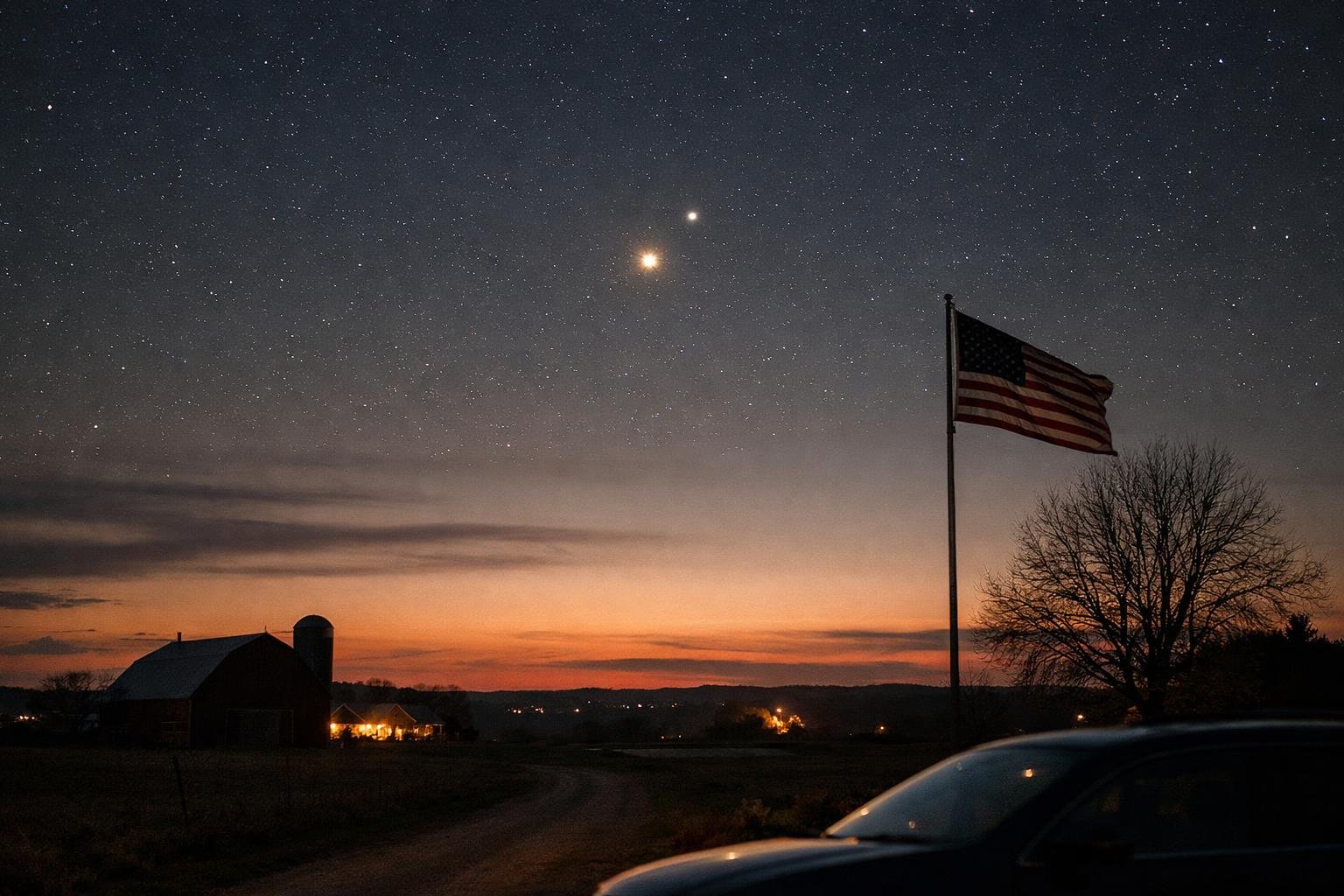
The sky is staging a rare performance, and you don’t need a telescope to feel involved. Over three evenings in a row, two brilliant worlds will sidle close in the twilight, offering a jaw‑dropping sight even from city streets. Think of it as a slow‑motion celestial handshake, bright enough to catch with a quick glance and rewarding enough to savor for a while.
“Look up for five minutes, and you’ll see why people still fall in love with the sky,” says just about every backyard stargazer, and they’re right. This is a chance to reconnect with that instinctive curiosity we often forget between traffic lights and timelines.
What you’re actually seeing
A conjunction is simply two bright objects appearing close in the sky, though they remain vastly separated in space. During this event, Venus steals the show with an intense, creamy glow, while Jupiter gleams nearby with a steadier, golden‑white light. Venus will look sharper and more dazzling; Jupiter slightly dimmer but still obvious.
“Think of it as two spotlights converging on a cosmic stage,” a phrase that fits because both planets are among the sky’s brightest beacons. You’re not just seeing light—you’re sensing geometry, the delicate alignment of orbits that makes the night briefly different.
When and where to look
Head out about 30 to 60 minutes after local sunset, when the sky is deepening but not yet fully dark. Scan the low western horizon—clear of trees, hills, or buildings—and find the two bright points sitting closer than usual, like glittering neighbors. The pairing will linger for roughly an hour, sinking toward the horizon as twilight fades.
If the planets are a true evening pair, west is your target; if your local alerts mention predawn viewing, shift to the east about an hour before sunrise. The rule of thumb is simple: follow the glow of twilight and let the brightest “stars” lead your eyes.
How to tell them apart
Venus is almost painfully bright, often sparkling with a crisp, icy sheen. Jupiter appears slightly less intense but still striking, and in steady air you might even glimpse its four largest moons with binoculars: tiny pinpoints stretching in a line.
A quick trick helps: if it looks like a bright lamp, it’s likely Venus; if you can tease out a miniature system through binoculars, that’s Jupiter. Don’t stress if you’re unsure—the beauty is in the shared view.
Make the most of three nights
Each evening the geometry shifts, subtly altering the planets’ separation and angle. Treat it like a mini‑series you binge under the open air, noticing how the lineup slides a little nightly. The middle night is often the tightest, but the flanking evenings bring context and contrast.
Use your outstretched hand as a built‑in ruler: a fist is about 10 degrees, a pinky about 1. During a close approach, the gap can shrink to a few degrees, making the pair feel intimate and rare.
Simple gear, big payoff
You don’t need fancy optics, but small binoculars transform the experience. A tripod or a stable fence post cuts the shake and reveals extra detail. If you own a small telescope, low power gives the most pleasing, two‑planet frame.
- Bring binoculars for Jupiter’s moons and steadier views of both bright disks
How to photograph it
A smartphone can absolutely capture this, especially in Night mode with exposure locked. Brace the phone on a wall, use a 3‑second timer, and tap to focus on the brighter planet. If your sky isn’t too bright, a short video can be stacked later with basic astrophotography apps.
For cameras, start around ISO 400–800, 1/4 to 1/2 second, and a wide aperture; keep shots short to avoid star trails near the horizon. Frame a skyline, a lone tree, or a calm body of water to add scale and quiet drama.
Safety and sky conditions
Never sweep binoculars near the Sun, especially on the earliest evening. Wait until the Sun is fully below the horizon before bringing optics to your eyes. Check a local forecast—thin cloud can soften the view, while clear, dry air makes everything pop.
Light pollution won’t spoil this show; both worlds are fiercely bright. Still, a darker park or lakeshore lowers glare and boosts contrast, revealing subtler colors and those tiny moons.
Finding your timing tools
Planetarium apps and weather apps make the planning easy. Set your city, scrub the time slider, and watch the planets glide toward their closest approach. If you prefer analog charm, print a star map and mark the western horizon from your usual observing spot.
“Let the sky set the agenda, and you just keep the appointment,” is a mantra worth borrowing. A few minutes of setup yields a memory that feels quietly enormous.
Why this pairing captivates
Brightness is only part of the story. There’s intimacy in seeing two distant worlds share one small patch of heavens, a fleeting overlap that reminds us how motion shapes our nightly canvas. Blink, and the geometry changes; wait, and it happens again.
Show up for one evening, then return the next to see the subtle shift. In that patient comparison lies the heartbeat of astronomy—not equipment or expertise, just repeated encounters with a living, turning sky.
