
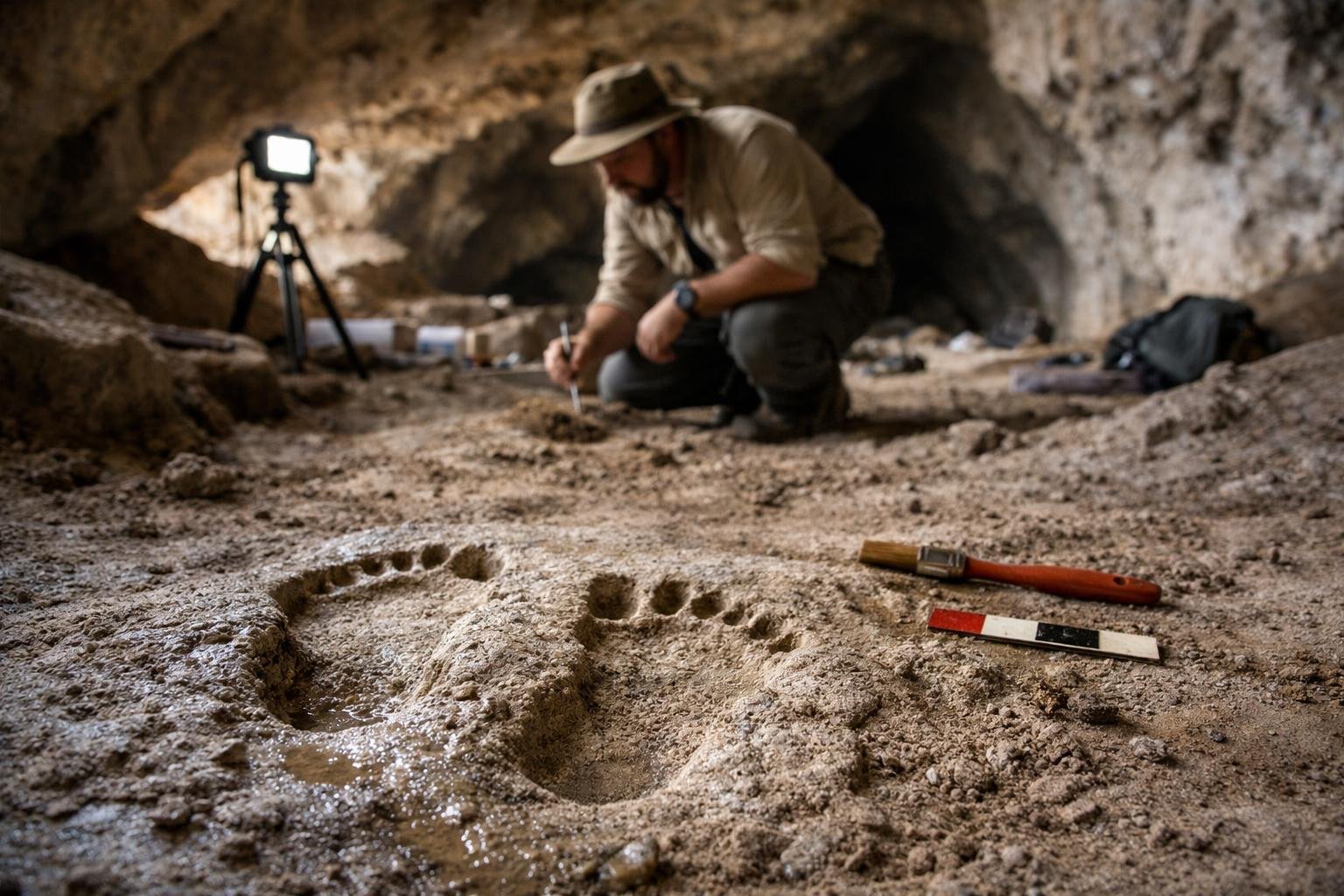
The news from a shadowed chamber in Utah feels startlingly immediate: ancient steps pressed into damp sediment, stilled by time, now speaking across millennia. These are not abstract artifacts of stone or bone. They are the impressions of feet—edges, arches, toes—mapped in fragile relief, and dated to roughly 23,000 years ago. If verified, they pull the American story backward, into the colder heart of the Ice Age.
“Extraordinary claims require extraordinary evidence,” Carl Sagan once warned. The scientists behind the Utah prints know this, which is why their case threads data, context, and caution together like footsteps in a line.
A trackway in the dark
Inside a limestone cavity, archaeologists documented a sequence of tracks etched into fine silts—multiple footprints in succession, some shallow, some deep, with the crisp roll of heel-to-toe transfer still visible. The pattern reads as deliberate movement across a damp floor: a small cluster of adult steps, a juvenile’s shorter stride, and what might be a pause marked by a scuff and a splayed toe.
Under raking light, micro-ridges and collapsed edges reveal how soft mud behaved beneath weight. 3D photogrammetry freezes every contour, preserving a digital twin for future work. One researcher put it simply: “Footprints do not lie, but sediments can mislead—so we test, and we test again.”
How do you date a moment in mud?
The team approached the problem like a layered puzzle. First came micromorphology—thin sections of the floor analyzed under the microscope—to show the prints are in their original position, not slumped or reworked by later flows. Then came optically stimulated luminescence (OSL), which clocks when quartz grains last saw the sun, bracketing the burial time of the track-bearing layer.
To triangulate the age, seeds and tiny plant fragments sealed just above and below the prints went to AMS radiocarbon dating. Bayesian models blended the results, placing the trackway during the Last Glacial Maximum, around 23 millennia before present. A thin carbonate film over some impressions allowed a cross-check via U-series methods, pulling the numbers in the same direction.
None of this is magic—just method on top of method. “Evidence only matters when it’s layered, dated, and repeatable,” one field note reads in careful pencil script.
Why that date matters
For decades, the “Clovis-first” model set arrival around 13,000 years ago, anchored by big, fluted points and mammoth kills. But sites like Monte Verde in Chile, Bluefish Caves in Yukon, and the famous White Sands footprints in New Mexico have been steadily chipping at that consensus. A Utah cave with Ice Age footsteps strengthens a picture that is both older and more complicated.
If people were here during the LGM, the interior West was not an empty ice-blocked void. It was a mosaic of wetlands, pluvial lakes, and cold-open steppe, navigable by small, adaptable groups. That nudges migration models toward a coastal entry followed by early dispersals, or perhaps multiple waves moving at different times along different paths. As one archaeologist quips, “Clovis-first is history, and the story is plural.”
What makes this site compelling
- Multiple overlapping tracks, not a single ambiguous impression.
- Clear in-situ microstratigraphy under microscope, minimizing rework concerns.
- Independent dating lines (OSL, radiocarbon, and U-series) that converge.
- High-resolution 3D models available for open scrutiny and replication.
Healthy skepticism is part of the path
Extraordinary sites invite scrutiny, and this one is no exception. Could burrowing animals have disturbed layers? Could water have cut channels that shuffled sediments? The micromorphology argues against it—edges are sharp, laminae are continuous, and load structures beneath toe pads look pristine. Still, peers will push the samples, the models, the assumptions to their limits.
Skeptics also ask whether “human-like” can be misleading. Nature is a trickster: drying cracks, hoof prints, and collapse features can mimic human forms. Here, the measured gait, bilateral symmetry, and consistent pressure arcs look, step after step, unmistakably human.
Rewriting the tempo, not just the headline
This discovery doesn’t just add earlier dates; it adjusts the tempo of how people spread into new ecologies. It suggests knowledge of local water, shelter, and seasonal rhythms long before big-game toolkits appear in the record. Footprints capture behavior in realtime: someone entered, someone lingered, someone left. No spearpoint narrates with such immediacy.
Think about what these tracks imply. A child testing cold mud, an adult setting a pace, a brief stop at the mouth of a dark corridor where light and echo meet. “For a moment,” as the field diary muses, “we stood inside their decision, not just their debris.”
The human signal endures
What resonates is the ordinary courage of movement—across wind-polished basins, along lake margins glittering with ice, into rock chambers smelling of mineral and water. The prints turn debate into footfalls, timelines into choices taken one measured step at a time.
If the dates hold, textbooks will bend. But even before the ink dries, the tracks have done something rarer: they have made the earliest Americans feel less like a distant category, and more like people whose weight, for a few quiet seconds, pressed into soft ground—and stayed.