
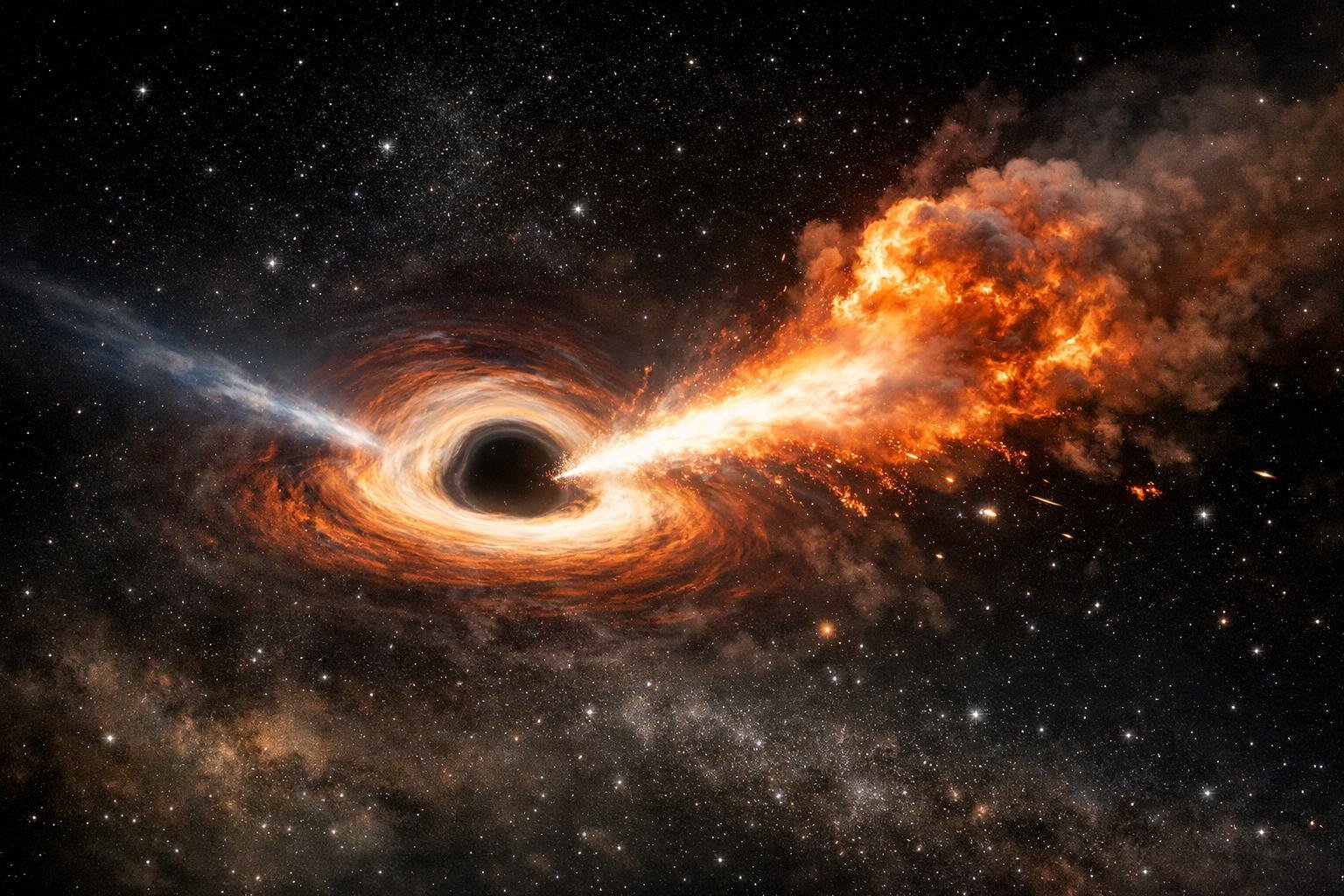
A ripple of light ran across deep space, and then something stranger followed: a side‑sweeping surge of matter that seemed to bend the rules of gravity. Telescopes on multiple continents caught it, and the data hinted at a behavior long assumed to be impossible.
In the heart of a distant galaxy, a supermassive engine spat out a plume that didn’t align with its classic jets. It curved and fanned like a shockwave, crossing the disk’s plane as if the black hole had momentarily changed its mind.
“Nature has a habit of improvising,” said one team member, “and this time the score wasn’t in any of our models.”
A burst that broke the rules
Black holes are notorious for narrow, relativistic jets that fire along magnetic axes. This outburst, however, widened into a lateral sheet—an expansive, shimmering front of particles that skimmed the disk like a stone skipping across water.
Instead of a tidy stream, astronomers saw a staggered train of plasmoids erupting sideways, each knot brightening and fading in quick succession. The structure traced a partial arc, as if a magnetic sling had snapped and flung material across the equator.
“Think of it as a jet that stood up, hesitated, and then slid sideways,” said the lead analyst. “That geometry doesn’t fit the playbook we’ve used for decades.”
How the team caught it
The event triggered a panchromatic campaign, linking radio arrays, space‑based X‑ray observatories, and rapid‑response optical scopes. Within hours, the source brightened in X‑rays while radio maps revealed a growing fan of emission offset from the usual jet axis.
Very long baseline interferometry resolved compact knots moving at apparent superluminal speeds, but along a track almost perpendicular to the black hole’s known jet. Near‑infrared flashes mirrored the radio pulse, stitching a timeline that was too coordinated to be a random flare.
Timing analysis showed a heartbeat-like pattern—brief pauses between ejections, followed by bursts that accelerated and then stalled. That cadence suggested magnetic reconnection near the innermost stable orbit, with energy released in avalanches rather than a steady flow.
What current theory missed
Standard models expect jets to collimate along stable magnetic funnels. They do not, however, predict a transient, wide‑angle spray that carves across the disk’s midplane. To produce this, fields must twist, tear, and re‑stitch in a configuration that flips the local pressure balance.
One candidate is a “magnetic slingshot” in which orbiting flux tubes load up on energy, rupture, and eject plasma sideways before the field recloses. Another option is a disk wind that becomes overpressured and briefly outcompetes the jet, forcing a detour through lower‑density channels.
“We’re looking at a geometry we haven’t simulated end‑to‑end,” a theorist noted. “The math isn’t wrong; the initial assumptions were just too tidy.”
Why this matters
When a giant black hole changes its voice, galaxies can feel the reverb. Sideways ejections deposit energy where it usually doesn’t go, stirring gas that feeds future stars and throttling the supply that feeds the black hole itself.
- Potential impacts include altered feedback in the host galaxy, new particle‑acceleration sites, and revised estimates of how often jets misalign or stall during accretion state changes.
If such eruptions are common but short‑lived, astronomers may have missed them by focusing on long, steady jets. The discovery hints that some “quiet” nuclei could be busy in bursts, reshaping their environments in quick pulses rather than slow drifts.
It also reframes puzzles about orphan radio arcs and asymmetrical lobes seen in some galaxies. A few could be the fossils of sideways surges, smeared by time and the medium they plowed.
The forensic details in the light
Spectra during the event showed hardened X‑ray indices, consistent with rapid particle acceleration. Polarization swung by double‑digit degrees, a fingerprint of writhing magnetic fields. In radio, the brightness temperature peaked and then cooled, matching adiabatic expansion of each plasmoid.
Light‑travel delays painted a 3D map. The X‑rays led by minutes, the infrared followed, and the radio lagged by hours—a stagger that matches particles spiraling outward and emitting as they cool. Combined fits point to launch sites within a few gravitational radii, where spacetime is anything but gentle.
What comes next
The team plans coordinated campaigns on changing‑look nuclei and flaring quasars, aiming to catch more sideways shots in the act. High‑cadence radio imaging and polarimetry will watch for arcs, kinks, and abrupt flips in field orientation.
On the theory side, new simulations will relax old assumptions: thicker disks, unstable field topologies, and reconnection physics that can hurl matter laterally. If the models reproduce the observed timings and polarization, the sideways scenario will shift from curiosity to canon.
“Every time the universe redraws the diagram, it hands us a better question,” the lead scientist said. For a moment, a monster at a galaxy’s core blinked, flexed, and showed its cards—not upward, but out across the plane where no one thought to look.