
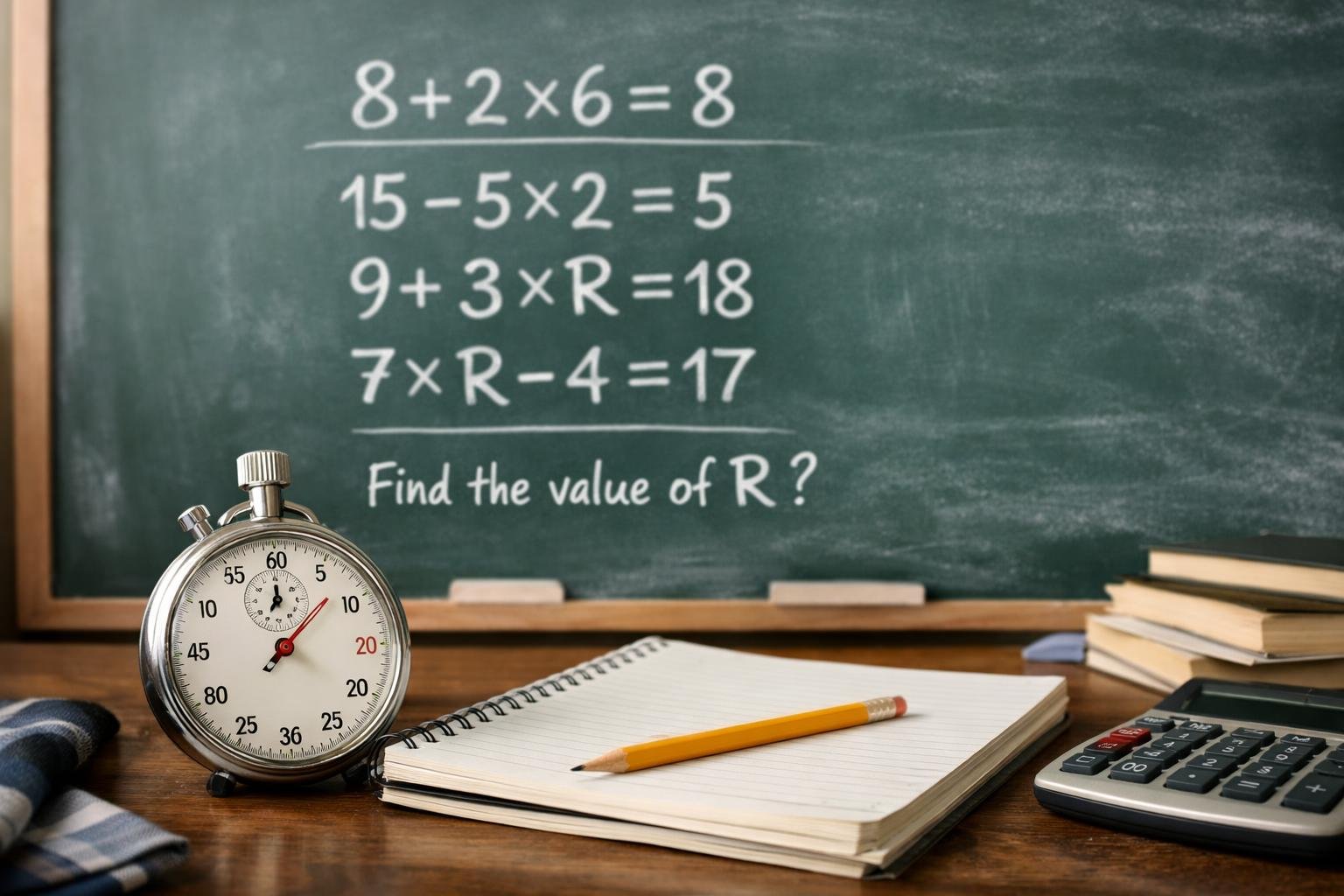
Tick-tock, the timer is running. You glance at a crisp set of numbers, your mind buzzes, and your pulse quickens just a little. There’s a single letter to hunt, a crisp answer to catch before the second hand completes its loop. You’re not just doing math—you’re doing a sprint, a quick, focused burst of clarity.
“Speed sharpens focus; structure ensures accuracy.” In that spirit, here’s a brain-tingling challenge, tight as a drum and clean as a whistle. Can you extract a single value from a tidy web of relations before the clock says stop?
The 40-second challenge
You’re given three snug equations, each stitching letters together with sums:
- R + P = 19
- P + Q = 23
- Q + R = 22
Find the value of R, and do it fast. Don’t compute piecemeal. Don’t guess and check. The trick is to collapse the system in one smooth motion.
“Breathe, scan, and aggregate.” That’s your mantra under the deadline.
The lightning method
Add all three equations at once. Left sides become 2(R + P + Q); right sides total 64. So R + P + Q = 32. Now pull a clean move: you know P + Q = 23, so R = 32 − 23. That’s 9. The clock barely warmed up.
This is the core idea: when variables appear in balanced pairs, the fastest route is global addition followed by a single subtraction. No detours, no friction.
Why this works
The structure is symmetric, so pairing terms cancels clutter. You trade three small puzzles for one big summary. Elimination by addition is not a trick; it’s algebraic geometry in miniature—straight lines pointing to a single intersection.
Your brain loves patterns, but panic loves noise. When the layout repeats, compress it to the essentials, and work with totals, not scraps.
Try a remix
Ready for a fresh set? Race the same pattern:
- R + S = 21
- S + T = 25
- T + R = 28
Add them: 2(R + S + T) = 74, so R + S + T = 37. Subtract S + T = 25, and you land on R = 12. “One sweep, one slice,” as a speed-solver might say.
Speed boosts you can apply now
- Spot pairwise sums fast by scanning for repeated letters.
- Add all lines first, then subtract the single pair you already know.
- Keep totals in one mental bucket, don’t juggle side math.
- Say the steps out loud (quietly): “Add, halve, subtract.”
- If numbers feel sticky, write the final two moves only: total, then minus.
Common pitfalls (and how to dodge them)
The first trap is local tinkering—solving for P or Q before you need to. That burns time and spawns extra arithmetic. The second trap is mis-adding the totals; whisper “nineteen, twenty-three, twenty-two—sixty-four” as a quick checksum. The third trap is dropping a sign when you subtract; anchor your mind to the structure: “R = total − (the pair without R).” Simple, repeatable, reliable under pressure.
“Elegance is speed you can trust.” When steps are few, errors have less room to hide.
Warm-up logic you can reuse
This technique generalizes beyond letters. Any time you see repeated pairs, you can compress the system. If there are three variables with three pairwise sums, add them, divide by two, then subtract the missing pair to isolate your target. Your mind becomes a press, squeezing out the extra air.
If coefficients vary, scale to make the pattern pop. If one line is odd, rewrite until the symmetry is visible. Think like a librarian: put like things together, then check them back out in the order you need.
One last test
Clock ready, eyes steady. Here’s a tougher set:
- 2R + M = 31
- M + N = 17
- N + R = 16
Hint: make the first line look like a pair. Replace M with 17 − N, and tidy the first equation: 2R + (17 − N) = 31 → 2R − N = 14. Now add that to (N + R = 16) to erase N: 3R = 30, so R = 10. “Combine to cancel, then strike for the center.”
Small, crisp moves. Big, clear payoff. With practice, forty seconds is plenty of time—not to rush, but to flow. When the page blurs and your thoughts race, remember the quiet strategy: aggregate, isolate, and let structure do the lifting.