
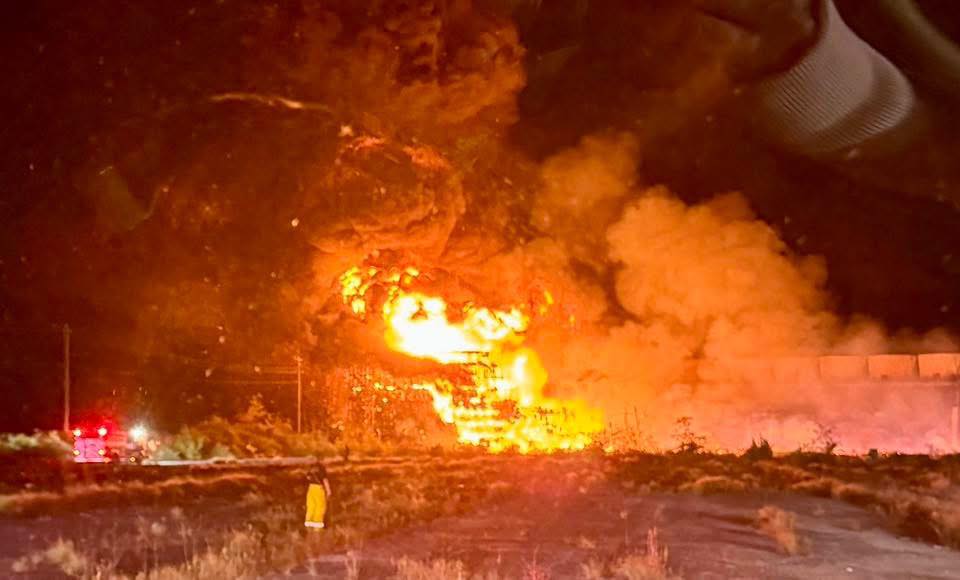
After a fire at a Galveston plant, neighbors continue cleaning and demand answers. Authorities investigate causes and potential risks in the area.
More than two weeks after the fire that consumed part of an old power plant in Galveston County, residents of Bacliff and San Leon continue to seek answers about what caused the blaze and how it could affect their health and surroundings.
The incident occurred in the early hours of November 16 at the former PHR Peakers plant, located near State Highway 146, between J Avenue and 29th Street. Although no injuries were reported, the fire caused the collapse of five dismantled cooling towers, generating a smoke cloud that forced neighbors to shelter inside their homes.
The property belongs to KV Land, LLC, which stated that the fire began around 2:30 a.m. in structures that were no longer in operation. The site adjoins a plot proposed for a seawater desalination plant, which has raised further concerns in the community.
Neighbors Affected by the Fire at a Galveston Plant
Ronnie Thompson Jr., a military veteran and resident of the affected area, was one of the many neighbors who began cleaning up the debris days after the event. According to reports, his yard contained black fragments and soot accumulated on outdoor furniture, grills, and interior surfaces of his home.
Thompson, who suffers from asthma and chronic bronchitis, expressed concern about air quality and potential health effects. According to his testimony, the smoke reached inside his home and caused him to have difficulty breathing during and after the fire.
Cases like his have repeated at various points near the incident site, where whole families have had to carry out extended cleaning tasks without clear information about the nature of the residues dispersed by the air.
Authorities Monitor Air Quality
During the afternoon of the same November 16, Galveston County officials assured that air quality measurements in the surrounding areas did not show significant cause for concern. Subsequently, the Texas Commission on Environmental Quality (TCEQ) explained that weather conditions helped disperse the particles toward less populated areas.
According to the monitoring, there were no significant increases in fine particles in the following days. However, this data has not been enough to reassure residents, who continue to demand clarity about the possible contaminants that could have been released during the Galveston plant fire.
Texas City authorities also noted that there is no evidence of hazardous chemicals at the site, which has limited immediate emergency actions. Still, the lack of direct communication and concrete updates has generated a sense of uncertainty among the population.
Ongoing Investigation and Demanding Answers
The local government has launched a formal investigation to determine the causes of the incident. The process involves the Texas City Fire Department, state agencies, and external contractors, who are seeking to determine what caused the fire in a supposedly inactive structure.
Municipal representatives have said the investigation will be thorough and could take weeks. Meanwhile, residents like Thompson continue to deal with the material and emotional consequences of an unexpected and worrisome event.
The case has sparked a broader debate about the management of decommissioned industrial properties in residential areas, as well as the need for greater environmental monitoring and effective communication by authorities.
In a county where coastal communities, industrial zones, and growing urban developments coexist, residents demand clearer measures to ensure safety in the face of emergencies like the Galveston plant fire.
Galveston Plant Fire: What Comes Next
Although the incident occurred outside the Houston city limits, its impact is felt across the metropolitan region. Air conditions, shared environmental risks, and the proximity of industrial areas to residential zones are topics of interest for those living in Southeast Texas.
Events such as the Galveston plant fire highlight the need to strengthen environmental monitoring systems and emergency communication strategies. They also underscore the importance of conducting ongoing assessments of sites that, even if decommissioned, can pose latent risks.