
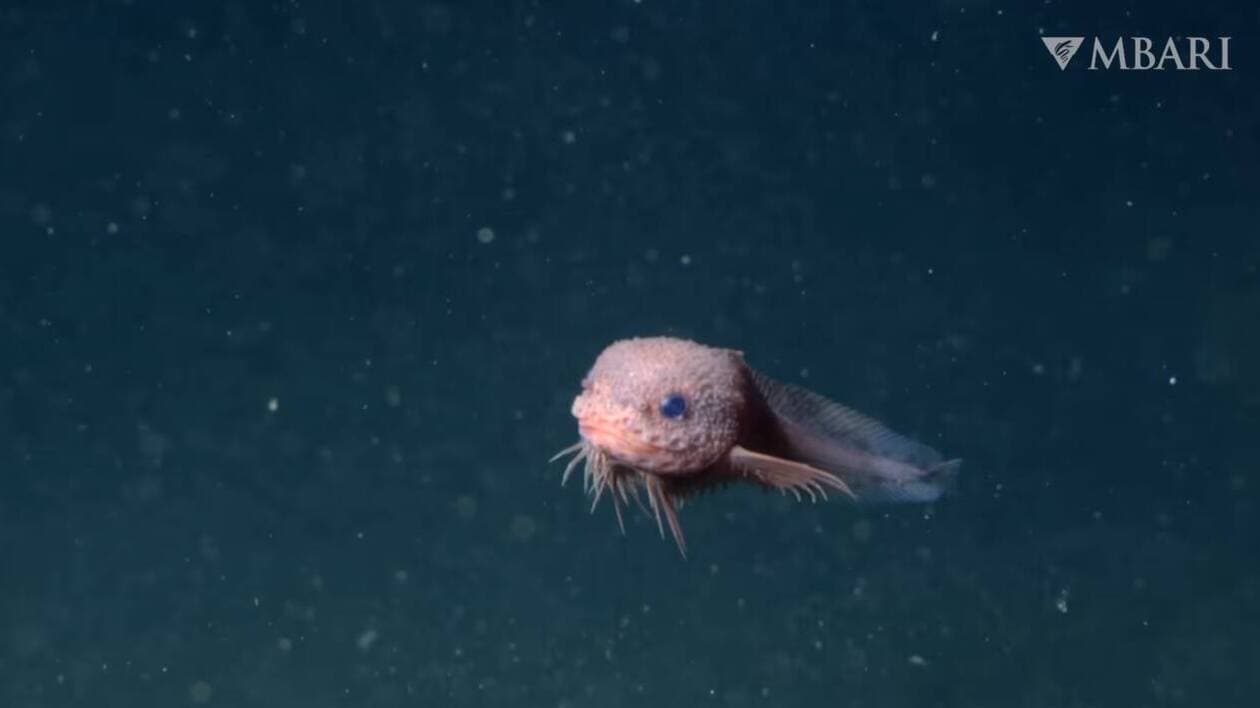
First glimpse from 3,000 meters
A team working off the California coast has captured the first-ever footage of a newly described species of deep-sea snailfish, recorded at roughly 3,000 meters beneath the waves. In the shimmering cone of an ROV’s lights, the animal appears pale and delicate, its translucent skin revealing a body exquisitely tuned to extreme pressure. The discovery, detailed in late August 2025 in the journal Ichthyology & Herpetology, adds a charismatic new face to one of the deep ocean’s most adaptable lineages.
From a distance, the fish reads as gentle, almost toy-like: a soft pink hue, a rounded head, and two large eyes with a faint blue sheen. It glides with economy, fluttering its fins as if conserving every spare joule of energy. For researchers accustomed to angular crustaceans and alien-looking cephalopods in the abyss, the newcomer’s charm is disarmingly humanizing.
Why scientists call it “adorable”
Unlike many deep-sea creatures with spines, teeth, or unsettling bioluminescence, this snailfish is undeniably cute. It presents soft contours and expressive eyes that give it an almost cartoonish appeal, a quality that can be rare among animals forged by cold, darkness, and crushing pressure. The video highlights a relaxed, hovering gait, as if the fish were sampling the water like a careful balloonist.
“It’s rather adorable,” said marine biologist Mackenzie Gerringer of SUNY Geneseo, reflecting a sentiment shared across the deep-sea community. The remark resonates because the deep ocean is often framed as forbidding and inhospitable, yet this species invites affection instead of dread.
Part of a trio uncovered
The sighting emerged from an expedition led by the Monterey Bay Aquarium Research Institute, which documented not just one, but three new species of deep-living snailfishes. These animals inhabit water that is “colder than our refrigerators,” a phrase that underscores both the brutal conditions and the remarkable resilience of their physiology. Each discovery helps fill crucial gaps in the snailfish family tree and in our understanding of life at the edge of habitability.
Key facts at a glance:
- Depth near 3,000 meters off the California coast, captured by a research ROV
- Water temperatures colder than typical household refrigerators
- One of three new snailfish species reported from the same expedition
- Study published in Ichthyology & Herpetology in August 2025
- Family Liparidae now includes roughly 450 recognized species, many described over the last two decades
Masters of adaptation
Snailfishes are found from tide pools to the planet’s abysses, and the group includes the current depth record-holder: the Mariana snailfish at an astonishing 8,230 meters. To survive such extremes, they employ clever adaptations. Their bodies are typically scaleless and partially gelatinous, which helps them withstand pressure that would crush most vertebrates. Shallow-water relatives carry a small suction disc on the belly to cling to rocks or even larger fish, while deep-dwelling cousins trade anchoring hardware for sleek buoyancy.
Physiologically, they fine-tune membranes, enzymes, and lipids to function in near-freezing temperatures and tremendous pressure. Many species adopt slow, efficient metabolisms, avoiding waste while exploiting sparse food resources. The result is a lineage that thrives where sunlight fails, turning the darkness into an arena for ingenuity and survival.
Filming the unfilmable
Capturing crisp, illuminating footage at 3,000 meters demands robust engineering and patient fieldwork. MBARI’s remotely operated vehicles pair stabilizing thrusters with low-light cameras and precise manipulators, allowing scientists to approach without disturbing fragile fauna. Every minute of video is both a visual revelation and a data set, documenting posture, movement, and context clues like seafloor sediments or drifting marine snow.
That first appearance—pink fish, blue-tinged eyes, quiet flutter—is more than a moment of wonder. It’s a live record of behavior that preserved specimens cannot convey, granting insight into how a delicate body balances thrust, lift, and drag in the deep.
What this means for science
Discoveries like this expand our map of biodiversity and sharpen questions about how life persists under such profound constraints. The deep sea is still largely unexplored, yet it plays a central role in Earth’s climate, carbon cycling, and nutrient flows. By piecing together who lives there and how, scientists can better anticipate ecosystem responses to warming waters, deoxygenation, and human disturbance.
Future work will likely integrate high-resolution genomics, finer anatomical scans, and more targeted ROV surveys to understand the new species’ place among its relatives. Each additional observation helps clarify whether its “adorable” features are adaptive traits, developmental quirks, or signals of evolutionary history. For now, the footage stands as a rare window into a world that is cold, dark, and relentlessly beautiful—a reminder that even the deepest places can surprise us with something quietly, undeniably charming.