
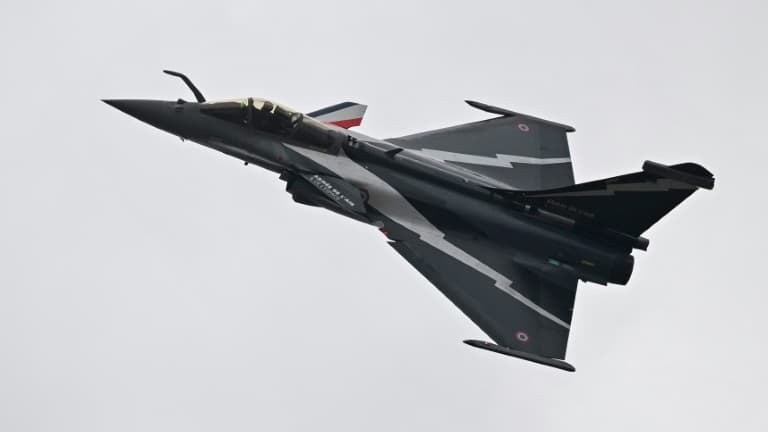
The three French Rafale fighters and their 68-person detachment on Poland’s eastern flank now live by the rhythm of a buzzer. Every alert could be the moment Russian drones drift across the NATO boundary, triggering a high-stakes intercept under Operation Eastern Sentry. From Mińsk Mazowiecki Air Base, roughly 50 kilometers east of Warsaw, the French team keeps a round-the-clock watch, poised to rise at minutes’ notice.
Inside the alert cycle
When the alert klaxon sounds, pilots hurry from the hangar to their jets, already fitted with four air-to-air MICA missiles and a 30 mm cannon. Captains Justine and Hugo, whose surnames remain withheld, drill the sprint from gear-up to engine start until it becomes pure reflex. They practice “Alpha scramble” procedures to turn a silent ramp into a roaring launch in less than the time it takes a drone to cross a county line.
“The alert team lives on site, ready to take off at the whistle,” said Commander Victor, the detachment chief. His crews rotate in tight shifts, sleeping meters from the hardened shelters where fuel, weapons, and flight data are staged for a snap rollout. On a recent weekend, two Rafales received a real-world tasking, surged toward tracked airborne contacts, and held a barrier that ultimately deterred an incursion before it met NATO airspace.
Why these jets, why this base
Mińsk Mazowiecki sits about 120 kilometers from the Belarus frontier and 150 kilometers from Ukraine, a position Polish officers call pivotal for east-of-Warsaw defense. The three Rafales were already in country for a NATO ACE dispersal exercise, which let France shift to alert status within hours of the operation’s formal start. That proximity, combined with Rafale’s sensor and weapons suite, creates a nimble net for intruding low, slow, and small targets.
The Combined Air Operations Center in Germany assigns tracks and vector pairs to the most advantageous angles. Air-to-air coordination with German and British Eurofighters, plus Danish F-16s, fills out a layered screen across the northeastern approach corridors. French aircrew say the goal is simple but exacting: find, fix, and, if needed, finish drones before they threaten people or critical infrastructure.
How an intercept unfolds
- Detect: fused NATO radar and ISR feeds cue a suspicious track approaching Polish airspace.
- Decide: the CAOC issues a scramble and assigns a pair to investigate or engage.
- Identify: Rafale sensors classify the object, confirming speed, altitude, and type.
- Act: the flight leads choose missile or cannon, weighing risk and backdrop.
- Report: crews pass real-time updates to controllers and national authorities.
Each step is drilled to compress timelines and reduce fog-of-war friction. Crews rehearse degraded comm procedures, nighttime merges, and tight deconfliction with allied patrols across busy corridors.
The hard choice: missile or cannon
Russian long-range drones like the Geran-2, laden with explosives, challenge air defenders by flying slowly at low altitude. Decoy and reconnaissance systems add further complexity, forcing pilots to balance certainty and speed against the environment below. A missile strike offers standoff safety, but cannon fire can be faster and more economical if geometry and ground risk allow.
For the aircrews, the choice hinges on safety, not accounting. As one Rafale weapons systems officer explains, “What decides the shot is the risk we accept; cannon passes are demanding, and it depends on the proximity to the ground.” Over populated areas or critical sites, stray rounds are unacceptable, nudging tactics toward missiles or carefully managed air-to-air setups. The calculus is rehearsed in simulators and verified in live sorties to give pilots a mental playbook before the real moment arrives.
Deterrence in the background
The jets on this line belong to France’s Strategic Air Forces, the airborne leg of its national deterrent. Their presence in Poland is a deliberate signal, aligning allied unity with a credible capability that adversaries must factor into their risk. While interception remains the frontline mission, the posture carries wider weight, reinforcing the European dimension of French deterrence in practical, visible form.
Allied contributions deepen that message. German and British Eurofighters and Danish F-16s mesh into a common architecture, smoothing handovers and building shared tactics. The upshot is a more resilient shield, where an intrusion anywhere along the arc meets a rapid, coherent response.
Relentless readiness
Between alerts, ground crews run engines, test avionics, and service weapons, while pilots brief routes, fuel plans, and identification matrices. The detachment’s small size—68 French personnel—demands tight synchrony, so maintenance, munitions, and mission planning operate like interlocking gears. Every minute shaved from a checklist is another minute gained over a drifting drone at the edge of the map.
This routine is part sprint, part marathon. Crews must be ready for the five-minute launch, yet conserve focus for nights of empty skies that can turn hot with a single cue. The measure of success is often what does not happen: drones that divert, borders that remain unbreached, and a region that goes about its business under a quiet, watchful cap. In that quiet, the French Rafales and their allied partners keep the line steady, prepared to destroy what crosses it—and, ideally, to make sure nothing tries.
