
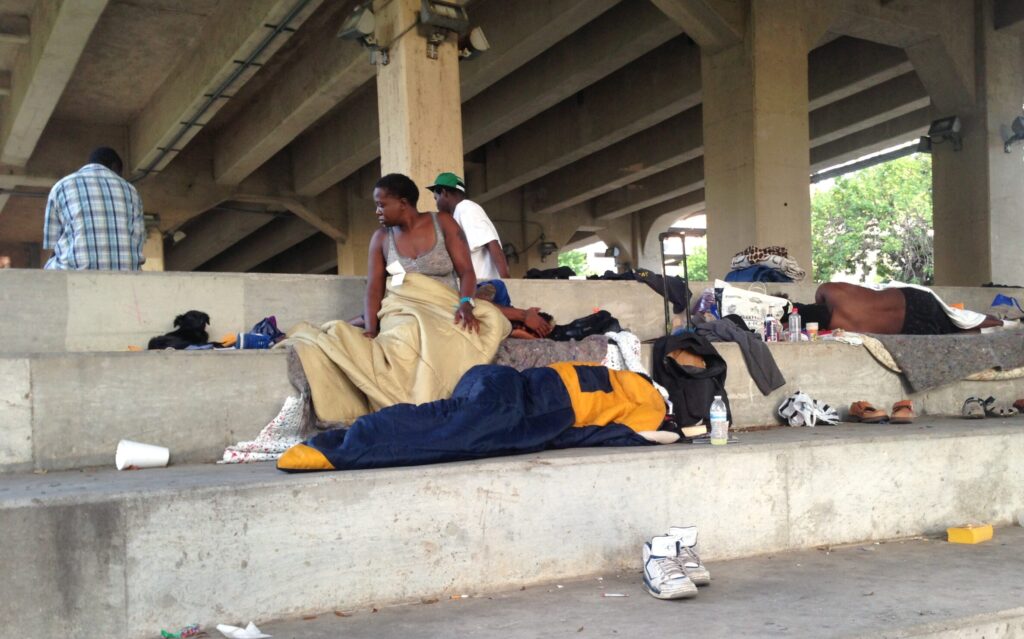
Homelessness in Houston: funding data, sidewalk-enforcement citations, and Whitmire’s plan, with a 240-bed facility slated for June.
Mayor John Whitmire has placed homelessness in Houston as a priority of his administration, with a goal of accelerating the move from street to permanent housing. At the same time, municipal court records show a rebound in sidewalk-rule enforcement in 2025, with more citations and fines, especially after changes to the civility ordinance.
Available data point to two main tensions: local funding raised fell short of the annual figure that had been set, and enforcement of rules in public spaces advanced faster than references to services and housing, according to figures included in reports published February 28.
A faster relocation goal for 2026
The operational goal presented by the municipal team aims for people experiencing homelessness to reach housing within a 30 to 90-day window, and for the local system to have the capacity to respond more quickly. To sustain that pace, a target of $70 million annually in local funding for the strategy was proposed.
In the region, the homeless services system has operated since 2011 with coordination and federal resources. The annual federal allocation cited in the sources is around $70 million. Additionally, events such as Hurricane Harvey and the COVID-19 pandemic brought additional resources at various times, increasing the response capacity. Between 2020 and 2024, more than 18,000 people were housed or diverted from homelessness in the area, according to figures attributed to the network coordinated by the Coalition for the Homeless of Houston and Harris County.
Local funding: what was raised and what didn’t come through
The fundraising for the municipal strategy reports around $31 million raised since the plan’s announcement, a figure below the annual target that had been set. Among external sources, there is mention of a $10 million contribution from METRO (Metropolitan Transit Authority of Harris County) that was subject to renewal discussions. It is also reported that $20 million expected from private philanthropy did not materialize.
In the same period, the municipal government redirected about $14 million of federal funds toward the initiative. Regarding money strictly local, the contribution from the general fund of approximately $3 billion included $3.5 million toward a specialized fund. However, sources also note that at least $3.5 million of that fund was used to cover expenses at the Navigation Center, which had previously been financed from the general fund, which in net terms left the local contribution without an effective increase.
Additionally, the City Council allocated more than $900,000 from that fund to the Houston Recovery Center, a sobriety center that is frequently attended by people processed by the police and that can refer to services.
Read also: Houston’s cooperation with ICE: what the law says and in Texas
Fines and Citations: the Pace of Enforcement in 2025
In parallel to the housing and services component, the city expanded sidewalk rule enforcement. The civility ordinance is described as a rule prohibiting sitting, lying down, or placing belongings on sidewalks within certain designated zones. By mid-July, the City Council expanded the rule to apply 24/7 in Downtown and East Downtown. Later, in November, an additional expansion was approved to cover East End.
With that change, the volume of citations rose sharply in the second half of 2025. From July to December, police issued nearly 2,000 citations for violations of the civility ordinance and general sidewalk obstruction rules, roughly double what was issued in the first half, according to municipal court records analyzed by the Media Innovation Group of the University of Texas at Austin. The typical fine cited for violations of the civility ordinance is about $200.
In a longer-term view, the same data review places 2025 at about 3,000 citations for the year. In earlier years, more than 5,000 citations were recorded in 2016 and 2020. Since 2016, the analysis notes more than 30,000 tickets issued, but concentrated in a smaller group: about 4,700 people received at least one citation. Among the 10 cases with the largest amounts, the total fines exceeded $38,000 per person. It is also reported a case with 794 citations between 2017 and 2025, with fines close to $200,000, though a large part of those amounts were dismissed or waived with “time served” credits in jail.
Homelessness in Houston: counts, stability, and the challenge of moving the needle
The Coalition for the Homeless of Houston and Harris County conducts the annual point-in-time count to count and survey people in shelters and on the street. In the most recent count cited in the sources (last year), about 3,000 people experiencing homelessness were counted in the area, including about 1,200 living on the street. That figure has remained relatively stable since 2021, after a drop from around 8,000 in 2011.
For the annual count, a deployment of 125 teams over three days was mentioned in Harris, Fort Bend and Montgomery. The full results are typically published mid-year after further analysis, with questions on disability, substance use, domestic violence, natural disasters, and other factors.
The 240-bed facility in East End, slated for June
A central component of the plan is the opening of a 240-bed facility at 419 Emancipation Ave., scheduled for June. The purchase of the site was approved by the City Council for $16 million. The operational intent described in the sources is that there would be an immediate temporary bed option and referral to services, rather than street-level response being limited to moving encampments or issuing citations.
Closing: With the 240-bed facility scheduled for June and the mid-year count report, the homelessness picture in Houston will continue to be measured by two tracks already visible in the data: how much the capacity for services and housing grows, and how sidewalk-enforcement moves in the designated areas.