
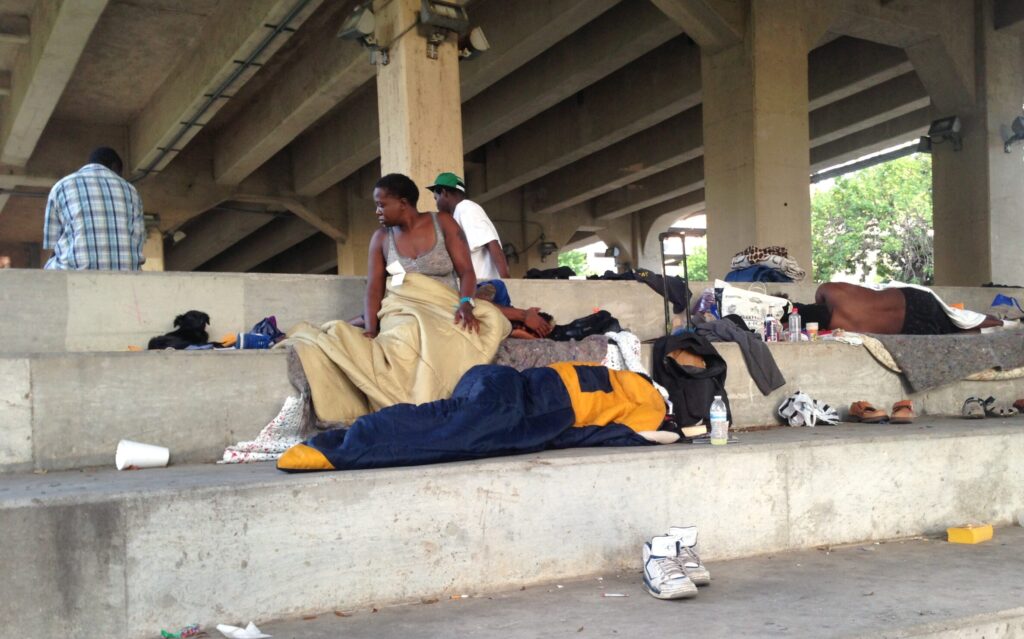
The annual count found 3,321 homeless people living on the streets or in shelters in the Houston region. The figure remains almost unchanged from 2025, as the city adjusts its strategy to reduce the unhoused population on the streets.
The Houston region recorded 3,321 homeless people during the 2026 annual count, according to data published by the Coalition for the Homeless of Houston/Harris County.
The count, known as the Point-in-Time Count or PIT Count, is conducted on one night per year and covers Houston, Harris County, Fort Bend County, and Montgomery County. In 2025, the same exercise counted 3,325 people.
The figure keeps the regional number stable for the sixth consecutive year, although local organizations warn that stability does not mean the problem is resolved.
The count covers streets and shelters across three counties
The PIT Count measures how many people are living in shelters or on the streets during a specific night.
For 2026, the reference night was Monday, February 23. The count of people in shelters is conducted using records from the Homeless Management Information System, while the count of people without shelter is carried out by volunteer teams and staff from local organizations.
The Coalition for the Homeless indicated that more than 400 volunteers and workers from allied organizations participated in the regional outreach.
The results help identify geographic shifts, service needs, and areas where outreach teams should concentrate resources throughout the year.
Most of the counted homeless were in Harris County
The majority of people recorded in the count were located in Harris County.
The unsheltered population on the county’s streets declined from 1,210 people in 2025 to 1,189 in February 2026, according to the released data.
The change is small, but it maintains the trend of a regional population that has not grown at the pace observed in other parts of the country.
Houston has been noted in recent years for its coordinated housing model, known as The Way Home, which brings together the city, the county, nonprofit organizations, and service providers.
According to the Coalition for the Homeless, Way Home partners have housed more than 36,000 people since 2012.
The city shifts the focus of its initiative
The administration of Mayor John Whitmire had unveiled an initiative to address the homeless population in Houston, with an initial emphasis on the downtown area.
During 2025, the city and its partners focused efforts in areas such as downtown and Midtown, where a visible presence of people experiencing homelessness remains.
Houston’s Housing and Community Development Director, Mike Nichols, indicated that the operational objective has shifted from “ending” homelessness on the streets to “reducing” it.
The city’s new target is to cut in half, within two years, the population of about 1,200 people living on the streets.
419 Emancipation opens as part of the local response
One of the central pieces of the local plan is the center located at 419 Emancipation Avenue, in East Downtown.
The city presented the site as an initial entry point into the homeless response system. The center was designed to receive people who sleep in public spaces and connect them with services, shelter, and pathways to permanent housing.
City documents describe the center as having capacity for up to 150 to 225 beds, in addition to health services, psychiatric support, substance use programs, meals, security, and connections to providers.
The site was also proposed as an alternative for referrals from outreach teams and law enforcement, especially in cases where a person has nowhere else to go.
The center seeks to connect people with a permanent home
The city has noted that 419 Emancipation does not function solely as a place to sleep.
The center’s model includes assessment, basic services, provider support, and connections to housing programs.
The property includes a residential building with rooms, bathrooms, a commercial kitchen, clinic, laundry, administrative spaces, and meeting areas.
The center is part of a broader strategy aimed at moving people away from shelters and public spaces toward permanent housing options.
Housing costs and job loss appear among the causes
The count also included surveys of homeless individuals about the reasons they lost their housing.
Among the most mentioned factors are job loss, eviction, and housing costs. About 32% of respondents identified these factors as the main reason.
Another 22% pointed to family or partner conflicts.
The data show that homelessness in Houston remains connected to rent costs, job stability, mental health, family networks, and the availability of immediate supports.
The local system relies on federal funding
The PIT count also serves an administrative function.
The United States Department of Housing and Urban Development, known as HUD, requires this exercise for the annual Continuum of Care funding process.
The Coalition for the Homeless reported that HUD allocated more than $71 million to the Houston area in 2024 for housing programs and supportive services.
That funding supports part of the regional system that serves homeless people, including permanent housing programs, rapid rehousing, and related services.
Key data from the 2026 homeless count
Homeless people counted in 2026: 3,321.
People counted in 2025: 3,325.
Counting area: Houston, Harris County, Fort Bend County and Montgomery County.
Unsheltered people in Harris County: 1,189 in 2026, versus 1,210 in 2025.
Leading organization: Coalition for the Homeless of Houston/Harris County.
Regional system: The Way Home.
New service center: 419 Emancipation Avenue, in East Downtown.
The next step for the city will be to measure whether 419 Emancipation and the new strategy adjustments reduce the unsheltered population on the streets in upcoming counts.