
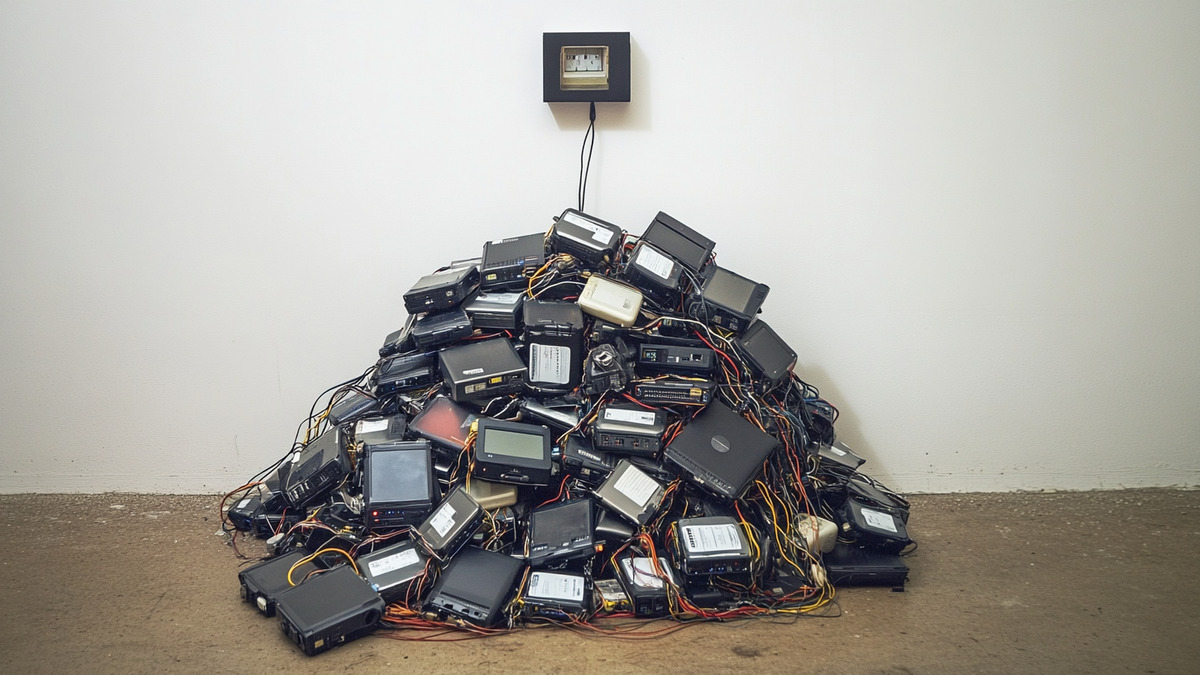
In an age of rising costs and climate anxiety, one homeowner turned discarded gadgets into a reliable source of power. He has kept his household running since 2016 with hundreds of laptop cells, proving that e‑waste can be energy. The result is a quiet, off‑grid system that blends thrift, ingenuity, and long‑term resilience.
From Scrap to Storage
What began with a handful of solar panels and a salvaged forklift battery grew into a full home setup. He gathered more than 650 old laptop packs, testing and sorting them for second‑life use. Each good cell became part of a larger, carefully organized bank designed for everyday loads.
A shed about fifty meters from the house serves as the hub, keeping the chemistry at a safer distance. Inside, charge controllers, an inverter, and tidy copper wiring turn sunlight and stored electrons into household electricity. The layout prioritizes neat routing, low resistance, and stable thermal behavior.
Designing a Safe DIY Battery Bank
The early challenge was uneven discharge among cells of different ages and histories. He dismantled packs, screened the cells, and grouped them into well‑matched racks to limit drift and prolong life. Around 100Ah modules form the building blocks, making maintenance simpler and expansion more modular.
Copper wiring, chosen for its low resistance, reduced waste heat and improved overall efficiency. Robust connections and tidy busbars kept impedance low, which helps distribute current more evenly. Over years of daily cycling, he reports no swelling, fires, or cell replacements, an unusually strong track record.
“Waste is just energy waiting for a second life—if you give it structure, it gives you power.”
Scaling Up With Sunlight
As confidence grew, he expanded generation with 24 panels, each rated 440 watts. On clear days, the array floods the system with renewable energy, while the battery bank smooths cloudy stretches and night‑time use. The two pillars—solar harvest and second‑life storage—work in steady, silent concert.
Continuous operation since 2016 underscores the setup’s quiet durability. Daily tasks, from refrigeration to lighting, draw on a hybrid of fresh solar and stored charge. When storms hit, the house keeps humming, a small proof of distributed resilience in a grid‑strained world.
What’s Inside the Shed
- Recovered laptop cells in matched, modular packs
- Charge controllers tuned for mixed‑chemistry battery banks
- A sine‑wave inverter sized for household loads
- Heavy‑gauge copper wiring and clean busbars
- A legacy forklift battery as early system buffer
- An array of 24 x 440W panels feeding the racks
Each piece plays a precise role, but the whole is greater than the sum of its parts. Standard components, carefully combined, deliver dependable power without proprietary lock‑in.
Lessons From Years Off‑Grid
The project shows that patience and process matter as much as pure hardware. Cell testing, matching, and periodic checks prevent tiny imbalances from becoming big failures. Modular packs make it easy to isolate, upgrade, or swap sections without shutting everything down.
Documentation also builds long‑term confidence. By tracking performance, he can spot gradual drift before it threatens reliability. That mindset—measure, adjust, improve—keeps the system boring, and boring is good in home energy.
The Bigger Picture
Beyond one household, the story highlights the value of reusing electronic waste at scale. Millions of lithium‑ion cells retire from devices while retaining substantial capacity. Repurposed thoughtfully, they can bridge seasonal dips, back up critical loads, and reduce peak‑time demand.
This approach strengthens local resilience while cutting embodied emissions. It also reframes the narrative around “end‑of‑life” electronics: not trash, but a feedstock for circular systems. With careful screening and design, second‑life cells become an asset, not a liability.
A Quiet Model for Independence
Energy independence is rarely about flashy gadgets; it’s about steady, patient craft. This homeowner paired common parts with disciplined assembly, and the result is robust, low‑cost electricity. The system doesn’t just save money—it delivers a sense of agency during outages and price spikes.
While not everyone will build a similar bank, the principles are widely applicable. Reduce waste, design for safety, and value maintenance as much as installation. Do that, and “off‑grid” becomes less a dream and more a daily, dependable routine.