

Astronomers using the James Webb Space Telescope have spotted enigmatic “little red dots” scattered across the infant Universe, mere hundreds of millions of years after the Big Bang. Their colors and brightness first suggested surprisingly mature galaxies, a result at odds with established models of cosmic evolution. A new interpretation is now gaining traction: these compact points may be black hole stars—enormous, star-like envelopes of gas powered not by nuclear fusion, but by a ravenous black hole at their core.
What the “little red dots” really are
In Webb’s deep surveys, the dots look extremely compact and intensely luminous, with light stretched to the red by vast distances and cosmic expansion. Early on, researchers proposed they were fully formed galaxies, already packed with old, reddened stars. Yet the implied stellar densities were implausible, and the timescales for assembling such systems were uncomfortably short.
Spectroscopy provided a different clue. Instead of features consistent with swarms of stars, some targets showed signatures compatible with dense hydrogen gas and energetic accretion. That combination points to a central engine—a black hole swallowing matter so swiftly that it inflates a huge, hot atmosphere around itself. From afar, that atmosphere shines like a star, but the power source is gravity-driven infall, not fusion.
A standout case sharpened the picture
Among thousands of distant objects, one extreme source—nicknamed “The Cliff”—demanded special attention. Its light has traveled nearly 12 billion years, letting us peer into a formative cosmic epoch. Analysis indicates a single, supermassive black hole cocooned in a colossal bubble of gas, compressed and heated to star-like temperatures. The result is a compact, brilliant sphere that mimics starlight while being fueled by relentless accretion.
Artist’s impression of a dense, star-like envelope powered by a supermassive black hole. © T. Müller, A. de Graaff, Max Planck Institute for Astronomy
This scenario echoes theoretical predictions of “quasi-stars” or black hole stars, long hypothesized but never confirmed. In such objects, intense accretion and trapped radiation inflate a massive envelope, while the core black hole grows at breakneck speed. The system appears red both because of cosmic redshift and because the dense shroud scatters and reddens escaping light.
Why a black hole can masquerade as a star
In a normal star, outward pressure from fusion balances inward gravity. In a black hole star, outward pressure comes from radiation and hot gas buoyed by furious accretion. As matter spirals inward, gravitational energy converts to heat and light, building a thick, luminous atmosphere. From galactic distances, that atmosphere collapses to a compact, point-like glow—one that Webb registers as a tiny red dot.
“These black hole stars could be the earliest phase of the supermassive black holes we see in galaxies today.”
This framework naturally explains several puzzles that the mature-galaxy interpretation struggled with:
- Extremely high apparent brightness without impossible stellar densities
- Very small angular sizes consistent with a single compact source
- Red colors from both intrinsic physics and cosmological redshift
- Spectral hints of dense hydrogen rather than classic stellar populations
- Rapid growth pathways for early supermassive black holes
Implications for the first galaxies and black holes
If even a fraction of the little red dots are black hole stars, they could mark a critical bridge between the first gas clouds and fully fledged quasars. Such objects would help seed the gargantuan black holes found in young galaxies, reconciling how these behemoths grew so quickly after the Big Bang. Their numbers and luminosities would place tight constraints on early gas collapse, feedback, and accretion physics.
Future observations will test the hypothesis by probing line shapes, gas densities, and variability that distinguish accretion-powered envelopes from dense starbursts. High-resolution spectroscopy can dissect hydrogen and helium features, while time-domain data may catch subtle flickers tied to inflow. Together, these signals can validate—or refute—the black hole star picture across Webb’s expanding surveys.
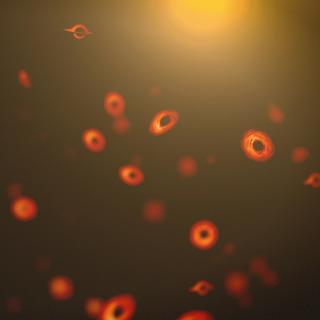
Concept art exploring early black holes. © NASA’s Goddard Space Flight Center
The stakes extend beyond exotic objects to the broader story of how structure formed. If black hole stars were common, early galaxies may have evolved under stronger feedback, with radiation and outflows sculpting their gas reservoirs. That would influence where, when, and how the first true stars and stellar populations took shape.
“The Universe is stranger than we imagine, and the only way forward is to follow its clues—even when they challenge our best models.”
As Webb continues to refine its deep catalogs, the little red dots have become beacons pointing to a hidden phase of cosmic history. Whether every dot is a black hole star or a mix of sources, they are forcing sharper theories, bolder predictions, and new tests. In the glow of these distant points, we may be watching the first supermassive black holes ignite—and the earliest chapters of galactic evolution being written in real time.
