
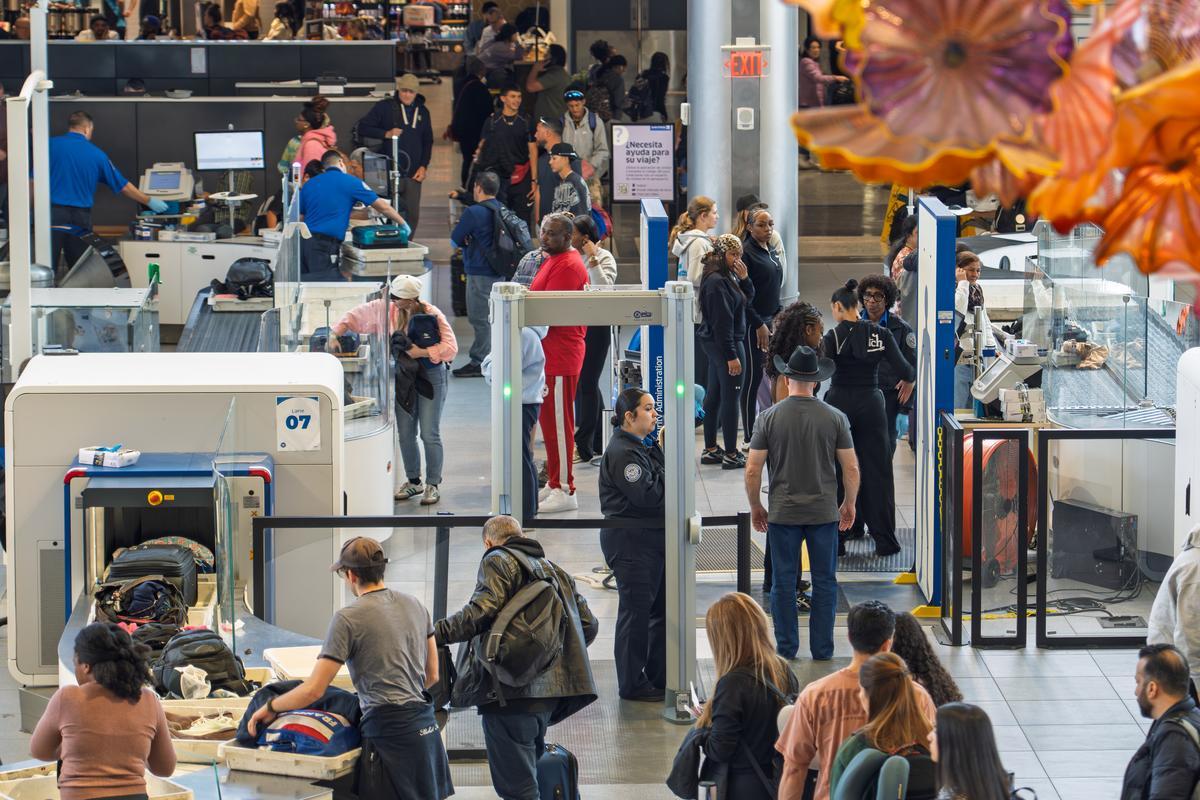
Houston’s largest airport records waits of up to four hours as TSA worker absences rise. The pressure coincides with a week of heavy activity due to events, tourism, and seasonal travel in the city.
George Bush Intercontinental Airport has become one of the most visible points of the impact of the partial federal government shutdown on air travel in the United States. In Houston, passengers have faced waits of up to four hours to pass through security screening, amid a marked reduction in Transportation Security Administration (TSA) staffing.
The problem is not limited to a long line. At Bush, TSA employee absences have been well above the national average and are combined with the operation of one of the country’s busiest airports. That combination has squeezed the system’s responsiveness at a time of high demand.
Bush Intercontinental and Hobby report absences above the national average
According to union data and the airport system, 11% of TSA staff were out nationally on Tuesday. At Bush Intercontinental, that figure approached 40%. At Hobby it was even higher, at 43%.
The average absence rate in Houston has fluctuated between 35% and 40%, a gap that explains part of the delays at the screening points. At both airports the effect is visible, but Bush bears the impact of each absence more due to the scale of its daily operation.
To this pressure, there is the fact that many TSA workers continue to face economic difficulties stemming from the shutdown. Labor representatives have also noted that the system has carried wear from previous interruptions and that rising everyday costs have affected attendance at several airports.
The size of Bush amplifies every delay at the checkpoints
Bush Intercontinental is not an average airport. In 2024 it moved more than 48.4 million passengers, compared with 14.6 million at Hobby. It also functions as one of United Airlines’ major connection hubs, which accounted for 34.8 million of the passengers who passed through that terminal last year.
That volume completely changes the impact of a staffing shortage. According to airport authorities, Bush typically operates 37 TSA screening lanes. At the moment only about a third to half of that capacity is functioning.
The airport’s layout also plays a role. Bush not only serves travelers departing from Houston, but also a large number of connecting passengers. When the number of open screening lanes falls at the same time that passenger flow remains high, waits begin to grow in blocks and end up affecting several terminals at once.
Union representatives have also warned that the system may have been understaffed even before the shutdown. According to those reports, there have been no new TSA hires nationwide in nearly a year.
March loaded Houston with more flights, more events, and more pressure
The month had already been heavy for Houston’s travel calendar. In addition to spring break travel, several large-scale events drew visitors from other cities and countries.
Among them were World Baseball Classic games, the CERAWeek energy conference, and the Houston Livestock Show and Rodeo, which drew 2.6 million attendees over three weeks. This same week, Houston is also hosting two Sweet 16 NCAA tournament games.
The combination of the tourism calendar, a sports schedule, and corporate traffic has pushed hotel occupancy and reservations to unprecedented levels for a March in the city, according to data shared by the city government.
That rise does not necessarily explain security delays by itself, but it does increase the number of passengers entering terminals in a week when Bush is operating with fewer screening lanes and less available staff.
Lines improved on Wednesday, but delays continued on Thursday
During Wednesday there was a slight improvement. Security crossing times dropped to under two hours at times, after days when alerts had shown waits of up to four hours.
However, the improvement did not hold completely. On Thursday morning, estimates again showed extended waits: 150 minutes at Terminal A and 240 minutes at Terminal E. At that time no other screening points appeared to be open within the airport.
The week’s picture is clear for Houston: Bush continues to operate under extraordinary security pressure, in a city with high air movement and an agenda that keeps traveler flow high. Until the TSA labor situation changes, delays at Bush Intercontinental will continue to shape the departure experience for thousands of passengers.
